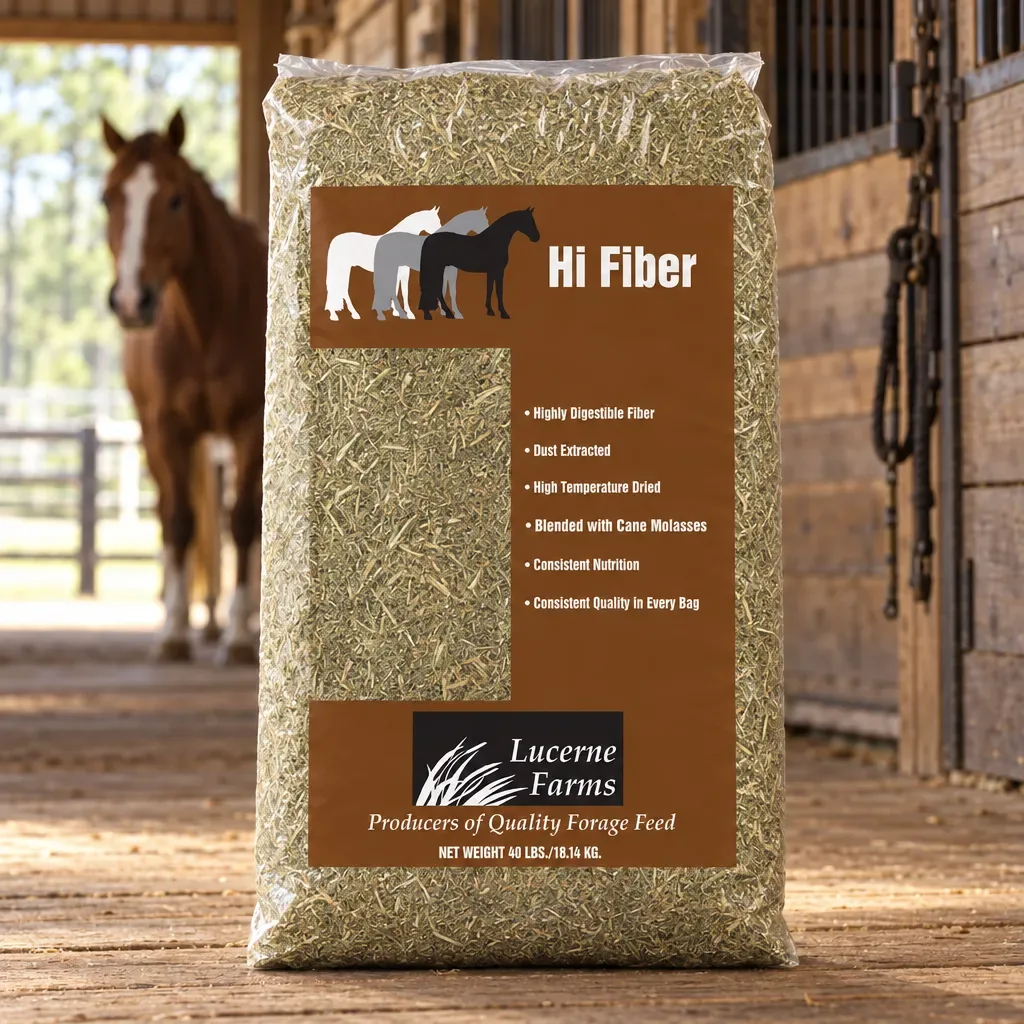
Give your horse a forage option that is easy to chew and work into the daily ration. Hi Fiber combines short-chopped timothy and oat hay with alfalfa and cane molasses. The chopped form suits older horses with dental problems as well as pleasure horses on a maintenance ration.
High-temperature drying and dust extraction prepare the forage for use as a hay replacement or a grain complement. Feed by weight, and choose the amount to fit your horse’s workload and the rest of the ration.
Highlights
- Short-chopped hay for easier chewing
- Dust extracted and high-temperature dried
- Cane molasses for palatability
- Can replace hay or supplement forage intake
At a glance
| Form | Short-chopped forage |
|---|
| Protein | 9.0% |
|---|
| Fiber | 30.0% |
|---|
| Preservative | Propionic acid |
|---|
Guaranteed analysis
| Nutrient | Amount |
|---|
| Protein | 9.0% |
| Fat | 1.5% |
| Fiber | 30.0% |
| Calcium (min) | 0.4% |
| Calcium (max) | 0.7% |
| Phosphorus | 0.2% |
Ingredients
Dehydrated chopped timothy hay, Dehydrated chopped Oat hay, Dehydrated chopped Alfalfa hay, Cane molasses, Propionic acid (preservative).
Feed complement
Mixing Lucerne Farms forage at a 3:1 ratio with grain, and other feeds, can help increase the digestibility and performance, making sure your horse’s digestive process gets off to a running start.
Fiber supplement
Adding 3-6 lbs of Lucerne Farms forage into your feeding program can help ensure your horse is getting the proper amount of fiber in a form that is more beneficial to their physical and mental health.
Hay replacement
When traditional hay is not an option, Lucerne Farms forage offers a natural alternative. Feeding Lucerne Farms at 2-2.5% of your horse’s body weight can ensure they are meeting their daily forage requirements.
Do you weigh your hay?
Always calculate your horse’s feed by weight, not volume.
Lucerne Farms’ forage can be fed in a bucket, in a corner feeder mixed with the daily grain ration, or even outside in a feed tub.
When feeding Lucerne Farms’ forage feeds, you determine the proper amount according to the horse’s age, weight, temperament, and workload.
Always make changes to your horse’s diet gradually over a period of 7 to 10 days. Consult a veterinarian or equine nutritionist concerning your horse’s specific needs.

 Ask Daisy