
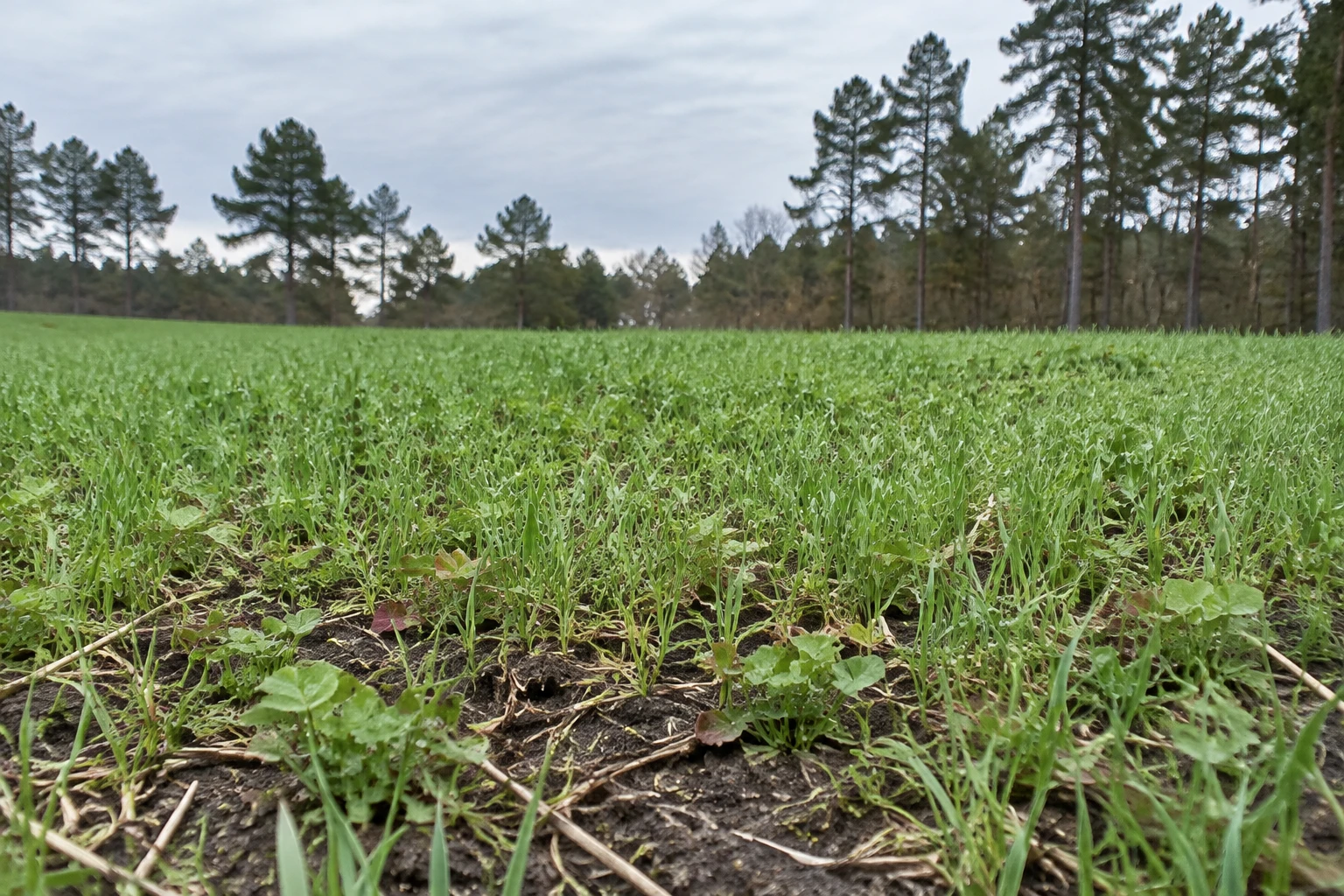
Best fall food-plot seed for North Florida
For North Florida (Florida Panhandle) fall food plots, the most practical choice is a small-grain + clover blend rather than a one-size branded mix—think oats or triticale combined with crimson clover plus a longer-lived clover (red or white) matched to your soil’s drainage. Plant that blend into a firm, moist seedbed during the regional fall window and follow UF/IFAS recommended blend rates and variety choices; planting depth, inoculant and lime matter as much as the seed. (UF/IFAS food-plot guidance and variety recommendations: A Walk on the Wild Side: Cool‑Season Forage Recommendations for Wildlife Food Plots in North Florida.) A Walk on the Wild Side: Cool‑Season Forage Recommendations (AG139).
Why small grains + clover beats single crops
Deer and other wildlife in North Florida reliably use cereal grains for early winter forage and clovers for protein through late winter and spring. A mixed plot spreads the season of usefulness: oats or triticale give quick winter cover and forage, crimson clover bolts early and feeds well in February–March, and red or white clover extends green forage into spring. UF/IFAS recommends this “best value” approach because it balances cost, establishment and animal preference. Cool‑Season Forage Variety Recommendations for Florida (AA266).
Recommended fall blend and how much seed to buy
Use the UF/IFAS “Best Value” mix as a model: per acre — 50 lb oats, 50 lb triticale, 6 lb red clover and 15 lb crimson clover. For smaller plots scale proportionally (quarter-acre — 12.5 / 12.5 / 1.5 / 3.75 lb; half-acre — 25 / 25 / 3 / 7.5 lb). Those amounts are the blend recommendation from the wildlife guide; do not apply full standalone seeding rates for each component when making a mixture. Winter Forage Legume Guide (DS127).
Which grain: oats, triticale or cereal rye?
Oats establish fast and are a good choice when you want quick winter forage, but they are less cold- and disease-tolerant than rye or triticale. Triticale is a good middle ground and UF/IFAS lists TriCal varieties adapted to wildlife plots. Cereal rye is more cold-tolerant and can survive harsher winters, but note that annual ryegrass is a different crop and is not recommended for wildlife plots because it can dominate mixtures and is less preferred by deer. Cool‑Season Forage Variety Recommendations for Florida (AA266).
Which clover for your soil
Match clover to drainage: crimson clover likes fertile, well-drained sandy loam and does poorly on deep, dry sand or flooded ground; white clover needs steady moisture and does best on loam/clay sites. Red clover and arrowleaf provide later spring growth; choose varieties recommended for Florida such as Dixie and AU‑Robin for crimson or Osceola and Ocoee for white clover. White Clover (AA198).
When to plant and how deep
Use the regional fall planting window: generally October 1–November 15 for northwest Florida, with some crop-specific adjustments. Plant large-grain seed 1–2 inches deep for oats/triticale/rye; clovers are shallow-seeded — crimson and red clover 1/4–1/2 inch, white clover 0–1/4 inch. Firm the seedbed so small seed contacts soil; broadcasting clover on a loose seedbed without firming reduces germination. Tillage and Overseeding Pastures for Winter Forage (AG146).
Soil test, lime and fertilizer — don’t skip these
Test soil well before planting so you can apply agricultural lime and let it react; most winter legumes need pH above 6.0. Apply lime 2–6 months before seeding if the test calls for it, and follow soil-test fertilizer recommendations at planting or after emergence. For mixed plots, avoid blanket N prescriptions; UF/IFAS gives crop-specific guidance. Forage Planting and Establishment Methods (AG107).
Clover inoculant and seed checks
Buy the correct Rhizobium inoculant for clovers unless the seed is pre-inoculated. Mix inoculant with seed per package directions and plant inoculated seed promptly, keeping it out of direct sun and heat. Always check seed tags for cultivar, purity and germination percentage; UF/IFAS recommends at least 80% germination and adjusting coated-seed rates for the extra weight of coatings. Winter Forage Legume Guide (DS127).
Practical planting steps
Common mistakes to avoid
Don’t buy annual ryegrass when you mean cereal rye. Don’t plant clover too deep or into a fluffy seedbed. Don’t assume lime and fertilizer can be skipped on acidic soils. Don’t use full standalone rates for every component in a mix. Don’t plant by the calendar alone—wait for soil moisture—and don’t overseed active warm-season sod too early. Finally, don’t inoculate clover with overheated or old inoculant. A Walk on the Wild Side: Cool‑Season Forage Recommendations (AG139).
Variety choices to look for
Use UF/IFAS-recommended, southeastern-adapted varieties: early oats like Legend 567 or Horizon 720; triticale TriCal 1143 or TriCal 342; cereal rye varieties FL 405 or Kelly Grazer III; crimson varieties Dixie or AU‑Robin; red-clover options Barduro or Red Ace; white-clover options Osceola or Ocoee. Choosing adapted varieties reduces disease risk and improves establishment. Cool‑Season Forage Variety Recommendations for Florida (AA266).
Broadcasting vs drilling, and small-plot math
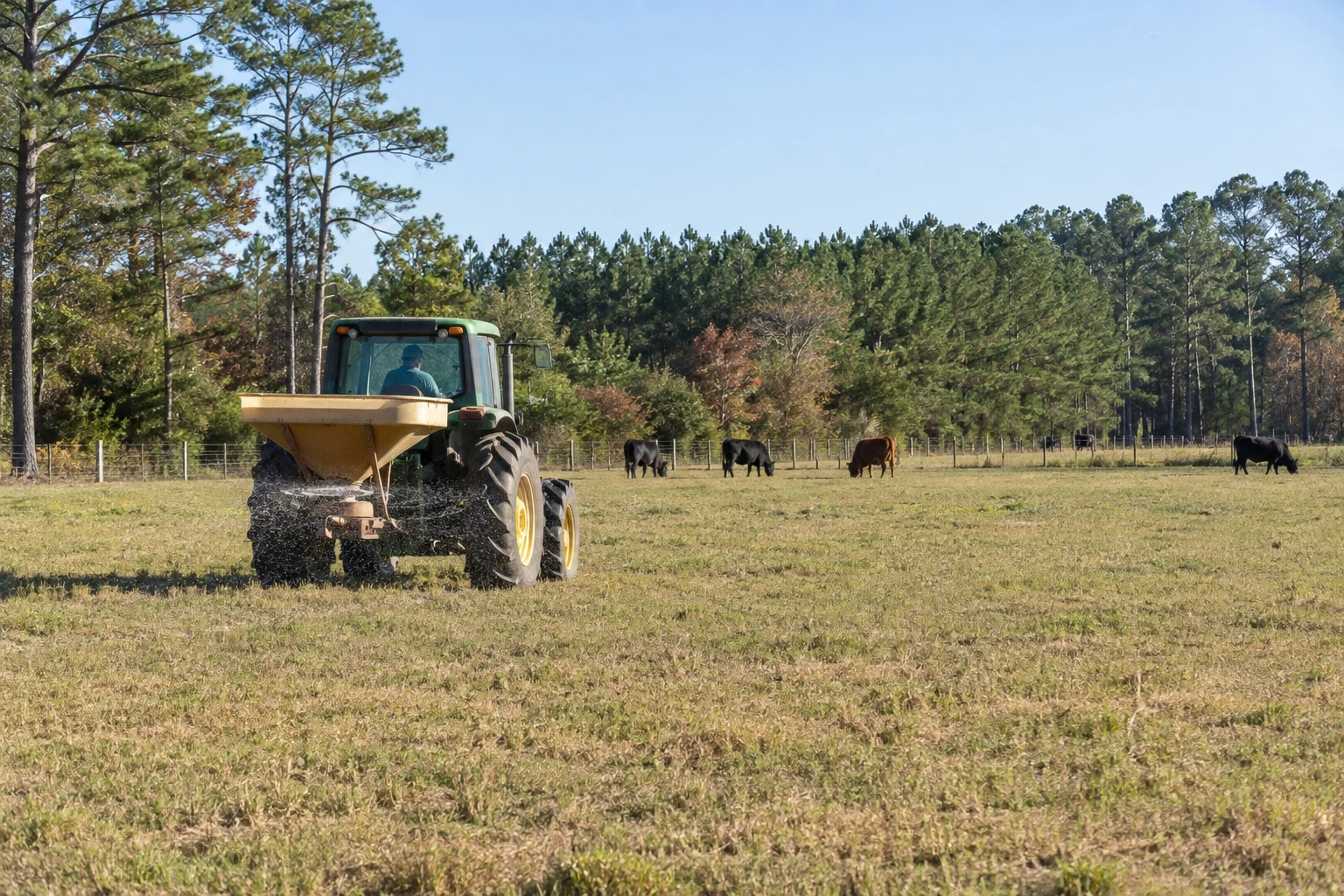
Broadcasting works for small plots if you firm seed into the soil after spread—use a cultipacker or drag. Drilling gives more uniform depth and often better stands for large grains. Seed math refresher: use the blend weights above and scale by area. If a bag tag shows coated seed weight, adjust the seed rate rather than assuming all bag weight is pure seed. Forage Planting and Establishment Methods (AG107).
What about brassicas (turnips, radishes)?
Brassicas can be part of a food-plot program but UF/IFAS warns that deer use varies widely and local adaptation data in Florida is limited. They’re not a guaranteed replacement for a small-grain + clover mixture; consider them as an annual supplement where soil and water conditions suit them. A Walk on the Wild Side: Cool‑Season Forage Recommendations (AG139).
Store tie-in and local help
Baker Feed & Country Store carries seed, inoculants, lime and fertilizer for food plots—call before you come to confirm varieties and stock. We can help you convert the UF/IFAS blend to bag counts and check seed tags at the counter; see our feed and seed options on the feed page. Our address: 5791 Hwy 4, Baker, FL 32531; phone (850) 537-1000. Hours: Monday–Friday 8 am–6 pm, Saturday 8 am–2 pm, Sunday Closed (Central Time). Feed and seed options.
Key references
Primary guidance and variety lists come from UF/IFAS Extension: A Walk on the Wild Side: Cool‑Season Forage Recommendations for Wildlife Food Plots in North Florida (AG139), Cool‑Season Forage Variety Recommendations for Florida (AA266), Winter Forage Legume Guide (DS127) and planting/establishment notes (AG107, AG146, AA198). Links to those publications appear at the end of this page.
What seed quantities do I need for a half-acre or quarter-acre?
Use the UF/IFAS recommended blend per acre and scale down. Half-acre: 25 lb oats, 25 lb triticale, 3 lb red clover, 7.5 lb crimson. Quarter-acre: 12.5 lb oats, 12.5 lb triticale, 1.5 lb red clover, 3.75 lb crimson.
Is annual ryegrass the same as cereal rye?
No. Annual ryegrass is a different species and is generally discouraged for wildlife plots in North Florida because it can dominate mixes and is less preferred by deer. Cereal rye (winter rye) is a different, cold‑tolerant cereal used in some mixes.
Do I need clover inoculant?
Yes, unless the seed is pre‑inoculated. Use the correct Rhizobium for the clover type, follow package directions, plant inoculated seed promptly and keep it protected from heat and sunlight.
When should I test soil and apply lime?
Test soil at least two months before planting (preferably longer). Apply agricultural lime 2–6 months before seeding if the test calls for it so pH has time to move into the desired range for legumes.
Can I broadcast the mix and still get a good stand?
Yes for small plots if you firm the seed into the soil with a roller, cultipacker or dragging so small seeds have contact. For large or commercial plots, a drill gives more consistent depth and stands.
 Ask Daisy