
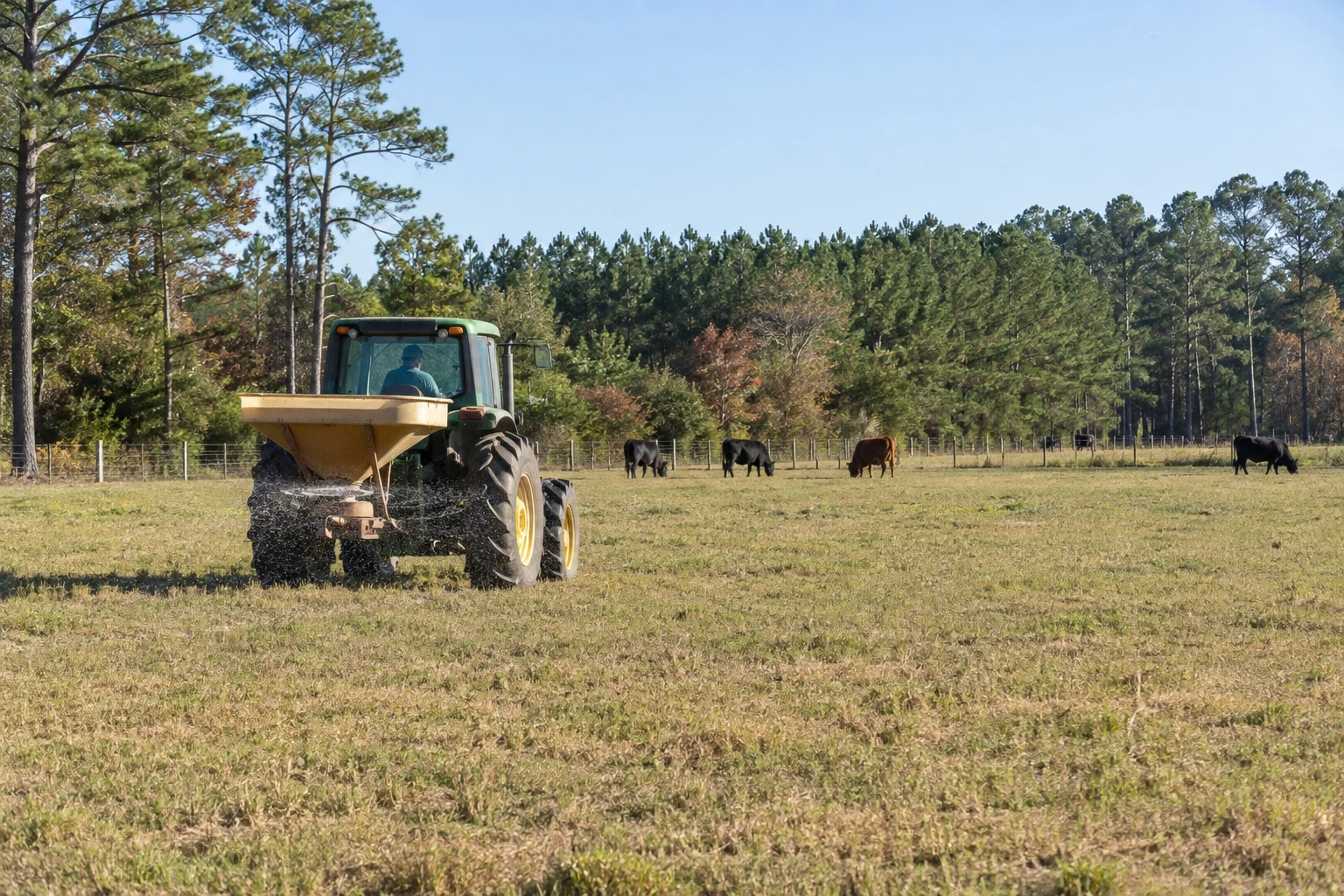
When to Plant Ryegrass Pasture in North Florida
In the Baker area of North Florida, plant annual ryegrass mainly from mid-October through November. On a prepared seedbed, mid- to late October is a reasonable target. When overseeding established warm-season pasture, wait until mid- to late November in many fields, when the existing grass is less competitive. Plant only when there is enough soil moisture to support germination. UF/IFAS’s North Florida pasture guide gives October 15 through December 1 as the general ryegrass window, but the right timing depends on field conditions, not the calendar alone.
Choose timing for your planting method
A prepared seedbed gives you more flexibility to plant earlier because you can reduce weeds and existing grass competition before sowing. Aim for mid- to late October if the seedbed is ready, the soil is moist, and rain or irrigation can keep the seed zone from drying out. The North Florida guide also supports planting through early December, but late planting may leave less time for establishment before colder weather and shorten the grazing season. See UF/IFAS guidance on planting and establishing forage on a prepared seedbed.
For overseeding bahiagrass or another perennial pasture, timing is trickier. If the warm-season grass is still growing strongly, it competes with ryegrass seedlings for light, water, and nutrients. Mow or graze the pasture down to about 1 to 2 inches of stubble before broadcasting. A strong frost often slows or puts warm-season grass into dormancy, but do not use the first frost as a guaranteed signal: some bahiagrass can resume growth between frosts. In many North Florida fields, mid- to late November is a better overseeding target than October.
A statewide UF/IFAS variety guide gives a broader October 1 to November 15 range for annual Italian ryegrass. For Baker-area pasture, use the North Florida field guidance first: earlier planting may suit prepared, clean ground, while established sod often needs a later date to reduce competition. Dry October or November conditions can delay planting. Waiting for workable moisture is usually better than scattering seed into dry ground just to meet a date. Compare recommended varieties in the Cool-Season Forage Variety Recommendations for Florida.
How much seed to plant
Use the rate for your planting method and check the seed label. UF/IFAS’s North Florida pasture guide lists 15 to 20 pounds per acre for ryegrass planted with tillage and 20 to 25 pounds per acre for overseeding. For broadcast planting on prepared ground, its establishment guide gives 20 to 30 pounds per acre. These recommendations differ by method, so do not treat them as interchangeable. Calibrate the spreader to the acreage and rate rather than estimating coverage by eye.
Seed-rate tables can sometimes conflict. One online UF/IFAS variety table has shown a much higher ryegrass rate than the establishment guidance. Because those figures differ sharply, confirm the appropriate rate with your county Extension office or the seed supplier before using an unusually high rate. Buy labeled forage seed and check cultivar identity, purity, germination, and weed content. UF/IFAS advises choosing seed with good germination, ideally over 80 percent, and no noxious weeds. Store seed cool and dry; heat and humidity can reduce viability.
Prepare the field and plant shallow
For prepared ground, make a firm, level seedbed. Ryegrass seed is small and should be planted at the surface to no more than about one-half inch deep. Broadcast seed evenly, then roll or cultipack so it contacts firm soil. Loose, fluffy ground makes it easy to bury seed too deeply, and exposed seed can dry out before it germinates.
For overseeding, first reduce the existing pasture to roughly 1 to 2 inches. Use the method that gives seed good contact with the soil, such as grazing or mowing followed by broadcasting and, where practical, rolling or light disking. If you broadcast without tillage, expect less uniform establishment than in a well-prepared seedbed and pay particular attention to sod competition and moisture. See Tillage and Overseeding Pastures for Winter Forage Production in North Florida for more detail.
Do not confuse annual ryegrass with cereal rye. They are different crops with different seed sizes, rates, planting depths, and growth patterns. A forage-seed label should identify the crop clearly; do not use a cereal-rye rate or planting depth for annual ryegrass.
Soil, fertilizer, and dry sandy fields
Test soil ahead of planting so lime and fertilizer decisions are based on the field. UF/IFAS lists a target soil pH of 6.0 for cool-season annual grasses. Lime can take months to react, so applying needed lime well before establishment is more effective than waiting until planting week. Follow the soil-test recommendation for phosphorus and potassium rather than applying a standard blend automatically.
Nitrogen recommendations depend on whether you are planting grass alone on prepared ground or overseeding an established pasture, and they are stated as pounds of actual nitrogen per acre, not pounds of fertilizer product. UF/IFAS guidance for grass-only prepared ground includes 30 pounds of actual nitrogen per acre before or at planting, then additional nitrogen after grazing. For overseeded perennial pasture, the guidance differs and calls for nitrogen after emergence. Mixtures that include clover have different fertilizer needs. Use the applicable UF/IFAS recommendation and your soil test rather than copying a fertilizer schedule from a different planting system. See UF/IFAS Standardized Fertilization Recommendations for Agronomic Crops.
Annual ryegrass is less dependable on nonirrigated deep sands, where moisture and fertility can limit growth. It tends to perform better on fertile soil with adequate moisture. For relatively sandy sites, UF/IFAS notes that cereal rye may be a better option. If your field is drought-prone, consider the soil and water supply before buying seed, and do not assume ryegrass will establish just because it is within the recommended calendar window.
Plan for winter and spring grazing
Ryegrass is mainly a late-winter and spring forage in North Florida. It commonly begins producing useful forage by late January and can support grazing into April or May, depending on weather, fertility, and establishment. It is not usually the answer to an early-winter feed shortage. Small grains such as oats or cereal rye can produce earlier; adding a small grain to a ryegrass planting may extend the grazing season. If you add clover, use inoculant intended for that legume and protect inoculated seed from sunlight, heat, and drying before planting. Ryegrass itself does not need legume inoculant.
Do not turn livestock onto a calendar date. UF/IFAS variety guidance lists ryegrass grazing entry at about 6 to 12 inches and removal at 3 to 4 inches. Growth rate, ground conditions, and the needs of the animals all affect when a pasture is ready, so check the stand and avoid grazing seedlings before they are established. In spring, manage grazing so late ryegrass growth does not shade or delay recovery of the warm-season pasture beneath it. We carry farm supplies and cattle supplies for your operation.
A practical Baker-area checklist
- Choose mid- to late October for a moist, prepared seedbed; consider mid- to late November when overseeding established pasture.
- Use a forage ryegrass rate matched to the method: typically 15 to 20 pounds per acre with tillage, or 20 to 25 pounds per acre for overseeding. Check local guidance if recommendations conflict.
- Reduce existing sod to about 1 to 2 inches before overseeding and give the seed good soil contact.
- Plant shallow, no deeper than one-half inch, and firm the seedbed with a roller or cultipacker when practical.
- Use a soil test to guide lime, phosphorus, and potassium; calculate nitrogen as actual nutrient, not fertilizer-product weight.
- For shopping, plan on labeled forage seed, soil-test-directed lime or fertilizer if needed, and access to a calibrated spreader and roller or cultipacker. Check with us to confirm availability.
These recommendations follow UF/IFAS publications including Tillage and Overseeding Pastures for Winter Forage Production in North Florida, Forage Planting and Establishment Methods on Prepared Seedbed, and UF/IFAS Standardized Fertilization Recommendations for Agronomic Crops. For a field-specific rate or a soil-test question, UF/IFAS Extension Okaloosa County can help interpret local conditions.
What month should I plant ryegrass pasture near Baker, Florida?
For a prepared seedbed, target mid- to late October if moisture is adequate. For overseeding existing warm-season pasture, mid- to late November is often more suitable because the sod is less competitive. The broader North Florida window runs from October 15 through December 1.
Should I wait for the first frost before overseeding bahiagrass?
A strong frost often slows warm-season grass, but it is not a dependable rule for every field. Some bahiagrass can grow again between frosts. Reduce the pasture to about 1 to 2 inches and judge competition and moisture rather than relying on frost alone.
How much ryegrass seed do I need per acre?
UF/IFAS’s North Florida guide lists 15 to 20 pounds per acre for tillage and 20 to 25 pounds per acre for overseeding. Broadcast planting on prepared ground may use 20 to 30 pounds per acre. Match the rate to your method, seed label, and local guidance.
When will ryegrass pasture be ready to graze?
Annual ryegrass often begins producing by late January, but establishment and grazing readiness vary with weather, moisture, and management. Check plant height and rooting rather than relying on a fixed date; guidance lists entry around 6 to 12 inches and removal at 3 to 4 inches.
Will annual ryegrass grow on dry, sandy pasture?
It is less reliable on nonirrigated deep sands and needs adequate moisture and fertility. UF/IFAS identifies cereal rye as a possible better fit for relatively sandy sites. Test the soil and consider the field’s moisture before choosing seed.
 Ask Daisy