
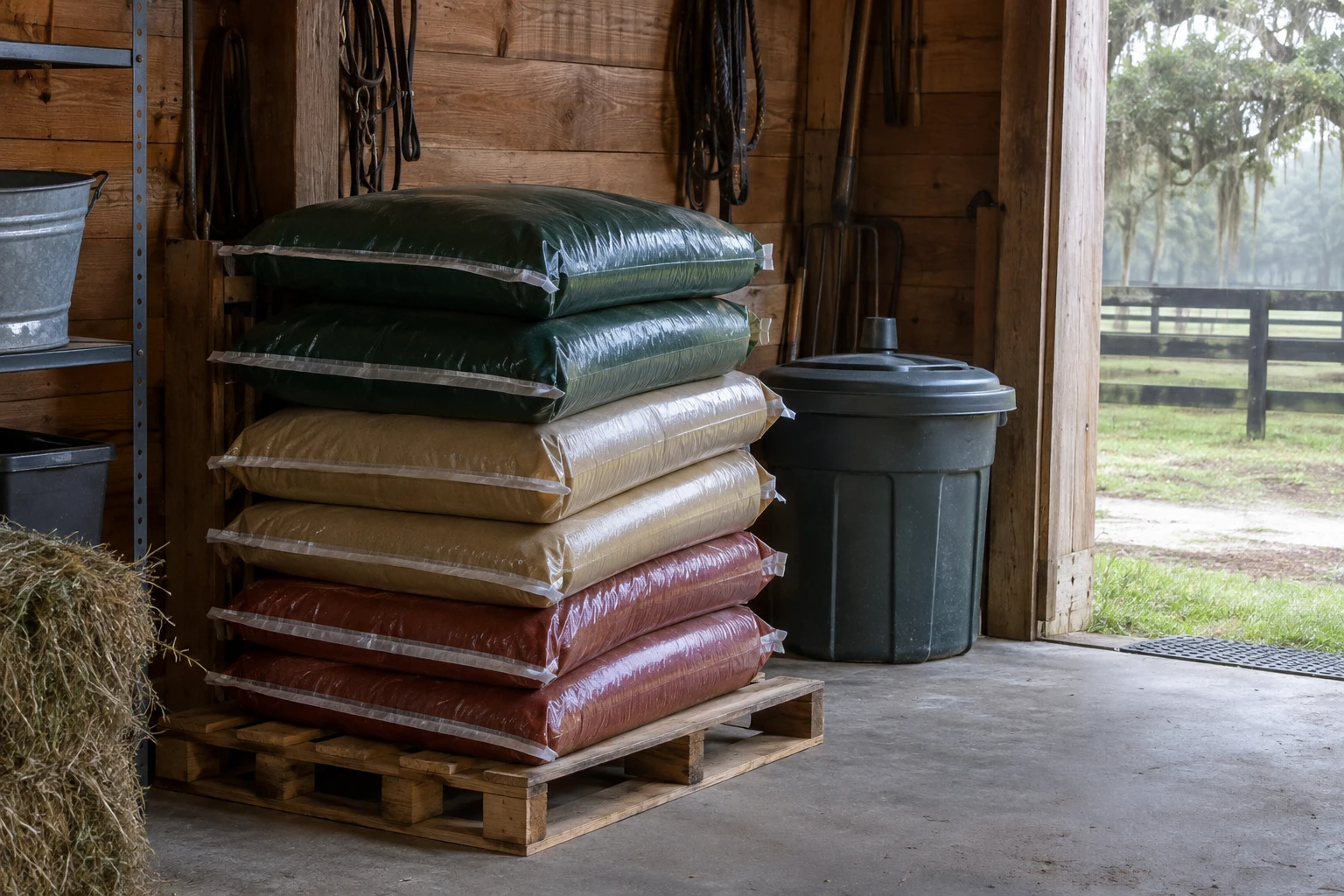
How to Store Horse Feed in Florida Humidity
To store horse feed in Florida humidity, buy a small supply at a time and keep it in a cool, dry, shaded place, raised off the floor and protected from rain, rodents and horses. Rotate older feed first, clean bins before refilling, and inspect feed whenever you open a bag and prepare a meal. In Baker and across the Florida Panhandle, heat and humidity can shorten the useful storage window, but no single shelf-life date or room-humidity percentage guarantees feed will stay fresh.
Buy for a short rotation
Triple Crown recommends buying about 2 to 3 weeks of feed at a time in hot weather. Treat that as a purchasing guideline, not a promise: feed stored in a damp, hot or poorly maintained space may spoil sooner. If your feed room stays hot or has big temperature swings, buy less at once and replenish more often. A cooler, drier space can give you more flexibility, but inspect the feed rather than relying on the calendar.
Use the bag weight and the amount you actually feed to estimate how quickly you will use a purchase. For example, a 50 lb bag fed at a combined 5 lb per day lasts 10 days. That is an inventory calculation, not a recommended ration. Weigh your horse’s feed with a scale at least once; a scoop’s volume does not reliably tell you its weight. Keep the manufacturer’s bag or write down its date and lot code if you transfer feed, so you can identify the product later if you have a concern.
Check bag dates or codes when buying where they are available, and avoid building a deep reserve just because a bag is unopened. Breathable feed packaging can still let moisture in. Use older bags first and put new purchases behind them. If a bag is damaged, damp or has been sitting near a water source, inspect it closely before feeding.
Choose a dry location and raise the bags
Keep bagged feed away from direct sun, rain, roof leaks and wash-down areas. Store it on a sturdy pallet or rack, not directly on concrete or dirt, and leave a little space between bags and walls. Concrete floors and metal surfaces can collect condensation as temperatures change. That moisture can reach bags even when the room looks dry. Keep feed separate from chemicals, cleaners and other barn supplies, and secure the storage area so a loose horse cannot get into it.
A feed bin can help keep feed contained and deter pests, but the container itself must stay dry. In Florida’s heat and humidity, a closed bin can sweat inside; a lid does not prevent condensation from forming. Check the bin walls and bottom, especially after hot days or sharp temperature changes. If moisture appears, move the feed to a dry place and address the source before filling the container again. There is no universally best material, so judge the container by how it performs in your actual feed room.
Clean, rotate and inspect every batch
Do not pour fresh feed on top of old leftovers. Empty the bin completely, remove dust and crumbs, and let the container dry before refilling. Old feed trapped in corners can spoil and contaminate the next batch. If you use a bin, keep the original label or record the product name, date code and transfer date. That way you can still identify the feed after opening or transferring it.
At each feeding, look and smell before measuring. Do not feed product with mold, an unusual or rancid odor, insects, damp clumps, or signs of contamination. Check the bottom of the bin as well as the top. If feed looks or smells wrong, set it aside and contact the manufacturer or your feed supplier for guidance rather than trying to salvage it.
- Check each new bag before opening it for dampness, damage or contamination.
- Look for changes in color, texture, smell or the presence of insects when you open it.
- Inspect feed again as you prepare each meal, especially if it has been in a bin.
- Do not mix questionable old feed with fresh feed.
High-fat supplements can also be affected by heat. University of Arizona Cooperative Extension advises against feeding a high-fat supplement if it smells rancid or its odor has changed. Buy amounts you can use in a reasonable rotation and follow the product label for storage directions. For an animal that seems ill or has eaten suspect feed, call your veterinarian.
Keep hay on its own storage plan
Hay is not stored like bagged pellets or grain. Keep it protected from roof leaks and ground moisture, raise bales on pallets so air can move underneath, and allow ventilation around the stack. Do not seal an ordinary hay stack under an airtight cover; trapped moisture and poor airflow can make storage problems worse. Inspect hay before feeding and do not feed moldy hay. Soaking dusty hay is not a way to make moldy hay safe.
Hay moisture content is different from the humidity of the feed room. University of Minnesota Extension gives 10% to 15% as the preferred moisture range for conventional dry hay at baling, and notes that hay baled above 17% is at risk of mold. Those figures describe moisture in hay, not a target relative humidity for your barn. If a bale smells musty, feels damp or shows visible mold, keep it out of the ration.
Plan for Florida storm season without stockpiling
UF/IFAS recommends keeping a protected 3- to 7-day emergency supply of feed, water and medications for horses. That is a practical reserve, not a reason to store months of feed in a hot barn. Keep the emergency feed off the floor and use a watertight container where appropriate. Rotate it into normal use and replace it with fresh feed so it does not sit forgotten. For a storm, follow local emergency guidance and protect feed from floodwater and roof leaks. Hay needs airflow during ordinary storage, while waterproof coverings may be useful for temporary storm protection.
Useful storage supplies may include a sturdy pallet or rack, a container that stays dry in your conditions, a feed scale and waterproof supplies for storm preparation. Choose based on the space and feed you actually have; do not assume a new bin solves humidity by itself. Baker Feed & Country Store carries bagged horse feed, but check with the store for current product availability and storage-supply options.
Frequently asked questions
How long does horse feed last in a hot Florida barn?
There is no dependable one-size-fits-all shelf life for a hot, humid barn. Triple Crown suggests buying about 2 to 3 weeks of feed at a time in hot weather. Actual freshness depends on the feed, its packaging and the storage conditions, so inspect it at every feeding and follow the manufacturer’s directions.
Can horse feed mold inside an unopened bag?
It can be exposed to moisture even while unopened, because some feed bags breathe. Keep bags away from damp floors, leaks and water sources, and inspect the bag and its contents when you open it. An intact bag is not proof that feed stayed dry.
Are metal or plastic bins better in Florida humidity?
Neither material is automatically best. A container can collect condensation inside in hot, humid conditions, so check the walls and bottom and keep the bin in a dry location. Empty, clean and dry it between batches, and do not refill it if you find moisture.
Should I keep feed in its original bag inside a bin?
You can use the original bag inside a suitable bin, but the bag does not replace dry storage. Keep the date or lot code with the feed, or record it before transferring the contents, so you can identify the product later.
How much horse feed should I keep for a hurricane?
UF/IFAS recommends a protected 3- to 7-day emergency supply of feed, water and medications. Keep feed raised and protected from water, rotate the reserve into regular use, and replace it with fresh stock. Plan hay storage separately so it remains protected while allowing airflow during normal conditions.
 Ask Daisy