
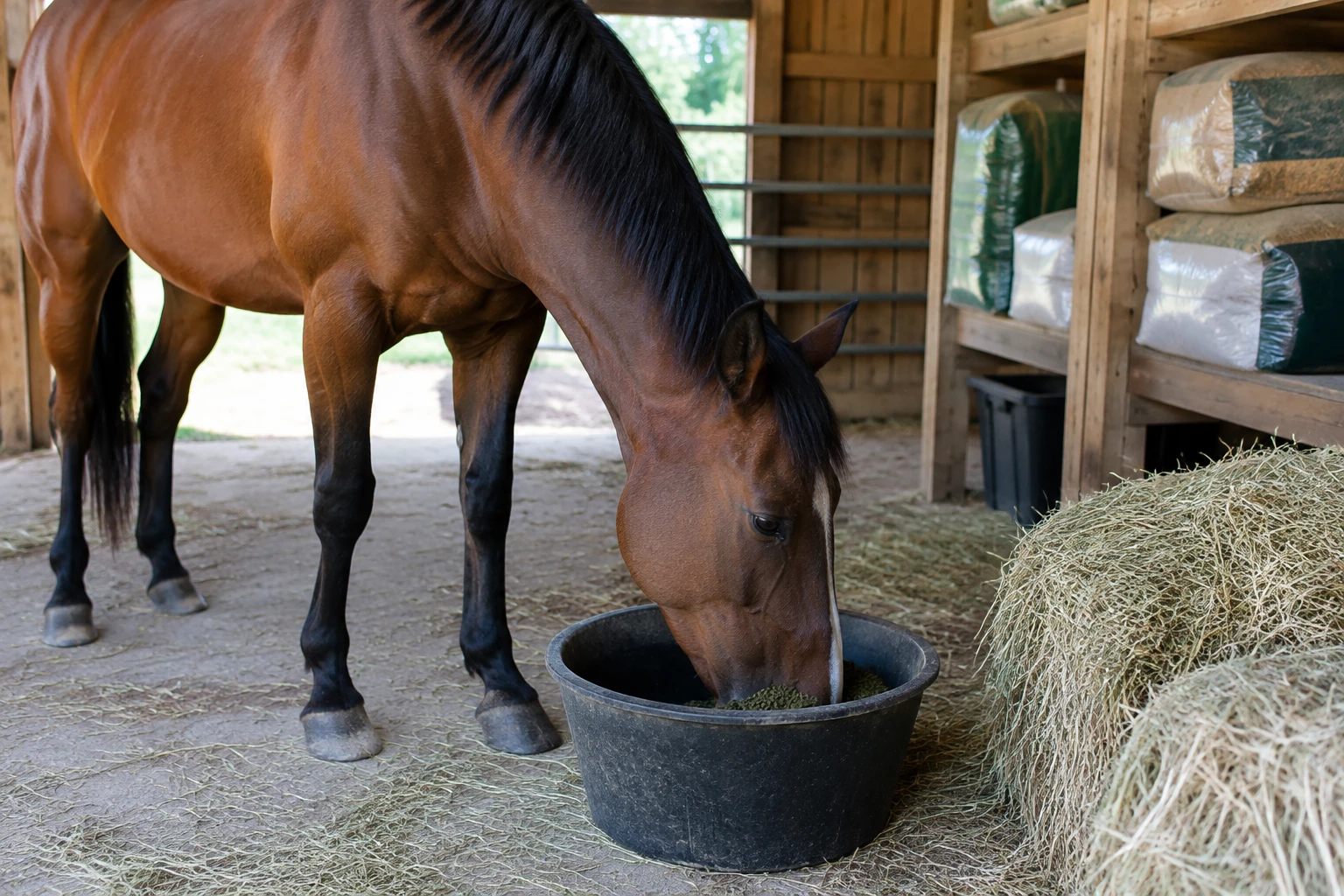
Alfalfa Cubes vs. Hay for Horses
Alfalfa cubes are chopped, compressed forage, not grain. They can supplement hay and may replace some or, with a carefully balanced plan, all of a horse’s forage. Compared with baled alfalfa, cubes are easier to portion and store compactly, and a horse cannot sort out leaves and leave stems. Long-stem hay usually takes longer to eat. If you compare alfalfa cubes with grass hay, you are comparing different forage plants and nutrient profiles as well as different forms. Neither choice is automatically right for every horse.
First, compare like with like
Alfalfa cubes versus baled alfalfa is mostly a question of processing and management. The University of Kentucky Cooperative Extension reports similar digestible energy, crude protein and calcium between alfalfa cubes and long-stem alfalfa. That does not mean every bag of cubes matches every bale. Nutrient value depends on the source forage and factors such as how mature the plants were when harvested. Check the specific product’s label, and ask for a hay analysis when one is available.
Alfalfa versus grass hay is a different comparison. Straight alfalfa may provide more protein and calcium than an adult horse at maintenance needs, while a grass or alfalfa-grass blend may fit some horses better as their main forage. Body condition, workload, age, current forage and the rest of the ration all matter. For a horse with a medical condition or a special feeding requirement, talk with your veterinarian before making a major ration change.
What changes when you feed cubes
- Storage and handling: Cubes take less room than loose bales and are straightforward to measure once weighed. Keep bags dry and protected from rain and dampness; moisture can spoil forage.
- Waste and sorting: A horse has less opportunity to pick through cubes than long-stem hay. That may reduce sorting and some feeding waste, though the actual savings depend on your hay, feeder, horse and local prices.
- Eating time: Cubes generally take more chewing than pellets but less than long-stem hay. They may not keep a horse occupied as long as hay. If your horse can safely eat long-stem forage, retaining some can preserve that longer eating opportunity.
- Dust: Do not assume cubes are dust-free or automatically better for every horse with a respiratory concern. Product condition and handling matter, and research does not support a universal promise that cubes have less dust.
- Cost: Compare the cost of forage the horse actually eats, not just the bag price against the bale price. Include waste, storage, delivery, and the time and water needed if you soak cubes.
How much forage does a horse need?
UF/IFAS gives a general range of 1.5% to 2.5% of body weight per day in forage dry matter for horses receiving no supplemental feed. For a 1,000 lb horse, that is 15 to 25 lb of forage dry matter a day. It is a broad planning range, not a cube feeding direction or an individualized ration. Pasture intake, other feed, body condition and workload change the picture.
Dry matter is the feed weight after its water is excluded. For example, 20 lb of forage dry matter supplied by a product that is 90% dry matter would require about 22.2 lb of that product before soaking: 20 divided by 0.90. This is just a moisture-conversion example, not a recommended amount for your horse. Weigh cubes dry, before adding water; soaking makes them heavier without adding forage.
If cubes are meant to replace a significant share of hay, work out the ration by weight and check the full diet with an equine nutrition professional or veterinarian. Ordinary forage cubes are not automatically a complete, fortified feed. Rutgers Cooperative Extension notes that straight alfalfa may be a useful partial supplement for some horses, while grass or alfalfa-grass cubes can be worth considering when cubes are a large share of forage for an adult horse at maintenance.
When cubes can be useful
Cubes can help when hay is short, when you need a compact forage supply, or when a horse leaves long stems behind. They may also be part of a forage plan for a horse that cannot chew long-stem hay, but that situation calls for an individualized plan. A dental problem or a sudden inability to chew warrants a veterinarian’s advice; do not assume ordinary cubes solve the whole feeding problem.
In the Florida Panhandle, winter planning matters because bahiagrass and bermudagrass go dormant. Think ahead about how you will cover the forage gap rather than waiting until pasture is short. Florida’s humidity also makes alfalfa production difficult, so much of the supply comes from elsewhere. Compare the actual delivered cost, available hay quality and storage needs. A hay analysis gives a better nutrient comparison than appearance or smell alone.
Transitioning, soaking and feeding
- Switch gradually. Increase the new forage while reducing the old over roughly 7 to 14 days, following the product maker’s directions. Avoid an abrupt change.
- Follow the bag for soaking. Instructions differ by product, including water amount, softening time and whether a maximum soak time applies. There is no universal soak time. If instructions are unclear, ask the manufacturer.
- Prepare only what the horse will eat promptly when the label calls for immediate feeding. In warm, humid weather, do not leave soaked forage standing for prolonged periods; follow the product’s handling guidance.
- Feed smaller, more frequent meals when practical rather than relying on a few large servings of cubed forage.
- Use a bucket, feeder or suitable mat rather than feeding cubes or hay directly on sandy ground. A mat or firm surface beneath the feeding area can help limit sand mixed into dropped feed.
A practical buying comparison
Before you choose, weigh a typical serving of dry cubes and compare the label with a hay analysis if available. Ask what forage the cubes contain, whether they are straight alfalfa or a blend, and what the manufacturer says about feeding and soaking. For hay, look at the delivered price, bale weight, storage conditions and how much your horse actually eats. Calculate cost per usable pound by dividing the purchase price by the package weight and then accounting for the share that is eaten rather than wasted.
Baker Feed & Country Store lists Stampede Alfalfa Cubes in a 50 lb bag, along with other alfalfa forage products. The store also offers hay. Compare the specific label and available hay before deciding which is a better fit; the name “alfalfa cubes” alone does not tell you the complete nutrient profile or the right daily amount. A feed scale, clean soaking bucket and feeding tub can make weighing and serving more consistent.
The short answer
Choose cubes when compact storage, portioning or reduced sorting helps, and baled hay when long-stem chewing and longer eating time suit your horse. They can be combined. Base the amount on dry weight and the entire ration, transition gradually, and follow the cube maker’s exact instructions. In North Florida, plan for winter pasture dormancy and keep stored forage dry.
Are alfalfa cubes as nutritious as baled alfalfa hay?
They can have similar basic energy, protein and calcium when comparing alfalfa cubes with long-stem alfalfa, according to Kentucky Extension. Actual nutrient content varies with the forage used, so check the product label and ask for a hay analysis when available.
Can alfalfa cubes completely replace hay?
They can supply all forage in some carefully planned situations, including for a horse that cannot manage long-stem hay. But ordinary cubes are not automatically a complete diet, and replacing long-stem forage reduces eating time. Get professional guidance for a full replacement plan.
Should I weigh cubes before or after soaking?
Weigh them dry, before adding water. Soaking adds water weight, not forage dry matter, so wet weight does not tell you how much forage you fed.
Do alfalfa cubes have to be soaked?
Not every cube has the same directions. Follow the current product label for whether to soak, how much water to use and how long to soften the cubes. Do not rely on a universal soak-time rule.
Are alfalfa cubes cheaper than hay?
Not necessarily. Compare price per pound the horse actually eats, accounting for bale or bag weight, waste, storage, delivery and any soaking time or water. A lower package price alone does not show which forage costs less to use.
 Ask Daisy