
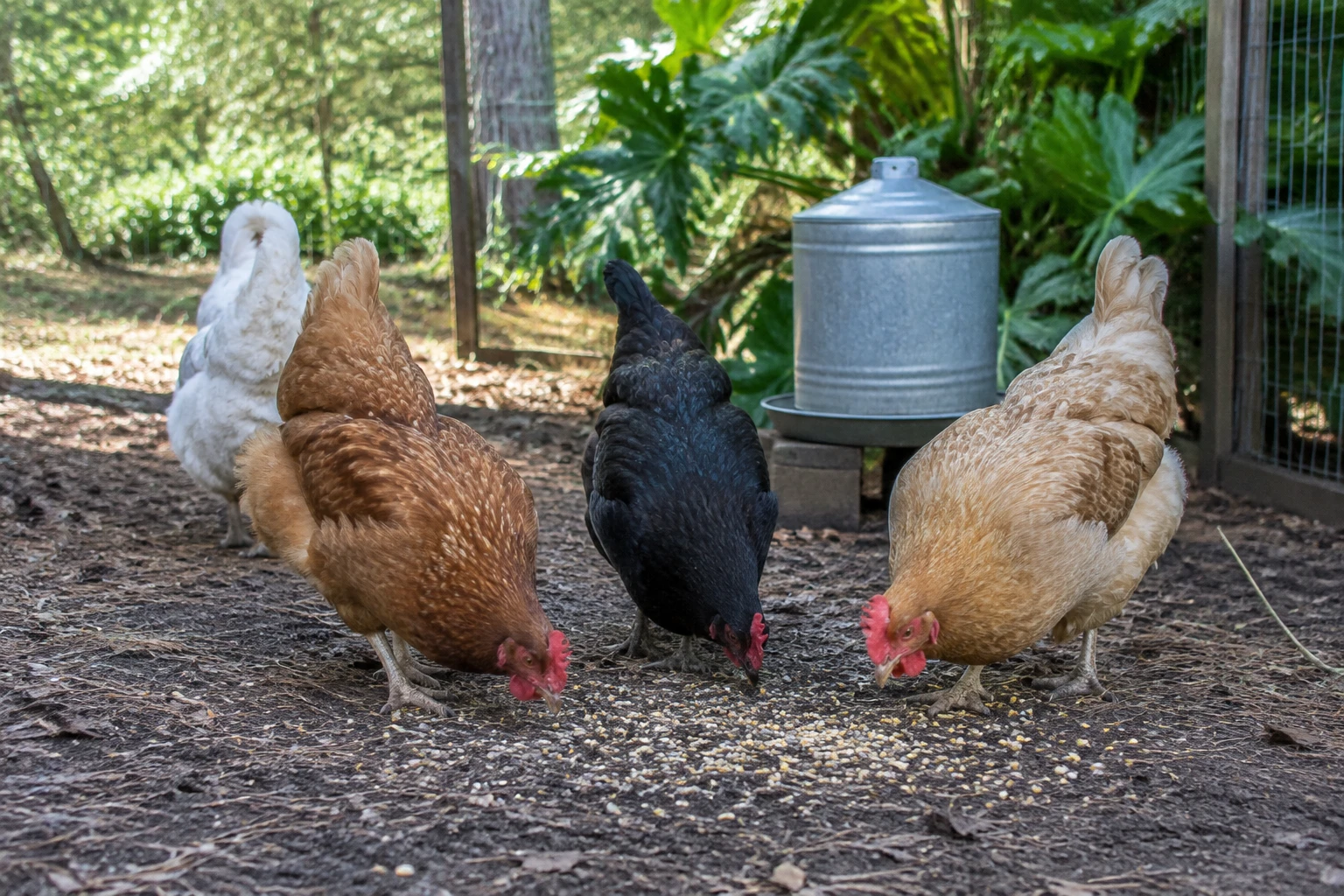
How Much Scratch Grain to Feed Chickens in Fall
For adult chickens in fall, keep scratch grain and all other treats combined to no more than 10% of the daily diet by weight. Offer a complete poultry feed suited to your birds’ age and purpose as their main food, and do not increase scratch just because the weather is turning cooler. In Baker and the Florida Panhandle, fall can still bring warm afternoons; the calendar alone is not a feeding signal.
A practical amount to start with
The 10% figure is a ceiling for treats, not a daily scratch requirement. Cornell Cooperative Extension recommends limiting supplemental treats, including scratch and scraps, so they do not crowd out a balanced ration. UF/IFAS also describes scratch and cracked corn as treats rather than dietary staples. Birds that fill up on grain may eat less of their complete feed.
Use a scale for the clearest measure. As a conservative example, if a hen eats about 100 grams of complete feed in a day, 10 grams of scratch brings scratch to about 9% of the combined amount. That works out to 50 grams for five hens, 100 grams for ten, or 200 grams for twenty, if you offer no other treats. These are calculated examples based on an assumed intake, not a universal requirement. Feed less if your flock eats less complete feed or gets other treats. Never withhold complete feed to make the math fit.
- Weigh your usual scoop of scratch once. Different grain mixes and scoops can weigh different amounts, so a cup or handful is not a dependable weight measure.
- Count kitchen scraps, mealworms and other treats in the same daily allowance. If you offer them, reduce or skip scratch.
- Offer scratch after the flock has had access to its complete feed, and give only what the birds finish in about 15 to 20 minutes. That cleanup window is not permission to offer unlimited grain.
- Scratch is optional. A measured portion a few times a week is fine if that suits your routine; the important point is that treats stay limited and do not displace complete feed.
Why fall does not automatically call for more scratch
Scratch grains provide extra energy, but they are not a complete ration. Their mix of grains does not supply the balanced nutrition intended in a complete poultry feed. The University of Georgia Cooperative Extension warns that scratch is not a complete feed for any bird and should not be mixed into a formulated ration. Keep it in a separate treat portion rather than stirring it into the feeder.
In inland Okaloosa County, fall often eases in gradually. Nearby Crestview’s long-term climate normals show an average October high above 80°F, so a heavy “winter scratch” routine can be a poor fit for many local afternoons. Those historical averages are not a forecast, and no specific date or temperature makes scratch necessary. Keep balanced feed available and adjust management to actual conditions and the flock in front of you.
Molting also commonly happens in fall. If hens are losing feathers, adding extra scratch is not a substitute for balanced nutrition. Some manufacturer guidance recommends a higher-protein complete feed for molting hens, but the right choice depends on the birds and product directions. Ask about a suitable complete feed rather than trying to correct molt with grain alone.
Egg production may drop as days get shorter. UF/IFAS notes that seasonal daylight changes can reduce or stop laying, so fewer eggs in fall do not automatically mean hens need more scratch. Choose feed for your birds’ age and production stage, follow its label, and keep fresh water available.
Offer grit, and store grain dry
Chickens eating scratch need access to insoluble poultry grit, which helps the gizzard grind whole or cracked grains. Use grit suited to the birds’ age. Oyster shell serves a different purpose and is not a replacement for grinding grit. Birds with access to appropriate ground or outdoor material may find some grit themselves, but make sure it is available when you offer scratch.
Keep scratch in a dry, covered, pest-resistant container. Do not feed grain that is moldy, damp or infested with insects. Provide clean water, too. In Baker’s humid weather, a dry storage spot matters as much as the grain choice.
What to buy for a fall routine
Buy the complete poultry feed first. It should match the flock’s age and purpose; chick starter, grower feed and layer feed are not interchangeable just because they are all poultry feed. If your birds are laying, a complete layer ration is the foundation. If the flock includes chicks or growing pullets, follow feed directions for their stage rather than applying adult-hen scratch guidance to them.
Scratch is a separate, optional purchase. Baker Feed & Country Store carries Mid-South Feeds 4-Grain Scratch and Extreme Grain Scratch. Compare the product label and grain mix, but remember that variety does not change scratch’s role as a supplement. A hanging poultry feeder can help keep complete feed accessible, but it does not turn scratch into a complete ration.
A simple routine is: keep appropriate complete feed available, weigh a small treat portion, offer scratch after the birds have eaten, provide grit, and count every other treat against the same limit. If a fall cold snap comes through, do not automatically raise the scratch share. Make sure the flock has enough balanced feed and water, then observe how the birds are eating.
How much scratch should I give five, ten or twenty chickens?
A conservative example is 50 grams for five hens, 100 grams for ten, or 200 grams for twenty when each hen eats about 100 grams of complete feed daily and gets no other treats. These are examples based on the 10%-by-weight treat ceiling, not fixed requirements.
Does the 10% limit apply to scratch alone?
No. It covers scratch, scraps, mealworms and other treats combined. Reduce scratch when you offer other extras.
Should I give more scratch during molt or when eggs slow down?
Not automatically. Keep a balanced, age-appropriate complete feed as the main diet. Molt and shorter fall days can affect feathers and laying; adding grain does not replace complete nutrition.
Do chickens need grit for scratch, and can oyster shell replace it?
Provide insoluble poultry grit when feeding scratch. Oyster shell is not a substitute because it serves a different purpose.
 Ask Daisy