
How Much Food Plot Seed for a Quarter Acre?
For a quarter-acre food plot, multiply the recommended broadcast rate per acre by 0.25. There is no one seed amount that fits every plot: in North Florida, a quarter acre takes about 25–30 lb of oats, 22.5–30 lb of cereal rye, or 5–6.25 lb of crimson clover when each is planted alone. A mixed planting uses different, reduced amounts for each ingredient; don’t add together all the full single-species rates.
Quarter-acre broadcast seed rates
These are broadcast quantities for a quarter acre, scaled from UF/IFAS Northwest Florida recommendations. They are alternatives for planting each crop alone, not a recipe for combining every row. Drilled rates may differ, so use the rate for your planting method.
- Oats: 25–30 lb, from 100–120 lb per acre.
- Cereal rye: 22.5–30 lb, from 90–120 lb per acre. Buy cereal rye, not ryegrass; the names are not interchangeable, and UF/IFAS generally does not recommend ryegrass for wildlife plots.
- Wheat or triticale: 22.5–30 lb, from 90–120 lb per acre.
- Crimson clover: 5–6.25 lb, from 20–25 lb per acre.
- Red clover: 2.5–3.75 lb, from 10–15 lb per acre.
- White clover: 0.75–1 lb, from 3–4 lb per acre.
The rate depends on the seed and the planting plan, not simply on plot size. If a bag label says it covers half an acre, use half the bag for a quarter acre. For example, a 4 lb bag labeled for 0.5 acre supplies two quarter-acre plantings, or 2 lb per planting. Always check whether the package rate is based on bag weight or pure live seed. The Mississippi Department of Wildlife, Fisheries, and Parks explains pure live seed rates.
A measured North Florida mix
UF/IFAS’s “Best Value” cool-season blend calls for 50 lb oats, 50 lb triticale, 6 lb red clover and 15 lb crimson clover per acre. Scaled to a quarter acre, that is 12.5 lb oats, 12.5 lb triticale, 1.5 lb red clover and 3.75 lb crimson clover, or 30.25 lb total. Follow a published blend recipe or the packaged blend’s label rather than combining full monoculture rates. Otherwise, the grains can crowd the clovers.
When to plant near Baker, Florida
Use North Florida planting guidance rather than a calendar written for a colder region. UF/IFAS lists these windows for cool-season wildlife forage in the Florida Panhandle:
- Oats: September 15 through November 15.
- Cereal rye and triticale: October 15 through November 15.
- Crimson, red and white clovers: October 1 through November 15.
A mix containing grains and clovers should be timed and planted so each ingredient gets a fair start. The exact conditions in your field matter, so don’t treat the end date as a guarantee that seed will establish. For named regional options, UF/IFAS lists oat varieties such as Legend 567, Horizon 720 and Horizon 306; triticale examples include TriCal 342 and TriCal 1143. Crimson clover examples include Dixie, AU-Robin and AU-Sunrise, and white clover examples include Ocoee and Osceola. These are regional examples, not a promise of local availability.
Match clover to the ground and sowing depth
A quarter acre can contain very different soil conditions. White clover prefers heavier, wetter soils and is a poor fit for excessively drained sand. Crimson clover prefers heavier, well-drained soils. Choose for the plot’s drainage rather than picking a clover based on acreage alone. Inoculate clover seed with the appropriate Rhizobium bacteria unless it is already properly pre-inoculated.
Large grains and tiny clover seeds should not be buried at the same depth. UF/IFAS gives these planting depths:
- Oats, wheat and triticale: 1–2 inches.
- Crimson and red clover: 1/4–1/2 inch.
- White clover: 0–1/4 inch.
For a grain-and-clover mix, establish the deeper-sown grains first, then make a shallow final pass with the clover. Burying all the seed 1–2 inches can leave the small clover seed too deep. Some packaged seed has its own instructions: for example, Whitetail Institute’s Imperial Whitetail Clover rate is about 8 lb per acre, or 2 lb for a quarter acre, and the manufacturer says not to cover that product with soil. Follow the specific bag directions instead of substituting a generic clover rate. See the manufacturer’s planting instructions.
Measure, prepare and spread evenly
Use this sequence to avoid spending seed on a poor seedbed:
- Measure the actual planted area. A quarter acre is 10,890 square feet; irregular clearings are easy to overestimate.
- Control competing vegetation before preparing the soil. Choose a workable site with drainage suited to the crop.
- Submit a representative soil sample from the rooting zone and follow its lime and fertilizer recommendations. There is no sound universal lime or fertilizer amount based on acreage alone. Lime can take months to change soil pH, so planting-day lime is not an instant correction.
- Firm the seedbed as appropriate for your method, then weigh the seed rather than guessing with a scoop. A small scale helps with low clover quantities.
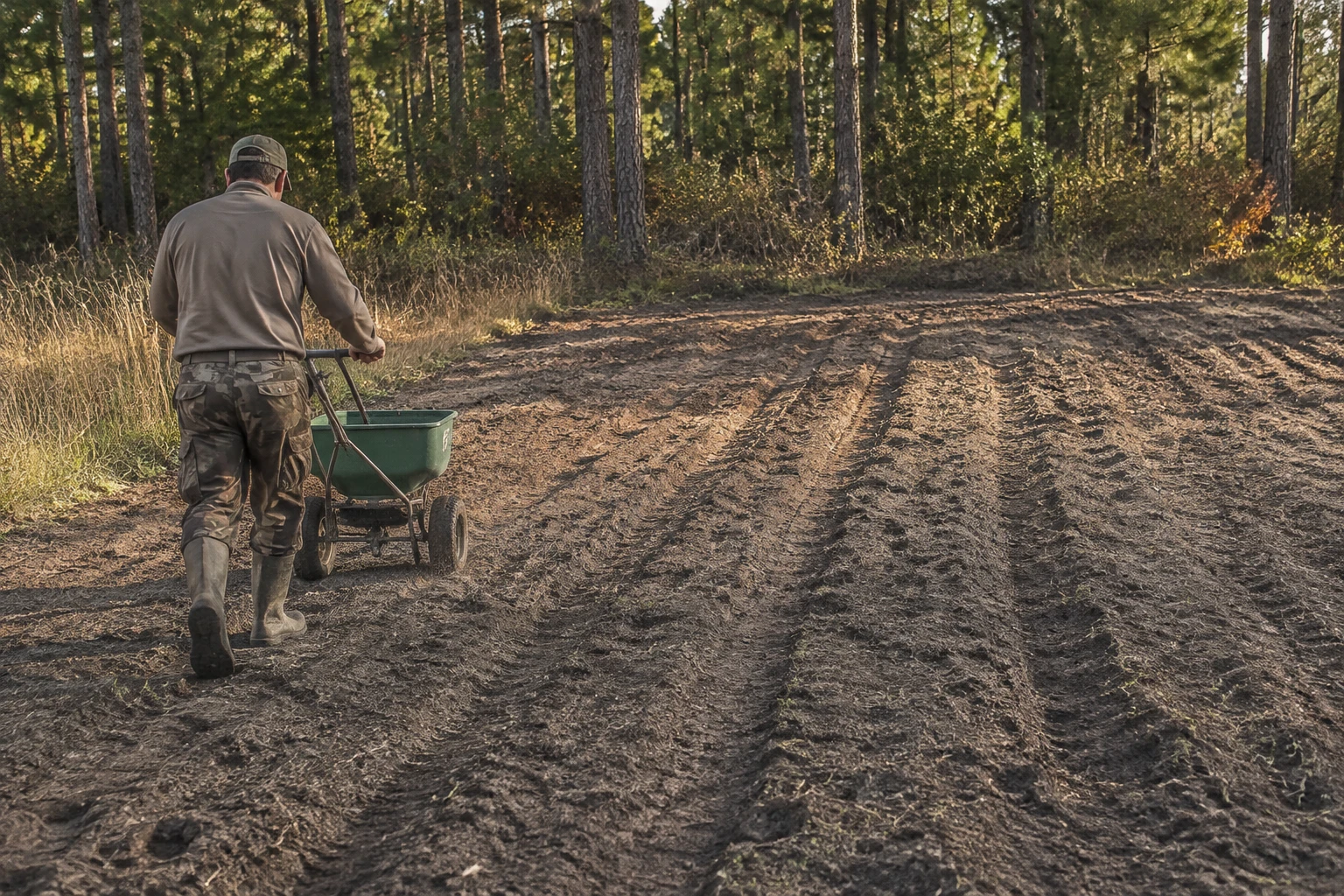
- If broadcasting, split the measured amount into two portions and spread in crossing directions for more even coverage. The two passes together equal the full rate; don’t use the full amount twice.
- Use a suitable spreader and follow the seed or blend label for covering, dragging or firming the seed. Shallow clover seed and deeper grain seed need different treatment.
The shopping list may include the exact seed varieties you choose, clover inoculant if needed, soil-test supplies, only the amendments called for by the test, a scale and a suitable spreader. Check bag coverage and the rate basis before buying. Baker Feed & Country Store carries farm and garden supplies, but check locally for current food-plot seed and spreader selection rather than assuming a particular variety or package is in stock.
A quarter acre has a browsing trade-off
A small plot can be eaten down before seedlings establish, especially where deer pressure is high. UF/IFAS guidance favors plots of at least half an acre, with 1–5 acres preferred where practical. That doesn’t mean a quarter-acre planting cannot be tried, but consider whether you can protect establishment or whether a larger area is feasible. Simply adding more seed is not a reliable fix for heavy browsing.
Sources
Rates, planting windows, depths, regional variety examples and the Best Value blend are from UF/IFAS Extension’s A Walk on the Wild Side: Cool-Season Forage Recommendations for Wildlife Food Plots in North Florida and Cool-Season Food Plot Forages. The pure-live-seed distinction is explained by the Mississippi Department of Wildlife, Fisheries, and Parks. Packaged-product directions can differ; the Imperial Whitetail example above follows Whitetail Institute instructions.
How many pounds of food plot seed do I need for a quarter acre?
It depends on the crop and planting method. For North Florida broadcast planting, a quarter acre takes about 25–30 lb oats, 22.5–30 lb cereal rye, or 5–6.25 lb crimson clover if planted alone. For a blend, use its recipe or label rate.
Is one 50 lb bag too much for a quarter-acre plot?
It may be more than you need for a single-species planting at the rates above, but a bag’s suitability depends on the species and its coverage instructions. Don’t assume a 50 lb bag is one quarter-acre’s worth; measure the labeled rate and save unused seed according to its storage directions.
Should I use more seed when broadcasting than drilling?
Use a recommendation for the method you are using. The figures here are broadcast rates. Do not silently substitute a drilled rate or increase seed without a rate recommendation.
How much lime and fertilizer does a quarter-acre food plot need?
A soil test is needed to choose amendments and amounts. Plot size alone cannot tell you how much lime or fertilizer to apply, and lime may take months to change soil pH.
Can I spread food plot seed on top of the ground?
It depends on the seed and the product instructions. Grain crops generally need 1–2 inches of planting depth, while clovers are planted much shallower. Some packaged clover products direct you not to cover them, so follow the particular label rather than treating all seed alike.
 Ask Daisy