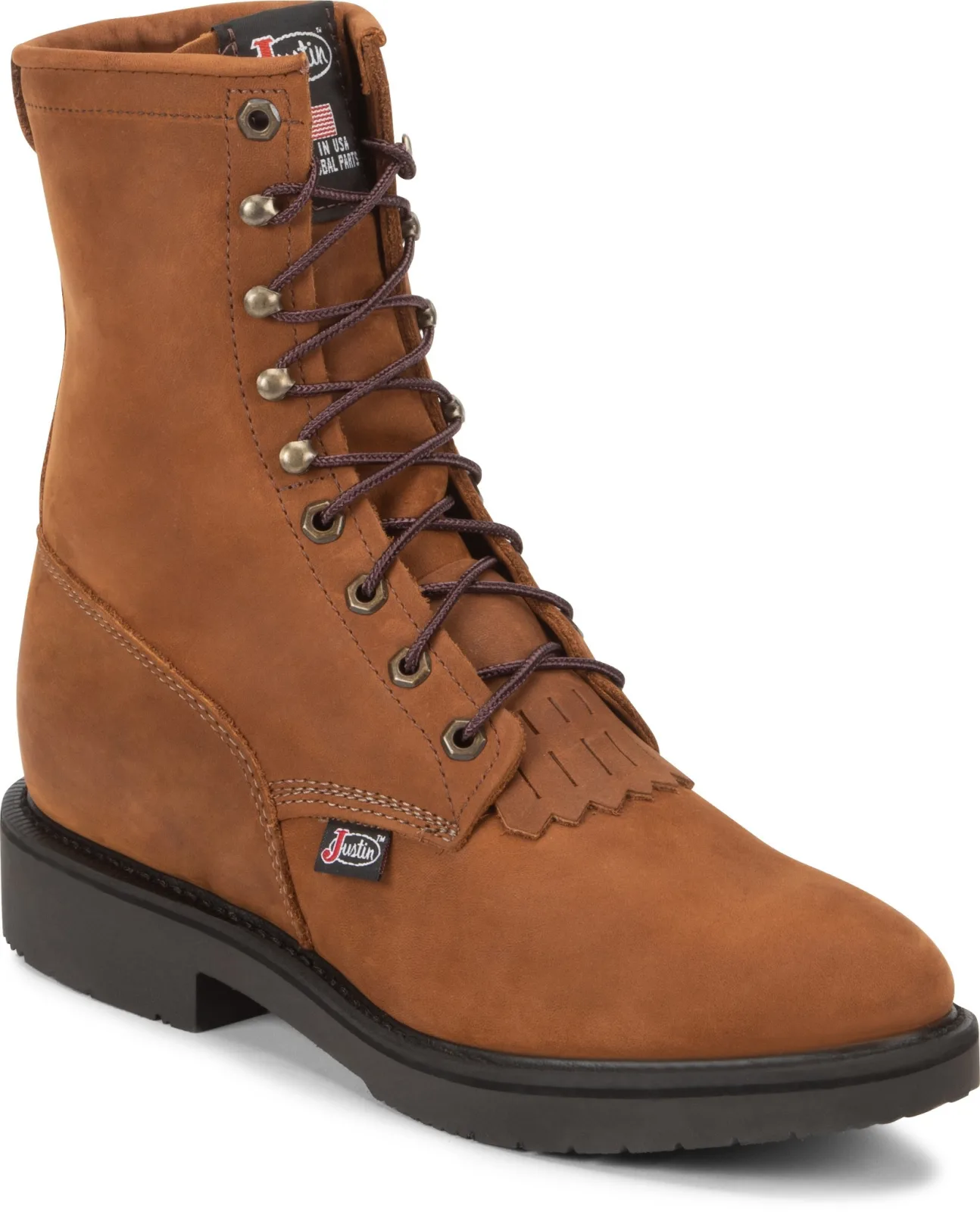
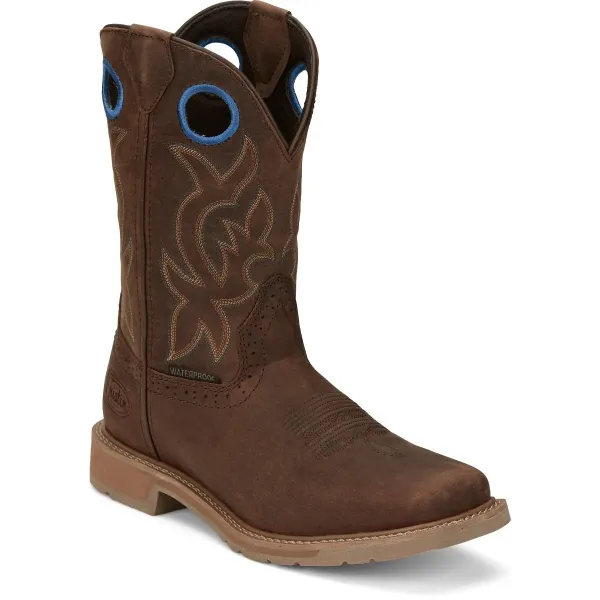
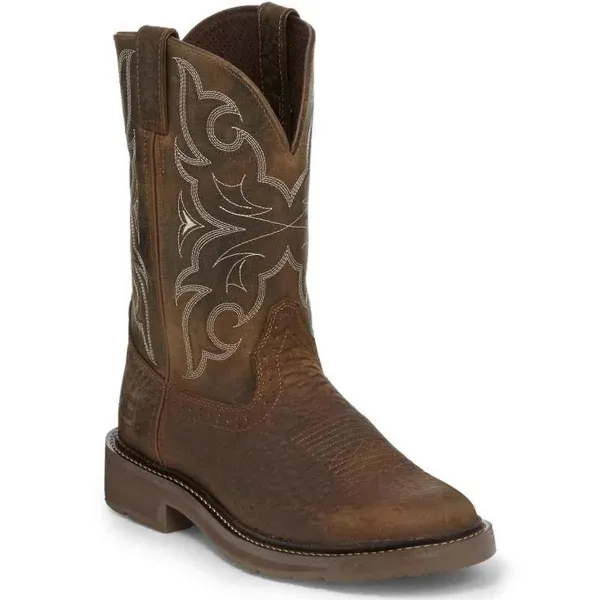
Long shifts on concrete and wet pasture ask a lot of a work boot. The Conductor answers with a full grain leather upper that takes scuffs, mud and barn grit, and a Double Comfort system that pairs orthotic inserts with an Orthotic Texon and PORON insole. The support is built in from the first feeding to the last gate latch.
The polyurethane outsole is oil and slip resisting, which keeps your footing on wet concrete, trailer ramps and greasy shop floors. The boot meets ASTM F2892 safety footwear standards, and its electric hazard protection is tested up to 18,000 volts. Each pair is crafted by hand at Justin's El Paso, Texas factory with global parts.
Highlights
- Full grain leather upper for scuffs, mud and barn grit
- Double Comfort system with orthotic inserts
- Orthotic Texon and PORON insole for all-day support
- Oil and slip resisting polyurethane outsole for wet ground
- Meets ASTM F2892 safety footwear standards
- Electric hazard protection tested up to 18,000 volts
Why a work boot with a safety rating
A work boot earns its place on the days when the job is the hard part. Fencing, feeding, loading feed and working the chute all put the feet under load, and a leather upper with a sewn seat and a sole built for wet ground holds up better than a light boot that softens after a few weeks.
Who it suits: the hand who needs one pair for the barn, the trailer and the feed store, the shop worker who stands on oily concrete all day, and anyone who wants a work boot that can be worn in town without looking like a work boot.
At a glance
| Upper | Full grain leather |
|---|
| Lining | Woven |
|---|
| Insole | Double Comfort with orthotic insert |
|---|
| Toe shape | Round |
|---|
| Construction | Sewn seat |
|---|
| Shank | Non-metallic |
|---|
| Outsole | Oil and slip resisting polyurethane |
|---|
| Safety | ASTM F2892 rated, electric hazard tested up to 18,000 volts |
|---|
How to use it
Try them on late in the day, when feet are at their largest, and wear the socks you will work in. Walk the length of the store and check that your heel stays put and your toes have room. A new work boot slips a little at the heel at first, and that eases as the leather breaks in, so give it a few wears before you judge it.
Good to know
- Pair them with work jeans or canvas pants long enough to break over the shaft, and wear a thin liner sock under a heavier work sock for cushion and warmth.
- Knock off mud and manure while it is still damp so it does not set into the grain, then let the boots air out away from direct heat.
- Condition the leather a few times a season. Leather that dries out cracks first at the flex points, and a little conditioner keeps it supple through the wet months.
- Never dry them by a heater or in direct sun. Slow drying at room temperature protects the leather and the glue.
- Replace the boots when the outsole tread wears smooth, because grip is what the oil and slip resisting outsole is built for.
About Justin
Justin Boot Company has made Western boots since 1879, when founder H.J. Justin started a boot repair business in Texas. Justin's work line is built by skilled artisans from quality leather, and the company has been part of the Western footwear industry for more than a century.
Get a pair on before the next round of chores, and keep a spare pair ready for the wet season.



 Ask Daisy