A nonionic spray adjuvant for compatible pesticide and nutrient mixtures when their labels call for improved wetting and coverage.
A helper in labeled spray mixtures
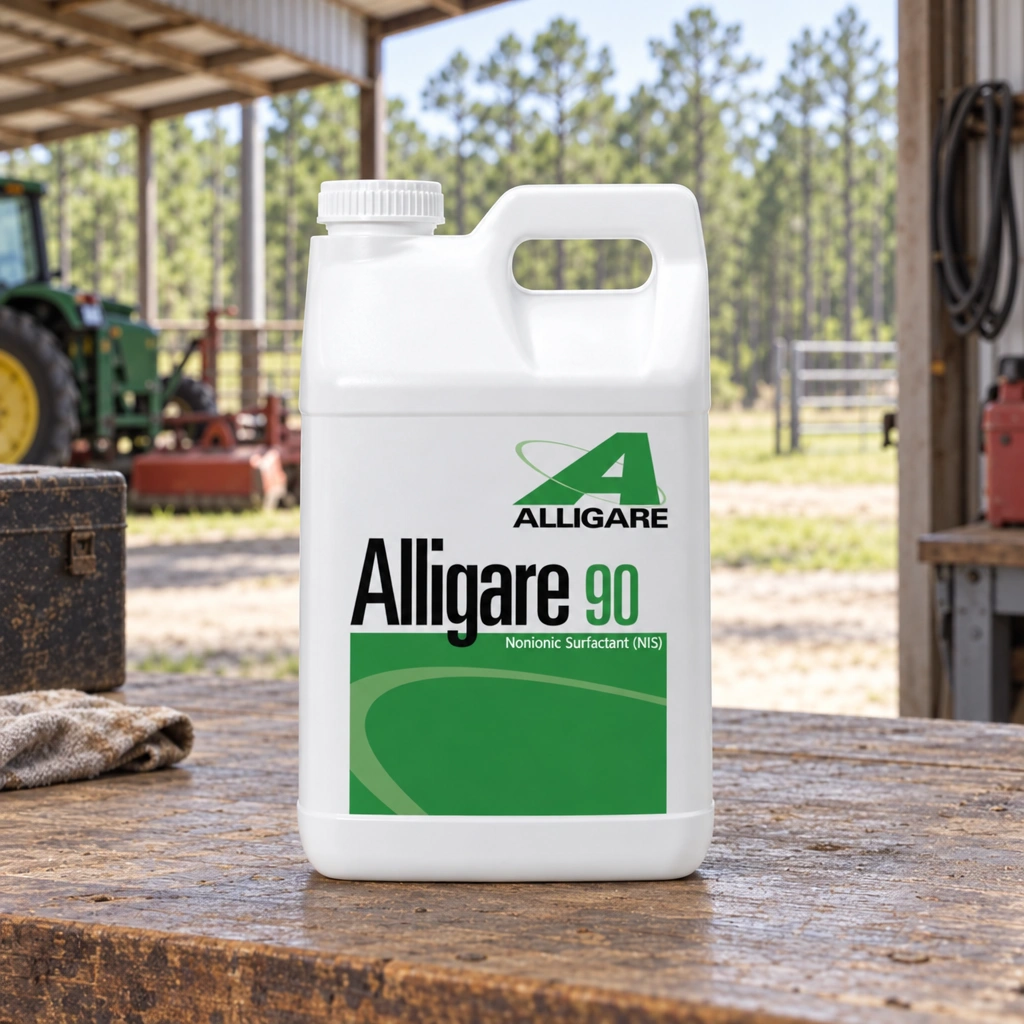
Alligare 90 is a nonionic surfactant, also called a nonionic wetting agent. It is added to a compatible pesticide or nutrient spray when the principal product’s directions call for an adjuvant. The surfactant changes how the liquid behaves on the target surface, helping droplets spread and wet more evenly. It does not supply the herbicidal, insecticidal, or fungicidal active ingredient. Its value comes from supporting a spray program that already has a labeled target and a product capable of controlling it.
Why wetting can matter
Plant leaves often have waxy or angled surfaces that cause water-based droplets to bead or run off. Better spreading can increase contact between a spray and the surface the principal product is intended to reach. That can matter in foliar applications where coverage is part of the product’s directions. A surfactant cannot make an unlisted plant or pest an approved use, and it cannot fix poor timing or inadequate application. It is a formulation aid, not a substitute for the main treatment.
Choose it from the main label
Alligare describes this product for use with various insecticides, fungicides, herbicides, plant growth regulators and nutrients. Compatibility and amount depend on the specific mixture. Some pesticide labels require a nonionic surfactant, some allow one as an option, and others may restrict adjuvants. The primary product’s current label determines whether Alligare 90 belongs in the spray and what rate is allowed. This is why the same gallon is not a universal additive for every tank.
A gallon for repeated farm spray work
The one-gallon package suits an operator who regularly prepares labeled spray mixtures across farm or grounds work. It is useful to have on hand when multiple principal-product labels specify a compatible nonionic surfactant. The gallon is the package offered here. Its application yield depends on the amount of finished spray and the adjuvant concentration specified for that mixture. Keep application records with the main product so the reason for including the adjuvant stays clear.
What the formulation contributes
The national Alligare 90 formulation identifies 90% principal functioning agents. Its nonionic character describes the surfactant type, which is an important distinction when the main pesticide specifically calls for a nonionic adjuvant. The label separates agricultural applications from other uses and gives different concentration guidance for particular situations, including forestry. A field mixture is therefore selected by both the principal product and the type of application, rather than adding one habitual amount to every tank.
Directions for use
Follow the directions and rate on the pesticide label being used.
| Type of Herbicide Application | Amount/100 gal. |
|---|
| Utility ROW and roadside foliar | 1/2 pt. - 2 qt. |
| Forest site preparation | 1 pt. - 2 qt./acre |
| Aquatic - surface | 1/2 pt. - 2 qt. |
| Aquatic - submerged | 1 - 2 gal. |
| Agriculture / Citrus / Turf | 1/2 - 4 pt. |
Complete product label and site-specific directions: https://labelsds.com/document.php?file=Alligare+90+Label+3-6-17.pdf&product=3038
Cautions
KEEP OUT OF REACH OF CHILDREN WARNING Si usted no entiende la etiqueta, busque a alguien para que se la explique a usted en detalle. (If you do not understand the label, find someone to explain it to you in detail.) Causes serious eye irritation. Read label before use. Keep container tightly closed. Keep only in original container. Avoid breathing dust, fume, gas, mist, vapors or spray. Wash skin thoroughly after handling. Do not eat, drink or smoke when using this product. Wear protective gloves, protective clothing, eye protection and face protection. FIRST AID Have the product container with you when calling a poison control center or doctor, or going for treatment. IF IN EYES: Rinse cautiously with water for several minutes. Remove contact lenses if present, after the first 5 minutes, then continue cautiously rinsing eye. If eye irritation persists: Get medical advice or attention. IF ON SKIN OR CLOTHING: Take off contaminated clothing and wash it before reuse. Wash skin with plenty of soap and water for several minutes. Call a poison center, doctor, chemical manufacturer, importer, or distributor to specify the appropriate source of emergency medical advice. If skin irritation persists: Get medical advice or attention. IF SWALLOWED: Call a POISON CENTER, doctor or physician if you feel unwell. Unless advised otherwise by a poison control center or doctor, have person rinse mouth with water, if able. Do not give anything by mouth to an unconscious person. IF INHALED: If breathing is difficult, remove person to fresh air and keep at rest in a position comfortable for breathing. If person is not breathing, call 911 or an ambulance, and then give artificial respiration, preferably mouth to mouth if possible.
STORAGE AND DISPOSAL STORAGE: Store in a cool well-ventilated place. Keep in original container tightly closed. Do not reuse empty container. Do not store with food, feed, or other material to be used or consumed by humans or animals. Do not contaminate water supplies. For optimal storage, store between 40° and 90° F. DISPOSAL: Do not contaminate water, food or feed by storage or disposal. Dispose of contents container to an approved waste disposal facility in accordance with all federal, state and local regulations. Triple rinse (or equivalent) adding rinse water to application tank. Offer container for recycling or dispose of in a sanitary landfill or by other procedures approved by local regulations. The Agricultural Container Recycling Council (ACRC) operates the national recycling program. To contact your state and local ACRC recycler visit the ACRC web page at www.acrecycle.org.


 Ask Daisy