A water-soluble pond fertilizer for managed fish ponds with low natural fertility.
Build the pond food chain
This 10-52-4 water-soluble fertilizer is intended for managed fish ponds. Added nutrients support algae, which feed zooplankton and insects; small fish eat those organisms, then larger fish feed on the small fish. That chain can support bluegill, golden shiners and other fish that use small natural foods. It suits a pond where the manager wants to improve natural food production and can follow a regular monitoring routine.
Check whether the pond can respond
Ponds with naturally fertile soil, regular fish feeding or nutrient-rich runoff may not need fertilizer. Muddy water blocks sunlight, and abundant aquatic weeds can use the nutrients before algae do. Ponds with heavy water exchange are poor candidates. Low alkalinity can also limit phosphorus availability; a water test helps identify that condition before a fertilization program begins. Avoid haphazard one-time additions, which can waste fertilizer and contribute to weed problems.
Track clarity and temperature
Use a Secchi disk to measure visibility and keep readings with the application date. Begin when water temperature stabilizes above 60°F. Apply every two weeks for the first month, then every three weeks for nine weeks, and monthly thereafter. Stop when Secchi visibility reaches 18 to 24 inches. A visibility below 18 inches means stop under the package directions; very clear water may indicate that the pond still needs nutrients. Follow the full schedule and measure again before each application.
Distribute the nutrients evenly
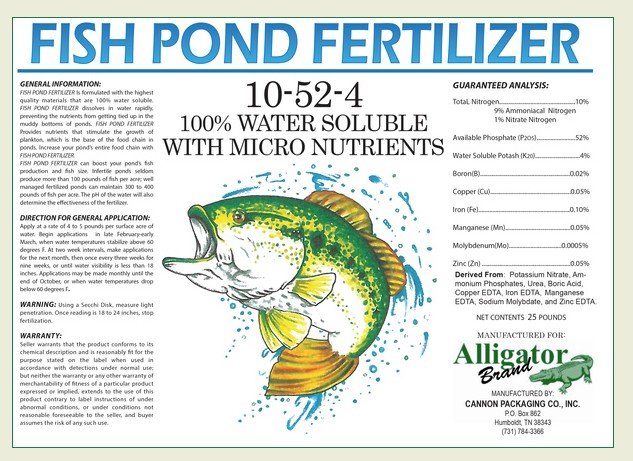
The analysis is 10% total nitrogen, 52% available phosphate and 4% soluble potash, with boron, copper, iron, manganese, molybdenum and zinc. Phosphorus is the main nutrient used to increase pond productivity, with nitrogen also contributing to the response. Because this product dissolves in water, distribute it across the pond rather than leaving concentrated material at one point. Keep the program consistent through the season and maintain records of clarity, temperature and applications. With proper management, fertilized ponds can produce several times the fish yield of unfertilized ponds. That gain depends on steady measurement and a consistent program, not a single application.
Fertilizer analysis
| Guaranteed analysis | Percent |
|---|
| Total nitrogen (N) | 10.00% |
| Ammoniacal nitrogen | 9.00% |
| Nitrate nitrogen | 1.00% |
| Available phosphate (P₂O₅) | 52.00% |
| Soluble potash (K₂O) | 4.00% |
| Boron (B) | 0.02% |
| Copper (Cu) | 0.05% |
| Iron (Fe) | 0.10% |
| Manganese (Mn) | 0.05% |
| Molybdenum (Mo) | 0.0005% |
| Zinc (Zn) | 0.05% |
Derived from potassium nitrate, ammonium phosphates, urea, boric acid, Copper EDTA, Iron EDTA, Manganese EDTA, Sodium Molybdate, and Zinc EDTA.
Directions for use
Use 4 to 5 pounds per surface acre. Begin in late February or early March when water temperature stabilizes above 60°F. Apply every two weeks for the next month, then every three weeks for nine weeks or until water visibility is less than 18 inches. Apply monthly thereafter until the end of October or until water temperature drops below 60°F. Measure visibility with a Secchi disk. When the reading is 18 to 24 inches, discontinue fertilization.
Cautions
WARNING: Using a Secchi disk, measure light penetration. Once the reading is 18 to 24 inches, stop fertilization.


 Ask Daisy