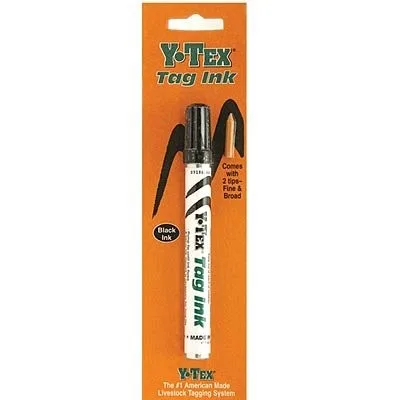
A tag is only useful if you can still read it. This black ink marker uses a deep-penetrating dye formulation that stands up to the environment and time, so the numbers you write on livestock tags stay legible through the season. It's a simple tool that solves a real problem at the chute or the pen.
Each marker includes an extra replacement tip, so a spare is close at hand. The pen features two tips, one fine and one broad, and the pressure you apply controls how much ink goes onto the ear tag. Apply the ink twice for the longest ink life, and the mark holds up well.
Highlights
- Deep-penetrating black dye
- Holds up to weather and time
- Extra replacement tip included
- Fine and broad tips
- Ink flow controlled by pressure
Why choose a tag ink marker
Ear tags do their job only when the numbers can be read at a glance. Smudged or faded ink means a second look, a stop at the chute or a guess at the record. A marker built to hold through weather and handling saves time at the end of a long day, when everyone wants to be done.
Ink pens are simple to keep ready. A black marker stays in the tack room or the truck until the next round of tagging, and it doesn't need batteries, charging or a special setup. Keep the spare tip on hand, and a worn tip won't stop the job.
It suits anyone who marks livestock: a cattle operation tagging new calves, a goat or sheep owner keeping records, or a hog farm working with tagged animals. Black ink reads well on most light-colored tags, which is why it's the usual choice for identification numbers.
At a glance
| Ink color | Black |
|---|
| Tips | Fine and broad |
|---|
| Included | Extra replacement tip |
|---|
How to use it
Get a clean, clear mark on the first try:
- Wipe dirt and moisture off the ear tag before you mark it, so the ink grips.
- Press the tip to the ear tag and let the ink flow. Let the pressure control how much ink you lay down.
- Go over the numbers a second time for the longest-lasting mark.
- Cap the marker between uses, and store it in a cool, dry spot.
- Swap in the spare tip when the first one wears down or dries out.
Good to know
- Use the fine tip for small numbers and the broad tip for larger marks.
- Keep the cap on tight so the tip doesn't dry out between tagging days.
- Keep ear tags and a tagger in the same spot as the marker, so you aren't hunting for supplies mid-job.
- Mark ear tags before they go on the animal when you can. The ink lays down cleaner on a flat, dry surface.
About Y-TEX
Y-TEX is deeply rooted in the livestock industry, and the company is based in Cody, Wyoming. Its work is guided by integrity, hard work and traditional family values, and livestock identification is what the company is known for.
Cautions
Contains xylene.
Keep a spare marker on hand before the next round of tagging.

 Ask Daisy