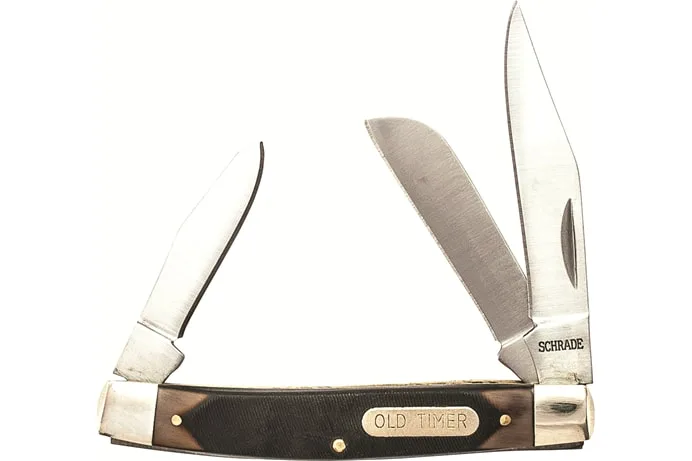
The 34OT Middleman is a pocket knife you reach for without thinking. The clip point handles twine, tape and feed sacks, the sheepsfoot gives you a straight edge for clean cuts, and the spey takes the small work. All three blades are satin-finished stainless steel, so they wipe clean and hold up to daily use.
It's a slip-joint folder, which means no lock to fiddle with. Open the blade you need, use it, and fold it away. The stockman-shaped handle uses polymer composite scales over brass liners, with polished nickel silver bolsters and brass rivets, so it feels solid in the hand and stands up to pocket wear.
Highlights
- Three blades for everyday cutting
- Satin-finished stainless clip, spey and sheepsfoot blades
- Slip-joint action with no lock
- Stockman-shaped handle with polymer composite scales
- Brass liners and nickel silver bolsters
- Brass rivet construction
Why a traditional folder still earns a spot
A slip joint is simple. There's no lock to engage, so the knife opens and closes the same way every time, and there's nothing to think about when a job comes up. For a farm pocket knife, that simplicity is the point. It lives in a jeans pocket, a truck console or a barn drawer, ready when you are.
The 34OT suits a farm pocket with a lot of small jobs: a rancher who keeps a spare in the truck, a horse owner who cuts twine and tape at the barn, a gardener who opens feed sacks and pulls baling twine, and anyone who grew up carrying a folder and wants one again.
At a glance
| Blade material | Satin-finished stainless steel |
|---|
| Handle | Polymer composite scales |
|---|
| Hardware | Brass liners, nickel silver bolsters, brass rivets |
|---|
| Blade shapes | Clip point, spey and sheepsfoot |
|---|
| Action | Slip joint |
|---|
| Type | Folding pocket knife |
|---|
How to use it
Open each blade with a firm pull and close it slowly toward the handle, keeping your fingers out of the path of the blade. A slip joint has no lock, so cut with control and close the blade before you put the knife away.
Use the clip point for twine, tape and feed sacks, the sheepsfoot for straight cuts and the spey for small detail work. Cut away from your hand and keep your fingers clear of the edge.
Wipe the blades after each job, especially after cutting twine, feed sacks or tape, so the stainless stays clean. Add a drop of oil to the pivot now and then so the blades open smoothly.
Keep it dry. Store it in a drawer or pocket rather than a wet truck console, so the brass liners and bolsters don't tarnish.
Good to know
- Pair the Middleman with a sharpening stone or a small file to keep the clip point ready for the next sack.
- Keep a spare in the truck or the barn, so you aren't hunting for a blade when a job needs one.
- Replace the knife when the joint wears loose enough that the blades wobble, or when the clip point won't hold an edge after sharpening.
About Old Timer
Old Timer makes traditional pocket knives, and the Middleman is one of the line's classic patterns. This 34OT has the stockman-shaped handle of that pattern.
Stock one for the truck and one for the barn, so a blade is always within reach.

 Ask Daisy