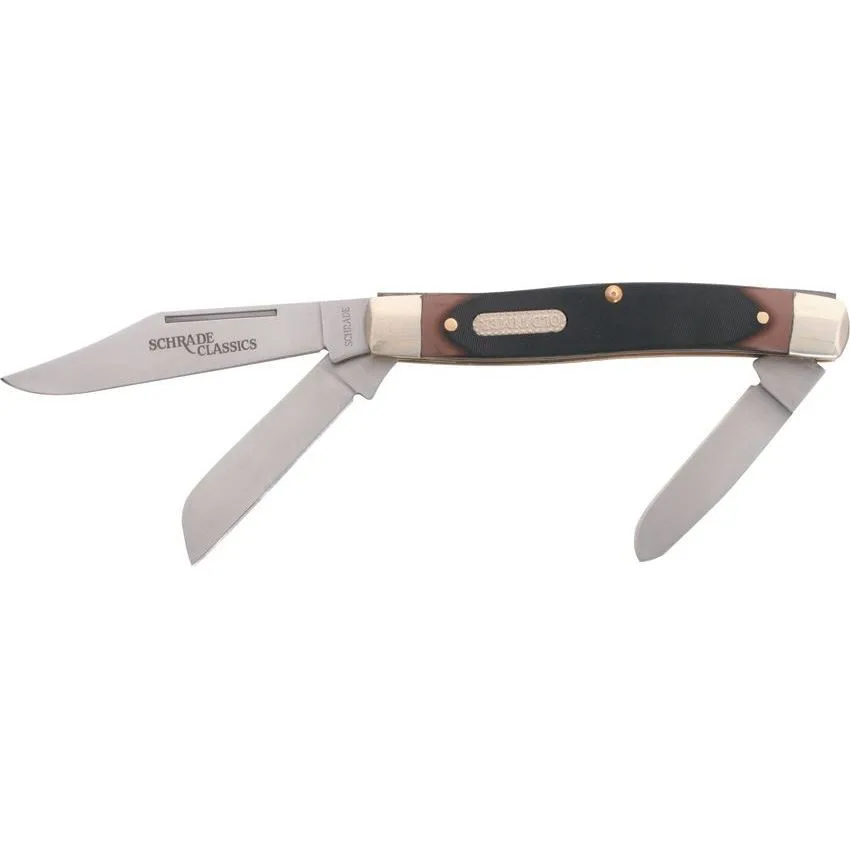
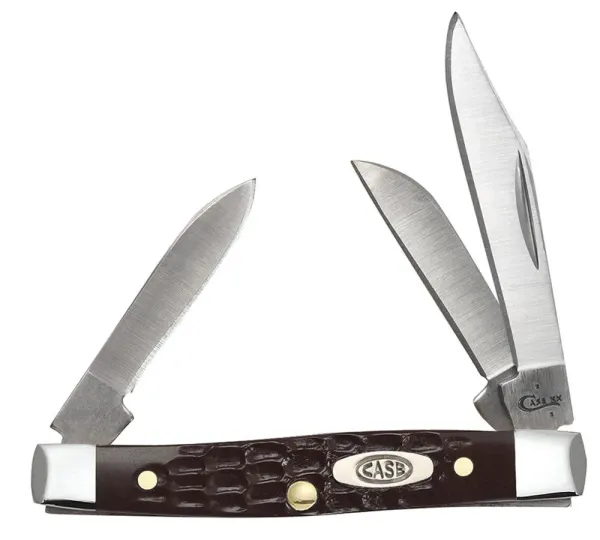
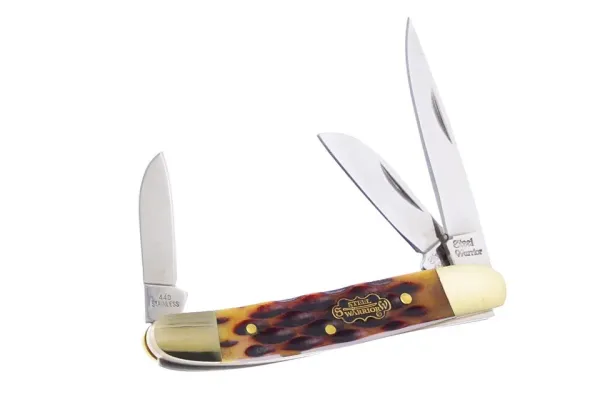
Three useful blades in one slim pocket knife cover most of the small cutting jobs a day brings. The clip point handles general cutting and tip work, the spey blade has a curved edge for general cutting, and the sheepsfoot gives you a straight edge and a blunt tip for twine and rope. You carry one knife and get three tools.
The blades are high-carbon stainless steel, so they clean up easily and keep a working edge. The sawcut Delrin handle gives a textured grip, and the nickel silver bolsters add a traditional look that dresses up the knife.
Highlights
- Three blade profiles in one pocket knife
- High-carbon stainless steel blades
- Inlay shield on a traditional stockman pattern
- Sawcut Delrin handle with a grippy texture
- Nickel silver bolsters
At a glance
| Blade styles | Clip point, spey, sheepsfoot |
|---|
| Blade material | High-carbon stainless steel |
|---|
| Handle | Sawcut Delrin with nickel silver bolsters |
|---|
| Locking mechanism | No lock, slipjoint |
|---|
| Closed length | Just under 4 inches |
|---|
| Weight | 2.4 oz |
|---|
What it's for
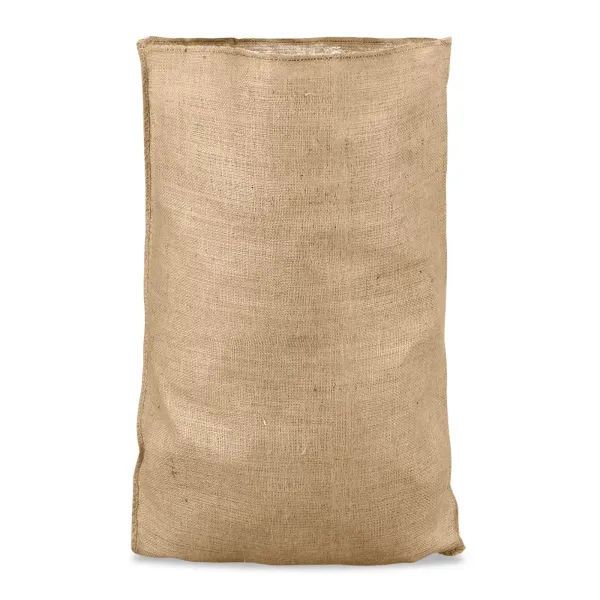
A slipjoint pocket knife earns its place on the belt or in the jacket. It's the knife you grab for feed sacks, baling twine, a zip tie or a small trim job, and its size lets you carry it all day without a bulky sheath. Three blades mean one knife covers more jobs than a single-blade pocket knife.
It suits a farm or ranch hand who wants one reliable pocket knife for chores, a trail rider who wants a knife in the saddlebag, or a weekend hunter who wants a backup. At just under 4 inches closed and 2.4 oz, it rides easily in a front pocket.
A slipjoint has no lock, so the blades stay open by spring tension alone. That keeps the knife simple and light, and it means you close each blade with your thumb and keep your fingers clear of the edge while you do it.
How to use it
- Open one blade at a time and let the spring hold it open.
- Cut away from your body, and pick the blade that fits the job: the clip point for general cutting, the sheepsfoot for twine and rope.
- Close each blade with your thumb, and keep your fingers out of the path of the blade.
- Wipe the blades dry after a wet or muddy job, and store the knife closed.
Good to know
- Keep a small sharpening stone or a fine file in the truck, so the edges keep working when you need them.
- Put a drop of oil on the pivot now and then to keep the blades opening smoothly.
- Keep the knife dry. Delrin handles hold up well, but a blade left wet can spot and stain.
- Pair it with a small leather belt pouch, so the knife stays on you during chores.
Add one to the truck before the next fence repair or feed run.

 Ask Daisy