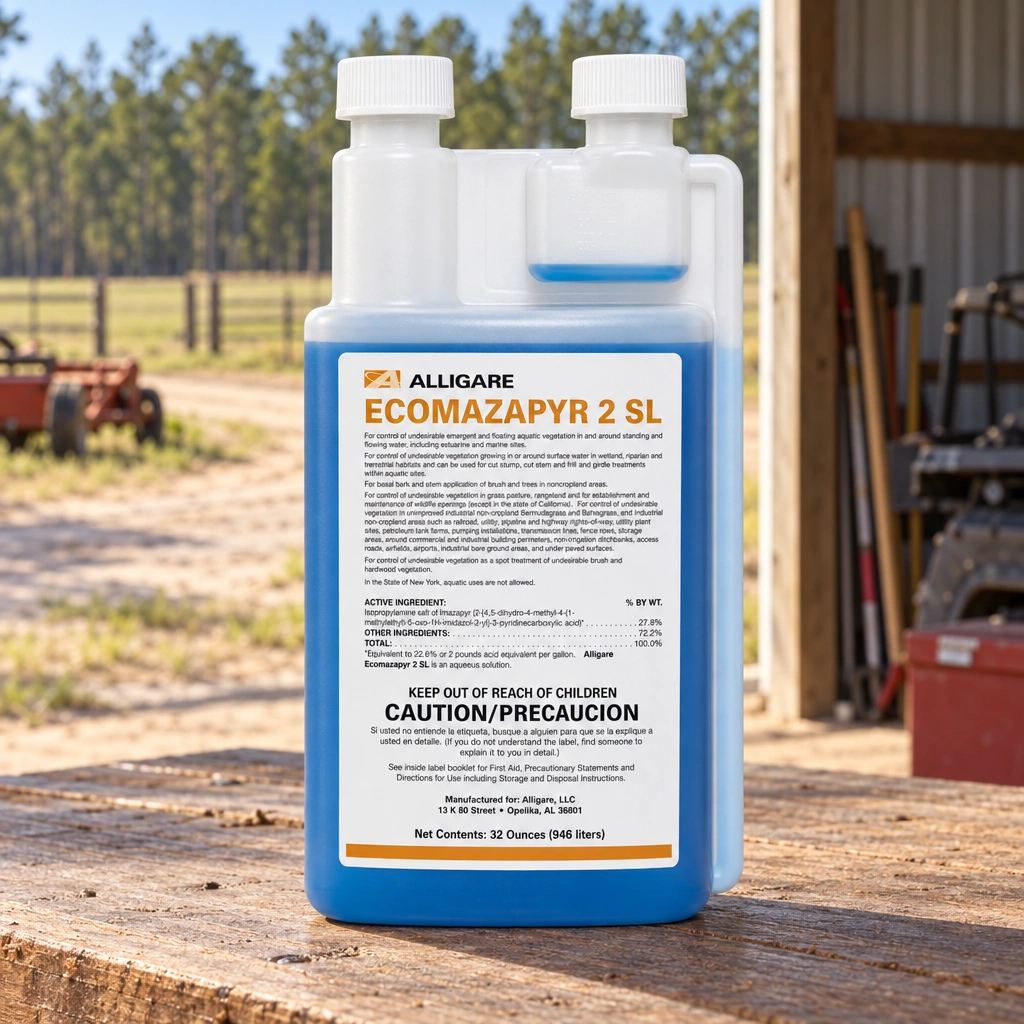
A one-quart imazapyr concentrate for labeled vegetation-management sites, including selected aquatic and non-crop settings.
For vegetation managers
Ecomazapyr 2 SL is a nonselective herbicide for control of labeled grasses, broadleaf weeds, brush and emerged aquatic vegetation. Alligare positions it for aquatic management, forestry, range and pasture, transportation and energy settings. Its label covers specific non-crop, rights-of-way and aquatic-adjacent uses. This is a vegetation-management product for sites where broad control is needed, not a selective lawn weed spray that preserves desirable turf.
Liquid concentrate with residual activity
The formulation contains two pounds of imazapyr per gallon, and the stocked package is one quart. Alligare describes both pre-emergent and post-emergent activity and residual control in bare-ground applications. The liquid concentrate must be prepared and applied according to the rate and method for the target plant and site. A quart is not one application: the label’s use pattern determines how much product is needed and where it may be applied.
A fit for hard-to-manage vegetation
Alligare highlights control of species such as cogongrass, Chinese tallow, phragmites, salt cedar and water hyacinth. Those examples show why a vegetation manager might choose imazapyr where unwanted plants span terrestrial and aquatic settings. The product also supports individual plant treatments in sensitive areas and applications intended to maintain bare ground. Each use has a different purpose, and the label lists which treatment method and site apply.
Absorption changes the treatment boundary
The label describes absorption through emerged leaves and stems, followed by movement through the plant and accumulation in growing regions. Treated plants stop growing before all visible effects appear. Yellowing and tissue death may take two weeks or more to become apparent in some species. This is a different response from an immediate surface scorch. Soil activity also matters when choosing boundaries near desirable plantings.
Emergent vegetation and bare ground
A permitted treatment of emerged aquatic vegetation targets plants growing above the water, rather than an unspecified treatment of the water itself. A bare-ground program has another objective: keeping a defined non-crop area free of susceptible growth, including later emergence. These uses share an active ingredient but differ in the site and result sought. A vegetation manager should choose between them based on the area being managed, rather than treating the broad weed list as a universal application pattern.
Directions for use
DIRECTIONS FOR USE It is a violation of Federal law to use this product in a manner inconsistent with its labeling . Read all label directions before using this product . DO NOT apply this product in a way that will contact workers or other persons, either directly or through drift . Only protected handlers may be in the area during application . For any requirements specific to your State or Tribe, consult the agency responsible for pesticide regulation . Keep containers closed to avoid spills and contamination .
Read the complete product label for the site-specific directions, rates, application tables and restrictions.
Complete manufacturer product label (PDF): https://alligare.com/wp-content/uploads/2024/06/Ecomazapyr-2SL-2.5Gal-Book_PA_MK-customer-copy.pdf
Cautions
KEEP OUT OF REACH OF CHILDREN CAUTION/ PRECAUCION Si usted no entiende la etiqueta, busque a alguien para que se la explique a usted en detalle . (If you do not understand the label, find someone to explain it to you in detail .) PRECAUTIONARY STATEMENTS HAZARD TO HUMANS AND DOMESTIC ANIMALS CAUTION! Harmful if swallowed or absorbed through skin . Avoid contact with skin, eyes or clothing . Wash thoroughly with soap and water after han- dling and before eating, drinking, chewing gum, or using tobacco . FIRST AID If swallowed: Call a poison control center or doctor for further treatment advice . Have person sip a glass of water if able to swallow . DO NOT induce vomiting unless told to do so by a poison control center or doctor . DO NOT give anything to an unconscious person . If on skin or clothing: Take off contaminated clothing . Rinse skin immediately with plenty of water for 15-20 minutes . Call a poison control center or doctor for treatment advice . If in eyes: Hold eye open and rinse slowly and gently with water for 15-20 minutes . Remove contact lenses, if present, after the first 5 min - utes, then continue rinsing eye . Call a poison control center or doctor for treatment advice . If inhaled: Move person to fresh air . If person is not breathing, call 911 or an ambulance, then give artificial respiration, preferably by mouth- to-mouth, if possible . Call a poison control center or doctor for further treatment advice . HOT LINE NUMBER Have the product container or label with you when calling a poison control center or doctor or going for treatment . For medical emergencies involving this product, call 1-800-424-9300 . See inside label booklet for additional Precautionary Statements and Directions for Use . PERSONAL PROTECTIVE EQUIPMENT (PPE): Mixers, loaders, applicators and other handlers must wear: • Long-sleeved shirt and long pants • Waterproof gloves • Shoes plus socks Discard clothing and other absorbent materials that have been drenched or heavily contaminated with this product’s concentrate. Do not reuse them. Follow manufacturer’s instructions for cleaning and maintaining PPE. If no such instructions for washables exist, use detergent and hot water . Keep and wash PPE separately from other laundry . ENGINEERING CONTROL STATEMENTS When handlers use closed systems, enclosed cabs, or aircraft in a man- ner that meets the requirements listed in the Worker Protection Standard (WPS) for agricultural pesticides [40 CFR 170 .240(d)(4-6)], the handler PPE requirements may be reduced or modified as specified in the WPS . User Safety Recommendations Users should: • Wash hands thoroughly with soap and water after handling and before eating, drinking, chewing gum, using tobacco, or using the toilet . • Remove clothing/PPE immediately if pesticide gets inside . Then wash thoroughly and put on clean clothing . • Remove PPE immediately after handling this product . Wash the outside of gloves before removing . Wash thoroughly and change into clean clothing . • Remove and wash contaminated clothing before reuse . ENVIRONMENTAL HAZARDS This product is toxic to plants and must be used strictly in accordance with the drift precautions on the label . Drift and run-off may be hazardous to plants in water adjacent to treated areas . Do not apply to water except as specified in this label . Treatment of aquatic weeds may result in oxygen depletion or loss due to decomposition of dead plants . This oxygen loss may cause the suffocation of some aquatic organisms . Do not treat more than one-half the surface area of the water in a single operation and wait at least 10 to 14 days between treatments . Begin treatments along the shore and proceed outward in bands to allow aquatic organisms to move into untreated areas . Do not contaminate water when disposing of equipment washwaters or rinsate . PHYSICAL AND CHEMICAL HAZARDS Spray solutions of Alligare Ecomazapyr 2 SL must be mixed, stored and applied only in stainless steel, fiberglass, plastic and plastic-lined steel containers . DO NOT mix, store or apply Alligare Ecomazapyr 2 SL or spray solutions of Alligare Ecomazapyr 2 SL in unlined steel (except stainless steel) containers or spray tanks .
AGRICULTURAL USE REQUIREMENTS Use this product only in accordance with its labeling and with the Worker Protection Standard, 40 CFR part 170. This Standard contains requirements for the protection of agricultural workers on farms, forests, nurseries, and greenhouses, and handlers of agricultural pesticides. It contains requirements for training, decontamination, notification, and emergency assistance. It also contains specific instructions and exceptions pertaining to the statements on this label about personal protective equipment (PPE) and restricted entry interval. The requirements in this box only apply to uses of this product that are covered by the Worker Protection Standard.
Do not enter or allow worker entry into treated areas during the restricted entry interval (REI) of 48 hours.
PPE required for early entry to treated areas that is permitted under the Worker Protection Standard and that involves contact with anything that has been treated, such as plants, soil, or water, is:
- Coveralls
- Shoes plus socks
- Chemical-resistant gloves made of any waterproof material
- Protective eyewear
NON-AGRICULTURAL USE REQUIREMENTS The requirements in this box apply to uses of this product that are NOT within the scope of the Worker Protection Standard (WPS) for agricultural pesticides (40 CFR Part 170). The WPS applies when this product is used to produce agricultural plants on farms, forests, nurseries, or greenhouses.
Non-crop weed control is not within the scope of the Worker Protection Standard. See the PRODUCT INFORMATION section of this label for a description of non-crop sites.
Do not enter or allow others to enter treated areas until sprays have dried.


 Ask Daisy