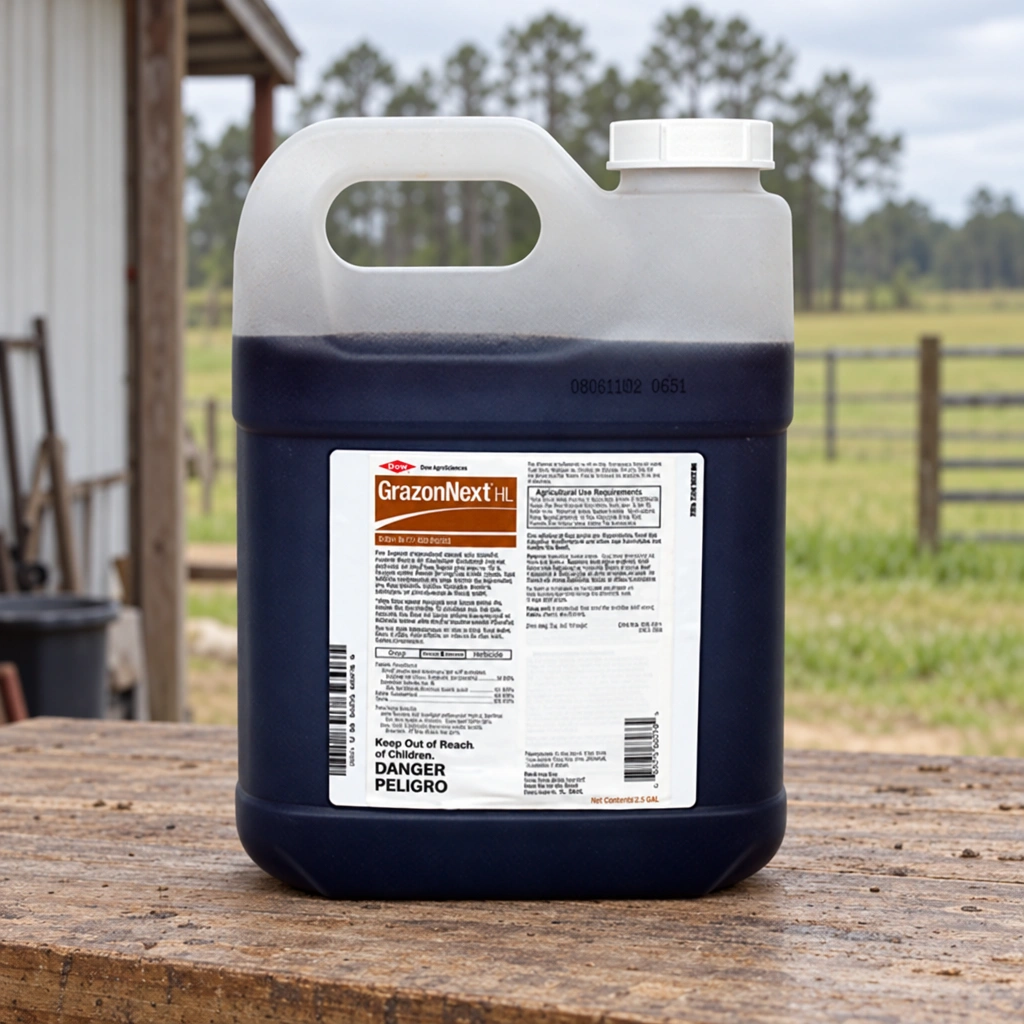
A pasture and rangeland herbicide for listed broadleaf weeds, including thistles and annual broomweed, in a 2 gallon jug.
Broadleaf weed control in forage land
GrazonNext HL is a liquid herbicide for labeled pasture, rangeland and grass hay uses. Corteva positions it for broadleaf weeds that compete with desirable forage, with targets such as thistles, annual broomweed, musk thistle and other listed species. It is a practical option when the land is managed primarily for grazing or hay and the problem is a labeled broadleaf weed rather than a grass weed or brush species requiring another treatment.
Two active ingredients in a liquid concentrate
The formula combines aminopyralid and 2,4-D in a liquid concentrate. The combination provides broadleaf weed control in grass forage settings while leaving many established grasses as the intended stand. The 2-gallon package fits farm-scale work where multiple acres or recurring weed patches may need treatment. The label’s rate table determines the amount for the species and site; package size alone does not establish how much area a particular application covers.
A useful fit for thistle patches
Thistles are a familiar example of broadleaf weeds that can interfere with pasture use and forage quality. GrazonNext HL gives a rancher an option where the specific thistle species and site are included on the label. A treatment decision should account for weed growth stage and the condition of the forage stand. The label’s timing and application method are important because the product is aimed at actively managed grassland, not a mixed ornamental bed.
Residual behavior affects later handling
Aminopyralid can remain active in treated plant material and manure, a practical consideration for operations that move hay, manure or compost off site. GrazonNext HL can be useful for weed control, but managers should understand those downstream consequences before treating forage destined for sensitive gardens or broadleaf crops. The exact label sets the restrictions for hay, manure and compost. This residual behavior is part of choosing where the product belongs in a farm program.
Annual weeds and established perennial patches
The label separates target species and growth conditions because a young annual weed is not the same treatment problem as an established perennial. Annual broomweed and listed thistles give a manager concrete starting points for identifying the problem. The purpose is broadleaf weed control in managed grass forage, rather than removal of all vegetation. Desirable legumes and other broadleaf plants can also be sensitive, so retaining them changes whether this is an appropriate pasture treatment.
Directions for use
Directions for Use It is a violation of Federal law to use this product in a manner inconsistent with its labeling. Read all Directions for Use carefully before applying. Do not apply this product in a way that will contact workers or other persons, either directly or through drift. Only protected handlers may be in the area during application. For any requirements specific to your State or Tribe, consult the agency responsible for pesticide regulation. Not For Sale, Distribution, or Use in New York State. Not For Sale, Distribution, or Use in the San Luis Valley of Colorado. Not for use on pastures in Connecticut, Maine, Massachusetts, New Hampshire, Rhode Island, and Vermont. All other labeled uses are permitted in these states including grazed areas in and around these sites.
Complete product label with site-specific directions, rates, application tables and restrictions: https://assets.greenbook.net/23-52-33-05-04-2023-GrazonNext_HL_-_label.pdf
Cautions
IMPORTANT USE PRECAUTIONS AND RESTRICTIONS TO PREVENT INJURY TO DESIRABLE PLANTS • Carefully read the section “Restrictions in Hay or Manure Use .” • It is mandatory to follow the “Use Precautions and Restrictions” section of this label. • Manure and urine from animals consuming grass or hay treated with this product may contain enough aminopyralid to cause injury to sensitive broadleaf plants. • Hay can only be used on the farm or ranch where product is applied unless allowed by supplemental labeling. • Consult with a Corteva Agriscience representative if you do not understand the “Use Precautions and Restrictions”. Call 800-258-3033 Customer Information Group. Not For Sale, Distribution, or Use in New York State. Not For Sale, Distribution, or Use in the San Luis Valley of Colorado.
Precautionary Statements Hazard to Humans and Domestic Animals EPA Reg. No. 62719-628 Keep Out of Reach of Children DANGER Corrosive • Causes Irreversible Eye Damage • Harmful if Swallowed Do not get in eyes or on clothing. Personal Protective Equipment (PPE) All mixers, loaders, applicators, flaggers, and other handlers must wear: • Long-sleeved shirt and long pants • Shoes plus socks • Protective eyewear • Chemical-resistant gloves made of any waterproof material such as barrier laminate, butyl rubber ≥ 14 mils, nitrile rubber ≥ 14 mils, neoprene rubber ≥ 14 mils, natural rubber ≥ 14 mils, polyethylene, polyvinyl chloride (PVC) ≥ 14 mils, or viton ≥ 14 mils, when applying with any handheld nozzle or equipment, mixing or loading, cleaning up spills or equipment, or otherwise exposed to the concentrate. • Chemical resistant apron when mixing or loading, cleaning up spills or equipment, or otherwise exposed to the concentrate See engineering controls for additional requirements Discard clothing and other absorbent materials that have been drenched or heavily contaminated with this product’s concentrate. Do not reuse them. Follow manufacturer's instructions for cleaning/maintaining PPE. If no such instructions for washables exist, use detergent and hot water. Keep and wash PPE separately from other laundry. Engineering Controls Statements When handlers use closed systems or enclosed cabs in a manner that meets the requirements listed in the Worker Protections Standard (WPS) for agricultural pesticides [40 CFR 170.240 (d) (4-6)], the handler PPE requirements may be reduced or modified as specified in the WPS. Pilots must use an enclosed cockpit that meets the requirements listed in the Worker Protections Standard (WPS) for agricultural pesticides [40 CFR 170.240 (d) (4-6)]. User Safety Recommendations Users should: • Wash hands before eating, drinking, chewing gum, using tobacco, or using the toilet. • Remove clothing/PPE immediately if pesticide gets inside. Then wash thoroughly and put on clean clothing. • Remove PPE immediately after handling this product. Wash the outside of gloves before removing. As soon as possible, wash thoroughly and change into clean clothing. First Aid If in eyes: Hold eye open and rinse slowly and gently with water for 15-20 minutes. Remove contact lenses, if present, after the first 5 minutes, then continue rinsing. Call a poison control center or doctor for treatment advice. If swallowed: Call a poison control center or doctor immediately for treatment advice. Have person sip a glass of water if able to swallow. Do not induce vomiting unless told to do so by a poison control center or doctor. Do not give anything by mouth to an unconscious person. Have the product container or label with you when calling a poison control center or doctor or going for treatment. You may also contact 1-800-992-5994 for emergency medical treatment information. Environmental Hazards This product is toxic to aquatic invertebrates and may be toxic to fish. Drift or runoff may adversely affect aquatic invertebrates and nontarget plants. Do not apply directly to water. Take care to minimize the incidental overspray along the shoreline when applying to terrestrial plants at the water’s edge or to water in areas where surface water is present. Do not apply directly to intertidal areas below the mean high water mark, except as permitted on this label. Drift and runoff may be hazardous to aquatic organisms in water adjacent to treated areas. Do not contaminate water when disposing of equipment washwater or rinsate. This chemical has properties and characteristics associated with chemicals detected in groundwater. The use of this chemical in areas where soils are permeable, particularly where the water table is shallow, may result in groundwater contamination. Application around a cistern or well may result in contamination of drinking water or groundwater.
Agricultural Use Requirements Use this product only in accordance with its labeling and with the Worker Protection Standard, 40 CFR part 170. This Standard contains requirements for the protection of agricultural workers on farms, forests, nurseries, and greenhouses, and handlers of agricultural pesticides. It contains requirements for training, decontamination, notification, and emergency assistance. It also contains specific instructions and exceptions pertaining to the statements on this label about Personal Protective Equipment (PPE) and restricted-entry interval. The requirements in this box only apply to uses of this product that are covered by the Worker Protection Standard. Do not enter or allow worker entry into treated areas during the restricted entry interval (REI) of 48 hours. PPE required for early entry to treated areas that is permitted under the Worker Protection Standard and that involves contact with anything that has been treated, such as plants, soil, or water, is: • Coveralls • Chemical-resistant gloves made of any waterproof material such as natural rubber. • Protective eyewear • Shoes plus socks Non-Agricultural Use Requirements The requirements in this box apply to uses of this product that are NOT within the scope of the Worker Protection Standard for Agricultural Pesticides (40 CFR Part 170). The WPS applies when this product is used to produce agricultural plants on farms, forests, nurseries, or greenhouses. Entry Restrictions for Non-WPS Uses: For applications on rangeland and permanent grass pastures, do not enter or allow worker entry into treated areas until sprays have dried.
Use Precautions • Applications made during periods of intense rainfall, to soils saturated with water, surfaces paved with materials such as asphalt or concrete, or soils through which rainfall will not readily penetrate may result in runoff and movement of GrazonNext HL. Injury to crops may result if treated soil and/or runoff water containing GrazonNext HL is washed, or moved onto land used to produce crops. Exposure to GrazonNext HL may injure or kill susceptible crops and other plants, such as grapes, soybeans, tobacco, sensitive ornamentals. • Seeding grasses: - Preemergence: Grasses may be reseeded in the fall following an application of GrazonNext HL applied in the spring or early summer. - Postemergence: During the season of establishment, GrazonNext HL should be applied only after perennial grasses are well established (have developed a good secondary root system and show good vigor). Most perennial grasses are tolerant to GrazonNext HL at this stage of development. GrazonNext HL may suppress certain established grasses, such as smooth bromegrass (Bromus inermis), especially when plants are stressed by adverse environmental conditions. Plants should recover from this transient suppression with the onset of environmental conditions favorable to grass growth and upon release from weed competition. • Field Bioassay Instructions: In fields previously treated with this product, plant short test rows of the intended rotational crop across the original direction of application in a manner to sample variability in field conditions such as soil texture, soil organic matter, soil pH, rainfall pattern or drainage. The field bioassay can be initiated starting a minimum of one year after herbicide application and following harvest of the treated crop. Observe the test crop for symptoms of herbicidal activity, such as poor stand (effect on seed germination), chlorosis (yellowing), and necrosis (dead leaves or shoots), or stunting (reduced growth). If herbicidal symptoms do not occur, the test crop can be grown. If there is apparent herbicidal activity, do not plant the field to the intended rotational crop; plant only to wheat, forage grasses, native grasses or grasses grown for hay. Consult with a Corteva Agriscience representative if you do not understand the “Use Precautions and Restrictions.” Call 800-258-3033 for more information. Pasture and Rangeland Restrictions • Do not use grasses treated with GrazonNext HL in the preceding 18 months for hay intended for export outside the United States. • Hay from areas treated with GrazonNext HL in the preceding 18 months CANNOT be distributed or made available for sale off the farm or ranch where harvested unless allowed by supplemental labeling. • Hay from areas treated with GrazonNext HL in the preceding 18 months CANNOT be used for silage, haylage, baylage and green chop unless allowed by supplemental labeling. • Do not move hay made from grass treated with GrazonNext HL within the preceding 18 months off farm unless allowed by supplemental labeling. • Do not use hay or straw from areas treated with GrazonNext HL within the preceding 18 months or manure from animals feeding on hay treated with GrazonNext HL in compost. • Do not use grasses treated with GrazonNext HL in the preceding 18 months for seed production. Restrictions for All Uses • This product is not intended for reformulation or repackaging into other end-use products. • Do not treat frozen soil where runoff could damage sensitive plants. • Maximum seasonal rate: Apply no more than 2.1 pints (34 fl oz) (0.87 lbs acid equivalent 2,4-D) per acre per use season. • Use 2 or more gallons of spray solution per acre • Do not make more than two applications per year • Do not apply within 30 days of previous application • If grass is to be cut for hay, Agricultural Use Requirements for the Worker Protection Standard are applicable • Maximum Application Rate: Do not broadcast apply more than 2.1 pints (34 fl oz) per acre of GrazonNext HL per year. The total amount of GrazonNext HL applied broadcast, as a re-treatment, and/or spot treatment per year must not exceed 2.1 pints (34 fluid oz) per acre. Spot treatments may be applied at an equivalent broadcast rate of up to 4.2 pints (68 fluid oz) per acre of GrazonNext HL per annual growing season; however, not more than 50% of an acre may be treated at that rate. • Grazing and Haying Restrictions: Do not harvest forage for hay within 7 days of GrazonNext HL application. Cutting hay too soon after spraying weeds can compromise the weed control. Wait 14 days prior to cutting grass hay to allow for maximum herbicide activity. • Do not use this product for impregnation on dry fertilizer, unless specified in a Corteva Agriscience state specific product bulletin. • Do not apply this product on lawns, turf, ornamental plantings, urban walkways, driveways, tennis courts, golf courses, athletic fields, commercial sod operations, or other high-maintenance, fine turfgrass areas, or similar areas. • Transfer of Animals Feeding on GrazonNext HL Treated Forage: Do not transfer animals grazing or feeding on hay to areas where sensitive broadleaf crop occur without first allowing 3 days of grazing on an untreated pasture. Otherwise, urine and manure may contain enough aminopyralid to cause injury to sensitive broadleaf plants. • Restrictions in Hay or Manure Use: – Do not use aminopyralid-treated plant residues, including hay or straw from areas treated within the preceding 18 months, in compost, mulch or mushroom spawn. – Do not use manure from animals that have grazed forage or eaten hay harvested from treated areas within the previous 3 days, in compost, mulch or mushroom spawn. – Do not spread manure from animals that have grazed or consumed forage or hay from treated areas within the previous 3 days on land used for growing broadleaf crops. – Manure from animals that have grazed forage or eaten hay harvested from treated areas within the previous 3 days may only be used on pasture grasses, grass grown for seed, wheat and corn. – Do not plant a broadleaf crop (including soybeans, sunflower, tobacco, vegetables, field beans, peanuts, and potatoes) in fields treated in the previous year with manure from animals that have grazed forage or eaten hay harvested from aminopyralid-treated areas until an adequately sensitive field bioassay is conducted to determine that the aminopyralid residues in the soil is at level that is not injurious to the crop to be planted. – To promote herbicide decomposition, plant residues should be evenly incorporated in the surface soil or burned. Breakdown of aminopyralid in plant residues or manure is more rapid under warm, moist soil conditions and may be accelerated by supplemental irrigation. • Grazing Poisonous Plants: Herbicide application may increase palatability of certain poisonous plants. Do not graze treated areas until poisonous plants are dry and no longer palatable to livestock. • Seeding Legumes: Do not plant forage legumes until a soil bioassay has been conducted to determine if aminopyralid residues remaining in the soil will adversely affect the legume establishment. • Crop Rotation: Do not rotate to cropland for one year following an application of GrazonNext HL. Cereals and corn can be planted one year after treatment. Most broadleaf crops are more sensitive and can require at least 2 years depending on the crop and environmental conditions. Do not plant a broadleaf crop until an adequately sensitive field bioassay shows that the level of aminopyralid present in the soil will not adversely affect that broadleaf crop. • GrazonNext HL is highly active against many broadleaf plant species. Do not use this product on areas where loss of desirable broadleaf forage plants, including legumes, cannot be tolerated. • Trees adjacent to or in a treated area can occasionally be affected by root uptake of GrazonNext HL through movement into the soil. Do not apply GrazonNext HL within the root zone of desirable trees unless such injury can be tolerated. Use special caution near roses, and leguminous trees such as locusts, redbud, mimosa, and caragana. • Chemigation: Do not apply this product through any type of irrigation system. • Do not contaminate water intended for irrigation or domestic purposes. Do not treat inside banks or bottoms of irrigation ditches, either dry or containing water, or other channels that carry water that may be used for irrigation or domestic purposes.
Storage and Disposal Do not contaminate water, food, feed or fertilizer by storage or disposal. Pesticide Storage: If this product is exposed to subfreezing temperatures, the active ingredient may crystallize and settle out of solution. Under these conditions the product should be warmed to at least 40°F and agitated well to dissolve any crystallized material prior to use. Pesticide Disposal: Pesticide wastes are toxic. Improper disposal of excess pesticide, spray mixture or rinsate is a violation of Federal law. If these wastes cannot be disposed of by use according to label instructions, contact your state pesticide or environmental control agency, or the hazardous waste representative at the nearest EPA regional office for guidance. Nonrefillable containers 5 gallons or less: Container Handling: Nonrefillable container. Do not reuse or refill this container. Offer for recycling if available, or puncture and dispose of in a sanitary landfill, or by incineration, or by other procedures allowed by state and local authorities. Triple rinse or pressure rinse container (or equivalent) promptly after emptying. Triple rinse as follows: Empty the remaining contents into application equipment or a mix tank and drain for 10 seconds after the flow begins to drip. Fill the container 1/4 full with water and recap. Shake for 10 seconds. Pour rinsate into application equipment or a mix tank or store rinsate for later use or disposal. Drain for 10 seconds after the flow begins to drip. Repeat this procedure two more times. Pressure rinse as follows: Empty the remaining contents into application equipment or a mix tank and continue to drain for 10 seconds after the flow begins to drip. Hold container upside down over application equipment or mix tank or collect rinsate for later use or disposal. Insert pressure rinsing nozzle in the side of the container, and rinse at about 40 psi for at least 30 seconds. Drain for 10 seconds after the flow begins to drip.


 Ask Daisy