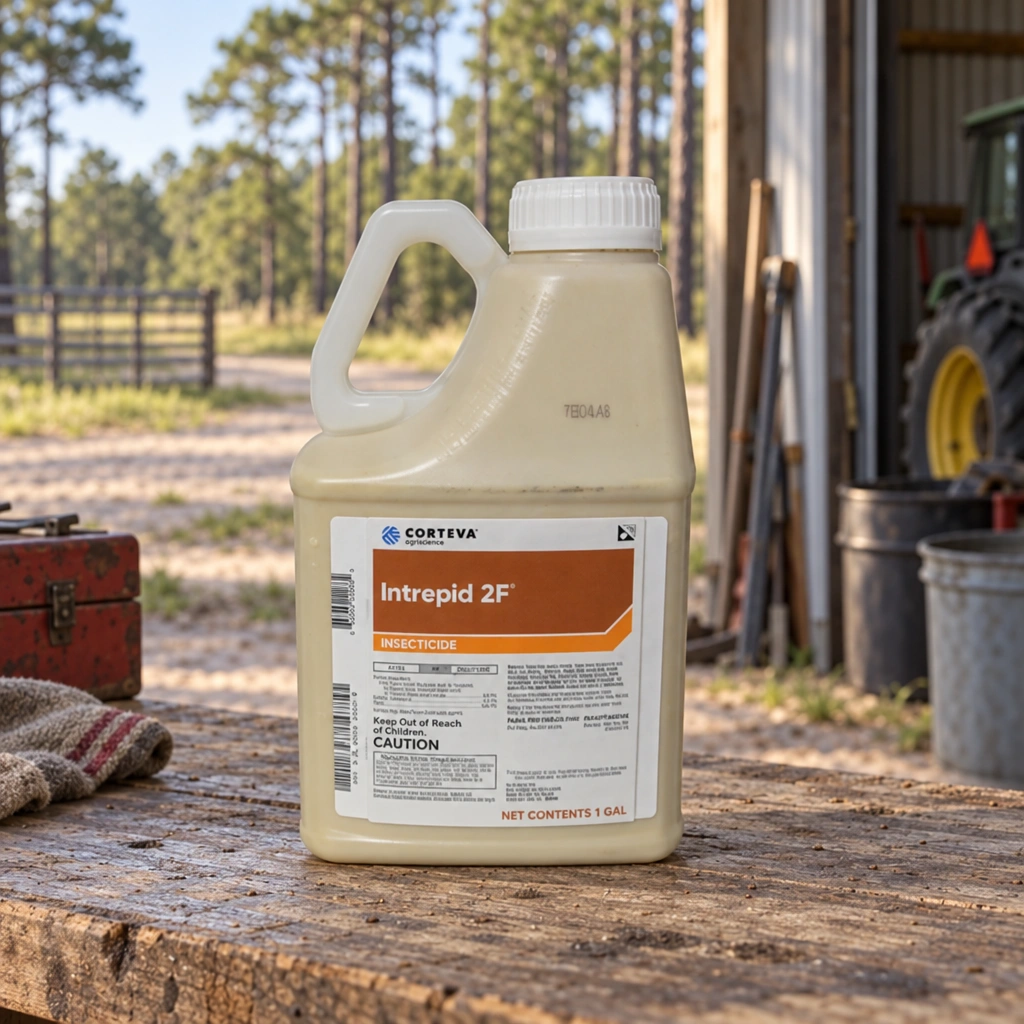
A one-gallon methoxyfenozide insect growth regulator for labeled crop pests, including caterpillars on listed crops such as apples.
Targets caterpillar larvae in crop programs
Intrepid 2F is a methoxyfenozide insect growth regulator for labeled lepidopteran pests. It is used against caterpillar larvae, not as a broad contact insecticide for every pest in a field. The active ingredient mimics the insect molting hormone and triggers a premature, unsuccessful molt in susceptible larvae. This distinct mode of action can make it a useful fit in crop programs that need a Group 18 insecticide and can time treatment to the vulnerable larval stage.
A liquid 2F concentrate
The 2F formulation is a flowable liquid concentrate for dilution and application under the label. The one-gallon package suits agricultural operators treating a labeled crop over a meaningful acreage or making repeated crop-protection decisions through the season. It is not a ready-to-use spray. The label’s crop and pest tables specify the legal rate, timing, application method, seasonal maximum and harvest interval for each use.
Use a concrete crop-pest match
The federal label includes apples and codling moth among its crop and pest combinations. That illustrates the kind of targeted use for this product: an orchard manager monitors the crop, identifies the labeled larval pest, and applies at the label’s timing. The same timing logic applies elsewhere only when that crop and insect appear on the label. Do not transfer an apple direction to another crop or assume all caterpillars are listed.
Ingestion and the feeding window
The label describes Intrepid 2F as most effective when ingested by susceptible larvae. After ingestion, feeding stops and the abnormal molt prevents successful development. That makes coverage of the feeding area and application near egg hatch useful concepts for the grower. A moth flying through an orchard is a monitoring clue, rather than the same treatment target as a young caterpillar feeding on the crop.
Mode of action in a seasonal program
The formulation contains 22.6% methoxyfenozide and is classified in Group 18. That classification lets a crop manager distinguish its mode of action from other insecticides used during the season. The label includes resistance-management guidance because repeatedly relying on one group can select less-susceptible populations. Product choice therefore includes both the current larval problem and the sequence of modes of action used against that pest, rather than selecting solely by package size or brand.
Directions for use
Directions for Use It is a violation of Federal law to use this product in a manner inconsistent with its labeling. Read all Directions for Use carefully before applying. Do not apply this product in a way that will contact workers or other persons, either directly or through drift. Only protected handlers may be in the area during application. For any requirements specific to your state or tribe, consult the agency responsible for pesticide regulation. Not for Sale, Use, or Distribution in Nassau County and Suffolk County in New York State.
Complete product label with site-specific directions, rates, application tables and restrictions: https://www3.epa.gov/pesticides/chem_search/ppls/062719-00442-20260616.pdf
Cautions
KEEP OUT OF REACH OF CHILDREN
Precautionary Statements Hazards to Humans and Domestic Animals CAUTION Harmful If Absorbed Through Skin Or Inhaled Avoid contact with eyes, skin or clothing. Avoid breathing spray mist. Personal Protective Equipment (PPE) Applicators and other handlers must wear: Long-sleeved shirt and long pants Waterproof gloves Shoes plus socks Follow manufacturer's instructions for cleaning/maintaining PPE. If no such instructions for washables exist, use detergent and hot water. Keep and wash PPE separately from other laundry. Engineering Controls Aerial applicators must be in enclosed cockpits. When handlers use closed systems, enclosed cabs or aircraft in a manner that meet the requirements listed in the Worker Protection Standards (WPS) for agricultural pesticides [40 CFR 170.240(d) (4-6)], the handler PPE requirements may be reduced or modified as specified in the WPS. User Safety Recommendations Users should: Wash hands before eating, drinking, chewing gum, using tobacco or using the toilet. Remove contaminated clothing immediately if pesticide gets inside. Then wash thoroughly and put on clean clothing. First Aid If Inhaled: Move person to fresh air. If person is not breathing, call 911 or an ambulance, then give artificial respiration, preferably mouth-to-mouth if possible. Call a poison control center or doctor for further treatment advice. If on skin or clothing: Take off contaminated clothing. Rinse skin immediately with plenty of water for 15-20 minutes. Call a poison control center or doctor for treatment advice. Have the product container or label with you when calling a poison control center or doctor, or going for treatment. You may also contact 1-800-992-5994 for emergency medical treatment information. Environmental Hazards Drift and runoff from applications of this product may be hazardous to sensitive aquatic invertebrates in water bodies adjacent to the treatment area. For terrestrial uses, do not apply directly to water or to areas where surface water is present or to intertidal areas below the mean high water mark. Do not contaminate water when cleaning equipment or disposing of equipment washwaters. Groundwater Advisory This chemical has properties and characteristics associated with chemicals detected in groundwater. The use of this chemical in areas where soils are permeable, particularly where the water table is shallow, may result in groundwater contamination. Surface Water Advisory Methoxyfenozide can contaminate surface water through spray drift. Under some conditions, methoxyfenozide may also have a high potential for runoff into surface water (primarily via dissolution in runoff water) for several months post-application. These include poorly draining or wet soils with readily visible slopes toward adjacent surface waters, frequently flooded areas, areas over-laying extremely shallow groundwater, areas with in-field canals or ditches that drain to overlaying tile drainage systems that drain to surface water. Do not cultivate within 10 feet of aquatic areas to allow growth of a vegetative filter strip. Do not apply by ground within 25 feet, or by air within 150 feet, of lakes, reservoirs, rivers, permanent streams, marshes, or natural ponds; estuaries and commercial fish farm ponds.
Agricultural Use Requirements Use this product only in accordance with its labeling and with the Worker Protection Standard, 40 CFR Part 170. This Standard contains requirements for the protection of agricultural workers on farms, forests, nurseries, and greenhouses, and handlers of agricultural pesticides. It contains requirements for training, decontamination, notification, and emergency assistance. It also contains specific instructions and exceptions pertaining to the statements on this label about personal protective equipment (PPE) and restricted-entry interval. The requirements in this box only apply to uses of this product that are covered by the Worker Protection Standard. Do not enter or allow worker entry into treated areas during the restricted entry interval (REI) of 4 hours. PPE required for early entry to treated areas that is permitted under the Worker Protection Standard and that involves contact with anything that has been treated, such as plants, soil or water, is: Coveralls Chemical-resistant gloves made of any waterproof material Shoes plus socks Non-Agricultural Use Requirements The requirements in this box apply to uses of this product that are NOT within the scope of the Worker Protection Standard for agricultural pesticides (40 CFR Part 170). The WPS applies when this product is used to produce agricultural plants on farms, forests, nurseries or greenhouses. Keep unprotected persons out of treated area until sprays have dried.
Storage and Disposal Do not contaminate water, food, or feed by storage and disposal. Pesticide Storage: Store in a cool dry well-ventilated area, but not below 32ºF. Pesticide Disposal: Wastes resulting from the use of this product must be disposed of on site or at an approved waste disposal facility. Container Handling: Nonrefillable container. Do not reuse or refill this container. Triple rinse or pressure rinse container (or equivalent) promptly after emptying. Triple rinse as follows: Empty the remaining contents into application equipment or a mix tank and drain for 10 seconds after the flow begins to drip. Fill the container 1/4 full with water and recap. Shake for 10 seconds. Pour rinsate into application equipment or a mix tank or store rinsate for later use or disposal. Drain for 10 seconds after the flow begins to drip. Repeat this procedure two more times. Pressure rinse as follows: Empty the remaining contents into application equipment or a mix tank and continue to drain for 10 seconds after the flow begins to drip. Hold container upside down over application equipment or mix tank or collect rinsate for later use or disposal. Insert pressure rinsing nozzle in the side of the container, and rinse at about 40 psi for at least 30 seconds. Drain for 10 seconds after the flow begins to drip. Then offer for recycling if available or puncture and dispose of in a sanitary landfill, or by incineration, or by other procedures allowed by state and local authorities.

 Ask Daisy