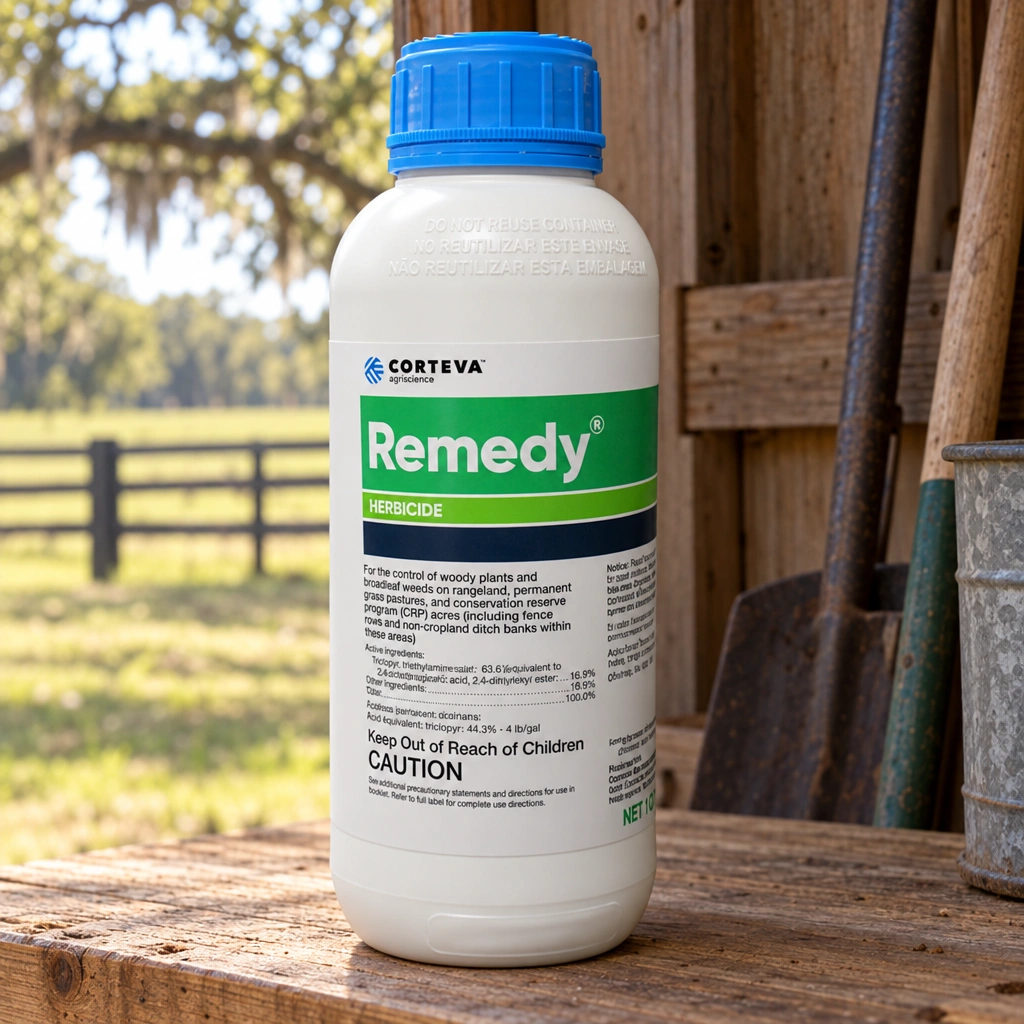
A quart of triclopyr ester concentrate for labeled brush control and broadleaf weeds in pasture and non-crop sites.
Original Remedy for brush work
Remedy Herbicide is a triclopyr ester concentrate for listed woody plants and broadleaf weeds. Its label includes brush species such as blackberry, poison ivy, multiflora rose and others, with methods that differ by plant and application situation. This product is distinct from Remedy Ultra, despite the similar names. Remedy’s formulation and label control its uses; the two products should not be treated as interchangeable.
A quart for measured treatment
The quart bottle contains a liquid concentrate intended for dilution or label-directed spot treatment. The smaller package suits a landowner or applicator treating limited brush areas, field edges or scattered woody plants. It is not a ready-to-spray trigger product. The exact quantity and carrier depend on whether the label method is foliar, basal bark or cut stump, and on which target species is being treated.
Choose method by plant and scale
Foliar applications are useful when brush has leafed out and can be covered as directed. Cut-stump treatment is a different option for freshly cut woody plants, while basal-bark directions address certain standing stems. These methods place herbicide on different plant surfaces and are not substitutes for one another. Matching the method to the species and job helps avoid treating an entire area when only scattered brush needs attention.
A pasture and non-crop use product
Remedy is intended for the sites and targets listed on its label, including pasture and non-crop settings. It can help control brush that obstructs access or competes with grass forage. The label contains important restrictions for dairy animals, hay and slaughter intervals, so farm managers should account for the livestock and harvest plan before use. Keep the full label available to match the method and restrictions to each treatment.
Active ingredient and movement
Original Remedy contains 61.6% triclopyr butoxyethyl ester and petroleum distillates. It provides four pounds of triclopyr acid equivalent per gallon. Triclopyr moves within susceptible woody plants and broadleaf weeds, so it has a different role from a contact product that only damages exposed tissue. The label describes control of established brush, with response affected by the species and treatment conditions rather than promising an immediate cosmetic change.
Standing brush and cut stems
Basal-bark work places treatment on the lower portion of suitable standing stems, while cut-stump treatment uses the exposed surfaces left by cutting. Those choices can be useful where the brush is scattered and the land manager wants an individual-plant approach. Foliar treatment instead uses the leaves of growing brush. The available plant surfaces and the condition of the target help determine which labeled method is practical before any mixture is prepared.
Directions for use
Directions for Use It is a violation of Federal law to use this product in a manner inconsistent with its labeling. Read all Directions for Use carefully before applying.
Mixing Directions Remedy may be diluted with water or with oil and water as described below.
Complete product label with site-specific directions, rates, application tables and restrictions: https://www.agrian.com/pdfs/Remedy1f_Label.pdf
Cautions
Precautionary Statements Hazards to Humans and Domestic Animals EPA Reg. No. 62719-70 Keep Out of Reach of Children CAUTION Causes Moderate Eye Irritation • Harmful If Swallowed • Prolonged Or Frequently Repeated Skin Contact May Cause Allergic Reactions In Some Individuals Avoid contact with eyes or clothing. Wear protective eyewear. Wash thoroughly with soap and water after handling and before eating, drinking, chewing gum, or using tobacco. Personal Protective Equipment (PPE) Applicators and other handlers must wear: • Long-sleeved shirt and long pants • Shoes plus socks Follow manufacturer’s instructions for cleaning/maintaining PPE. If no such instructions for washables are given, use detergent and hot water. Keep and wash PPE separately from other laundry. User Safety Recommendations Users should: • Wash hands before eating, drinking, chewing gum, using tobacco, or using the toilet. • Remove clothing immediately if pesticide gets inside. Then wash thoroughly and put on clean clothing. First Aid If in eyes: Hold eye open and rinse slowly and gently with water for 15-20 minutes. Remove contact lenses, if present, after the first 5 minutes, then continue rinsing eye. Call a poison control center or doctor for treatment advice. First Aid (Cont.) If swallowed: Immediately call a poison control center or doctor. Do not induce vomiting unless told to do so by a poison control center or doctor. Do not give any liquid to the person. Do not give anything by mouth to an unconscious person. Note to Physician: Contains petroleum distillate. Vomiting may cause aspiration pneumonia. Have the product container or label with you when calling a poison control center or doctor, or going for treatment. You may also contact 1-800-992-5994 for emergency medical treatment information. Environmental Hazards This pesticide is toxic to fish. Do not apply directly to water, or to areas where surface water is present or to intertidal areas below the mean high water mark. Do not contaminate water when cleaning equipment or disposing of equipment washwater or rinsate. This chemical has properties and characteristics associated with chemicals detected in groundwater. The use of this chemical in areas where soils are permeable, particularly where the water table is shallow, may result in groundwater contamination. Physical or Chemical Hazards Combustible. Do not use or store near heat or open flame.
Grazing and Haying Restrictions Except for lactating dairy animals, there are no grazing restrictions following application of this product. • Grazing Lactating Dairy Animals: Do not allow lactating dairy animals to graze treated areas until the next growing season following application of this product. • Do not harvest hay for 14 days after application. • Portions of grazed areas that intersect treated rangeland, permanent grass pastures, and conservation reserve program acres may be treated at up to 8 lb ae per acre if the area to be treated on the day of application comprises no more than 10% of the total grazable area. Slaughter Restrictions: During the season of application, withdraw livestock from grazing treated grass at least 3 days before slaughter.
Storage and Disposal Do not contaminate water, food or feed by storage and disposal. Open dumping is prohibited. Pesticide Storage: Store above 28°F or agitate before use. Pesticide Disposal: Wastes resulting from the use of this product must be disposed of on site or at an approved waste disposal facility. Nonrefillable rigid containers 5 gallons or less: Container Handling: Nonrefillable container. Do not reuse or refill this container. Then offer for recycling if available, or puncture and dispose of in a sanitary landifll, or by incineration, or by other procedures allowed by state and local authorities. Triple rinse or pressure rinse container (or equivalent) promptly after emptying. Triple rinse as follows: Empty the remaining contents into application equipment or a mix tank and drain for 10 seconds after the flow begins to drip. Fill the container 1/4 full with water and recap. Shake for 10 seconds. Pour rinsate into application equipment or a mix tank or store rinsate for later use or disposal. Drain for 10 seconds after the flow begins to drip. Repeat this procedure two more times. Pressure rinse as follows: Empty the remaining contents into application equipment or a mix tank and continue to drain for 10 seconds after the flow begins to drip. Hold container upside down over application equipment or mix tank or collect rinsate for later use or disposal. Insert pressure rinsing nozzle in the side of the container, and rinse at about 40 psi for at least 30 seconds. Drain for 10 seconds after the flow begins to drip. Offer for recycling if available.


 Ask Daisy