A non-residential brush and broadleaf herbicide concentrate for labeled non-crop and non-timber sites.
For brush and broadleaf weeds off the home landscape
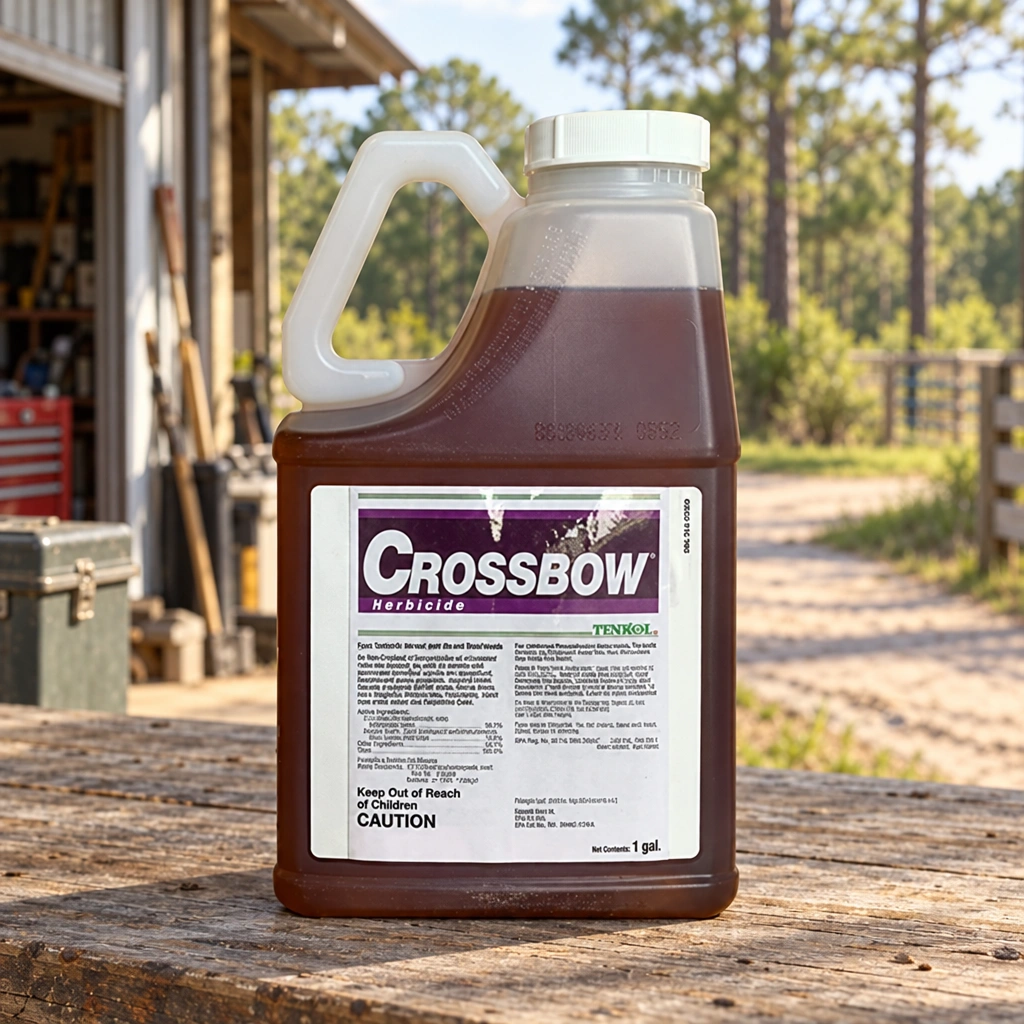
Crossbow is a liquid herbicide for non-residential use on plants in non-crop and non-timber areas. The label covers sites such as fence rows, roadsides, rights-of-way and industrial areas. Its target list includes brush and broadleaf weeds such as blackberry, poison ivy, multiflora rose, dandelion and curly dock. It is suited to vegetation management where these plants are unwanted, not to crop protection or routine residential yard care.
Combines 2,4-D and triclopyr
Crossbow contains 2,4-D butoxyethyl ester and triclopyr butoxyethyl ester. The two active ingredients are used together for broadleaf weed and woody plant control in the listed non-crop settings. A liquid concentrate allows application methods such as foliar spray and selected woody-stem treatments. The label’s target-specific sections determine which method fits; a brush treatment and a broadleaf weed spray are not necessarily the same mixture.
Select a treatment method for the vegetation
The label includes broadcast and high-volume foliar methods, along with directions for cut-stump and basal-bark treatment on certain woody plants. Foliar spray is for leafy growth that can receive coverage. Cut-stump treatment is aimed at freshly cut woody stems, while basal bark treatment targets the lower stem of standing plants where listed. This range helps a non-residential operator address both broad patches and scattered brush without assuming one method works for every target.
A fence-row example
A non-residential fence row containing blackberry is one concrete setting for this product. The fence line may need to remain accessible while nearby grass cover is retained. A foliar application and an individual woody-stem treatment address different growth and access conditions in that same setting. The target species and method determine the treatment, rather than using a single mixture indiscriminately along the whole boundary.
Broadleaf activity sets its role
The two active ingredients are classified as Group 4 herbicides. Their broadleaf and woody-plant activity explains why this product is selected for unwanted brush among desired grasses, rather than for removing grass from a planting bed. The same activity also reaches desirable broadleaf plants. Knowing whether the vegetation to retain is grass, a legume or a woody ornamental is therefore part of deciding whether Crossbow fits the site. It is a non-timber product, not a forestry treatment.
Directions for use
Directions for Use It is a violation of Federal law to use this product in a manner inconsistent with its labeling. Read all Directions for Use carefully before applying.
Complete product label with site-specific directions, rates, application tables and restrictions: https://www3.epa.gov/pesticides/chem_search/ppls/062719-00260-20250204.pdf
Cautions
KEEP OUT OF REACH OF CHILDREN
Precautionary Statements Hazards to Humans and Domestic Animals CAUTION Harmful If Swallowed • Causes Moderate Eye Irritation • Prolonged Or Frequently Repeated Skin Contact May Cause Allergic Reactions In Some Individuals Avoid contact with eyes or clothing. Wash thoroughly with soap and water after handling and before eating, drinking chewing gum, or using tobacco. Personal Protective Equipment (PPE) All mixers, loaders, applicators, flaggers, and other handlers must wear: • Long-sleeved shirt and long pants • Shoes plus socks • Chemical-resistant gloves made of any waterproof material such as barrier laminate ≥ 14 mils, nitrile rubber ≥ 14 mils, neoprene rubber ≥ 14 mils, and Viton ≥ 14 mils • Protective eyewear • Chemical resistant apron when mixing or loading, cleaning up spills or equipment, or otherwise exposed to the concentrate Wear a minimum of a NIOSH-approved particulate filtering facepiece respirator with any N*, R or P filter; OR a NIOSH-approved elastomeric particulate respirator with any R or P filter; OR a NIOSH approved powered air purifying respirator with HE filters. See engineering controls for additional requirements Follow manufacturer's instructions for cleaning/maintaining PPE. If no such instructions for washables, exist, use detergent and hot water. Keep and wash PPE separately from other laundry. Engineering Controls When handlers use closed systems or enclosed cabs in a manner that meets the requirements listed in the Worker Protections Standard (WPS) for agricultural pesticides [40 CFR 170.607(e-f)], the handler PPE requirements may be reduced or modified as specified in the WPS. Pilots must use an enclosed cockpit that meets the requirements listed in the Worker Protection Standard (WPS) for agricultural pesticides [40 CFR 170.607(e-f)]. User Safety Recommendations Users should: • Wash hands before eating, drinking, chewing gum, using tobacco, or using the toilet. • Remove clothing/PPE immediately if pesticide gets inside. Then wash thoroughly and put on clean clothing. • Remove PPE immediately after handling this product. Wash the outside of gloves before removing. As soon as possible, wash thoroughly and change into clean clothing. First Aid If swallowed: Immediately call a poison control center or doctor. Do not induce vomiting unless told to do so by a poison control center or doctor. Do not give any liquid to the person. Do not give anything by mouth to an unconscious person. If in eyes: Hold eye open and rinse slowly and gently with water for 15-20 minutes. Remove contact lenses, if present, after the first 5 minutes, then continue rinsing eye. Call a poison control center or doctor for treatment advice. Have the product container or label with you when calling a poison control center (1-800-222-1222) or doctor, or going for treatment. You may also contact the Corteva Agriscience Emergency and Information Process Line at 1-800-992-5994, for emergency medical treatment information. Note to Physician: This product may pose an aspiration pneumonia hazard. Contains petroleum distillates. Environmental Hazards This pesticide is toxic to fish and aquatic invertebrates. Drift and runoff may be hazardous to aquatic organisms in water adjacent to treated areas. Do not apply directly to water, or to areas where surface water is present, or to intertidal areas below the mean high water mark. Drift or runoff may adversely affect fish and nontarget plants. Do not contaminate water when disposing of equipment washwaters. GROUNDWATER ADVISORY: This chemical has properties and characteristics associated with chemicals detected in groundwater. This chemical may leach into groundwater if used in areas where soils are permeable, particularly where the water table is shallow. SURFACE WATER ADVISORY: This product may impact surface water quality due to runoff of rain water. This is especially true for poorly draining soils and soils with shallow ground water. This product is classified as having high potential for reaching surface water via runoff for several weeks after application. A level, well-maintained vegetative buffer strip between areas to which this product is applied and surface water features such as ponds, streams, and springs will reduce the potential loading of triclopyr from runoff water and sediment. Runoff of this product will be reduced by avoiding applications when rainfall or irrigation is expected to occur within 48 hours. NON-TARGET ORGANISM ADVISORY: This product is toxic to plants and may adversely impact the forage and habitat of non-target organisms, including pollinators, in areas adjacent to the treated site. Protect the forage and habitat of non-target organisms by following label directions intended to minimize spray drift. Physical or Chemical Hazards Combustible. Do not use or store near heat or open flame.
Use Precautions • Apply this product only as specified on this label. • Be sure that use of this product conforms to all applicable regulations. • Under conditions which are conducive to evaporation (high temperatures and low humidity), vapors from this product may injure susceptible crops growing nearby. Excessive amounts of this herbicide in the soil may temporarily inhibit seed germination and plant growth. • The combination of spray contact with impervious surfaces, such as roads and rocks, and increasing ambient air temperatures, may result in an increase in the volatility potential for this herbicide, increasing a risk for off-target injury to sensitive crops such as grapes and tomatoes. Use Restrictions • For use on plants in non-crop and non-timber areas only. Not for use on crops, timber, or other plants being grown for sale or other commercial use, or for commercial seed production, or for research purposes. • For non-residential uses only. • Do not use on bentgrass. Do not use on newly seeded grasses until grass has established a good root system and is tillering. • Do not reseed pastures within a minimum of three weeks after treatment. • Do not spray pastures containing desirable broadleaf forbs, especially legumes such as clover, unless injury or loss of such plants can be tolerated. However, the stand and growth of established grasses usually is improved, particularly when rainfall is adequate and grazing is deferred. • Do not apply Crossbow directly to, or otherwise permit it to come into direct contact with cotton, grapes, tobacco, vegetable crops, citrus, flowers, fruit or ornamental trees, or other desirable broadleaf plants and do not permit spray mists containing it to drift onto them. • Application Restrictions: Do not apply this product in a way that will contact workers or other persons, either directly or through drift. Only protected handlers may be in the area during application. • Entry Restrictions: Do not allow people (or pets) to enter the treated area until sprays have dried. • This product may not be applied to forage that is to be cut and sold for commercial purposes. • Chemigation: Do not apply this product through any type of irrigation system. • Foliar sprays should be applied during warm weather when brush and weeds are actively growing. Application under drought conditions may provide less than desirable results. Use low spray pressures to minimize spray drift. Apply Crossbow in a manner to avoid contacting nearby susceptible crops or other desirable plants and to avoid contaminating water intended for irrigation or domestic use. Read and follow all use precautions given on this label. • Grazing and Haying Restrictions: Except for lactating dairy animals, there are no grazing restrictions following application of this product. • Grazing Lactating Dairy Animals: Do not allow lactating dairy animals to graze treated areas until the next growing season following application of this product. • Do not harvest hay for 14 days after application. • Grazed areas of non-cropland and forestry sites may be spot treated if they comprise no more than 10% of the total grazable area. • Slaughter Restrictions: During the season of application, withdraw livestock from grazing treated grass at least 3 days before slaughter. • Compost Restriction: This product is persistent and may be present in treated plant materials for over 30 days after application. Do not sell or transport treated plant materials or manure from animals that have grazed on treated plant materials off-site for compost distribution or for use as animal bedding/feed for 30 days after application. • Animals that have been fed triclopyr treated forage must be fed forage free of triclopyr for at least 3 days before movement to an area where manure may be collected, or sensitive crops are grown.
Storage and Disposal Do not contaminate water, food, or feed by storage or disposal. Pesticide Storage: Store above 10°F or agitate before use. Pesticide Disposal: Pesticide wastes are toxic. Improper disposal of excess pesticide, spray mixture, or rinsate is a violation of federal law. If these wastes cannot be disposed of by use according to the label instructions, contact your State Pesticide or Environmental Control Agency, or the hazardous waste representative at the nearest EPA Regional Office for guidance. Container Handling: Nonrefillable container. Do not reuse or refill this container. Triple rinse or pressure rinse container (or equivalent) promptly after emptying. Triple rinse as follows: Empty the remaining contents into application equipment or a mix tank and drain for 10 seconds after the flow begins to drip. Fill the container 1/4 full with water and recap. Shake for 10 seconds. Pour rinsate into application equipment or a mix tank or store rinsate for later use or disposal. Drain for 10 seconds after the flow begins to drip. Repeat this procedure two more times. Pressure rinse as follows: Empty the remaining contents into application equipment or a mix tank and continue to drain for 10 seconds after the flow begins to drip. Hold container upside down over application equipment or mix tank or collect rinsate for later use or disposal. Insert pressure rinsing nozzle in the side of the container, and rinse at about 40 psi for at least 30 seconds. Drain for 10 seconds after the flow begins to drip. Then offer for recycling if available or puncture and dispose of in a sanitary landfill, or by incineration, or by other procedures allowed by state and local authorities.


 Ask Daisy