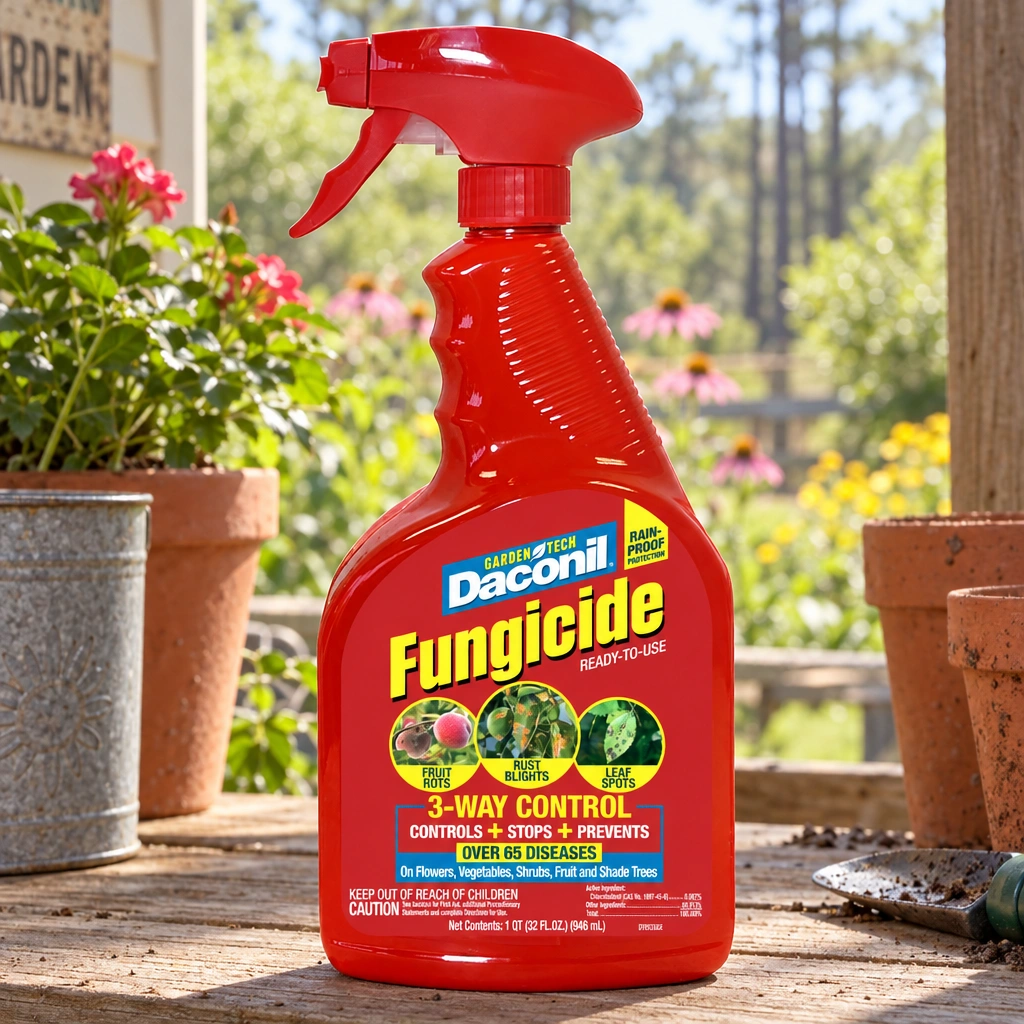
A 32 fl oz trigger sprayer of premixed chlorothalonil for listed outdoor garden plants and fungal diseases.
For fungal disease on garden plants
Daconil Fungicide Ready-to-Use is a premixed chlorothalonil spray for diseases named on its label. GardenTech lists flowers, vegetables, shrubs, fruit and shade trees among its use groups. Examples of listed disease problems include leaf spots, downy mildew, blight, fruit rot and rust. This is a fungicide for matching plant-and-disease combinations, not a remedy for insects, nutrient disorders or noninfectious leaf damage.
A trigger bottle for smaller treatments
The 32-fluid-ounce bottle has a trigger sprayer and is applied without mixing a concentrate. That makes it convenient when a gardener needs to treat a few listed plants or a limited garden area. It differs from the Daconil concentrate, which must be diluted before application. The ready-to-use format removes measuring and mixing, while the concentrate is more practical for preparing a chosen spray volume.
Contact protection needs even coverage
Chlorothalonil acts as a contact fungicide on treated plant surfaces. The label’s plant and disease directions determine what to spray and when, and GardenTech recommends covering all sides of the plant. The trigger bottle suits targeted applications where the user can reach the listed foliage directly. Untreated surfaces and new growth do not receive the same contact coverage, so timing and the label’s repeat-application instructions matter.
Choose by plant and disease
GardenTech’s disease list includes powdery mildew, black spot, downy mildew and several blights, among other named problems. A gardener should identify the plant and likely disease before spraying, then check that both appear in the label directions. The bottle is intended for outdoor plants, though GardenTech says houseplants should be taken outside for spraying and allowed to dry before returning indoors. Its ready-to-use format is suited to direct, small-area application.
A vegetable bed and an ornamental border
For a labeled vegetable disease, the plant entry supplies the treatment schedule and harvest information. An ornamental disease uses its own entry even if the damaged leaves look similar. The trigger bottle lets the gardener move between separated plants without preparing a tank, but that convenience does not combine the disease directions. A rose problem and a tomato problem remain separate decisions based on the plant and diagnosis.
Protectant coverage rather than internal treatment
This ready-to-use formula contains 0.087% chlorothalonil. It places a protective fungicide on the surfaces reached by the spray rather than supplying a systemic treatment through the roots. Expanding leaves and untreated undersides are therefore meaningful parts of coverage. The practical job is reaching the listed plant surfaces at the recommended timing, not simply misting the most visibly damaged spot. The retail label excludes home lawns and specified turf sites.
Directions for use
DIRECTIONS FOR USE It is a violation of Federal law to use this product in a manner inconsistent with its labeling. Application Instructions Shake Well Before Using Read Entire Label and Use Strictly in Accordance with Precautionary Statements and Directions. For any questions regarding disease identification, consult an extension agent, university or local arborist. Personal Protective Equipment (PPE): Wear long-sleeved shirt, long pants and chemical-resistant gloves made of any waterproof material while mixing and applying this product. This product is highly effective for the control of a broad spectrum of vegetable, fruit and ornamental plant diseases when used according to the label directions. Turn sprayer to ‘on’ position. Hold sprayer 8-12 inches from the area to be treated. Spray until surface is wet. Thorough uniform coverage of plant surfaces is essential for good disease control. Turn sprayer to ‘off’ position when application is complete. Keep children and pets off treated area until dry.
Complete product label with site-specific directions, rates, application tables and restrictions: https://www.gardentech.com/-/media/0400331C5D7944A8B671A338F33B34D7.ashx
Cautions
KEEP OUT OF REACH OF CHILDREN
If Swallowed: Have person sip a glass of water if able to swallow. Do not induce vomiting unless told to do so by the poison control center or doctor. Do not give anything by mouth to an unconscious person. Immediately call a poison control center or doctor for treatment advice. If Inhaled: Move person to fresh air. If person is not breathing, call 911 or an ambulance, then give artificial respiration, preferably mouth-to-mouth, if possible. Call a poison control center or doctor for further treatment advice. If on Skin or Clothing: Take off contaminated clothing. Immediately rinse skin with plenty of water for 15-20 minutes. Call a poison control center or doctor for treatment advice. If in Eyes: Hold eye open and rinse slowly and gently with water for 15-20 minutes. Remove contact lenses, if present, after the first 5 minutes, then continue rinsing eye. Call a poison control center or doctor for treatment advice. Have the product container or label with you when calling a poison control center or doctor or going for treatment. You may also contact 1-800-420-9347 for emergency medical treatment information. PRECAUTIONARY STATEMENTS Hazards to Humans and Domestic Animals CAUTION: Harmful if swallowed, inhaled or absorbed through skin. Causes moderate eye irritation. Avoid contact with skin, eyes or clothing. Avoid breathing spray mist. Prolonged or frequently repeated skin contact may cause allergic reactions in some individuals. Remove contaminated clothing and wash clothing before reuse. Wash thoroughly with soap and water after handling. Environmental Hazards This pesticide is toxic to aquatic invertebrates and wildlife. To protect the environment, do not allow pesticide to enter or run off into storm drains, drainage ditches, gutters or surface waters. Applying this product in calm weather when rain is not predicted for the next 24 hours will help to ensure that wind or rain does not blow or wash pesticide off the treatment area. This chemical is known to leach through soil into groundwater under certain conditions as a result of label use. Use of this chemical in areas where soils are permeable, particularly where the water table is shallow, may result in groundwater contamination. This chemical can contaminate surface water through spray drift. Under some conditions it may also have a high potential for runoff into surface water for several days to weeks after application. These include poorly draining or wet soils with readily visible slopes toward adjacent surface waters, frequently flooded areas, areas overlaying extremely shallow ground water, areas with infield canals or ditches that drain to surface water, areas not separated from adjacent surface waters with vegetated filter strips, and areas over-laying tile drainage systems that drain to surface water.
Product Precautions and Restrictions Not for use on plants being grown for sale or other commercial use, commercial seed production or research purposes. For use on plants intended for aesthetic purposes or climatic modification and being grown in interior plantscapes and ornamental gardens or parks. Also for use on fruit trees and vegetables. Do not allow people or pets to enter treated areas until sprays have dried. Do not apply this product in a way that will contact other persons or pets either directly or through drift. Do not use on home lawns and turf sites associated with apartment buildings, daycare centers, playgrounds, playfields, recreational park athletic fields, athletic fields located on or next to schools (i.e., elementary, middle or high schools), campgrounds, churches and theme parks.
Storage and Disposal Pesticide Storage: Store in a cool, dry (preferably locked) place inaccessible to children and pets. Pesticide/Container Handling: Nonrefillable container; do not reuse or refill this container. If empty: Offer for recycling, if available; otherwise, discard in trash. If partly filled: Call your local solid waste agency for disposal instructions. Never place unused product down any indoor or outdoor drain.


 Ask Daisy