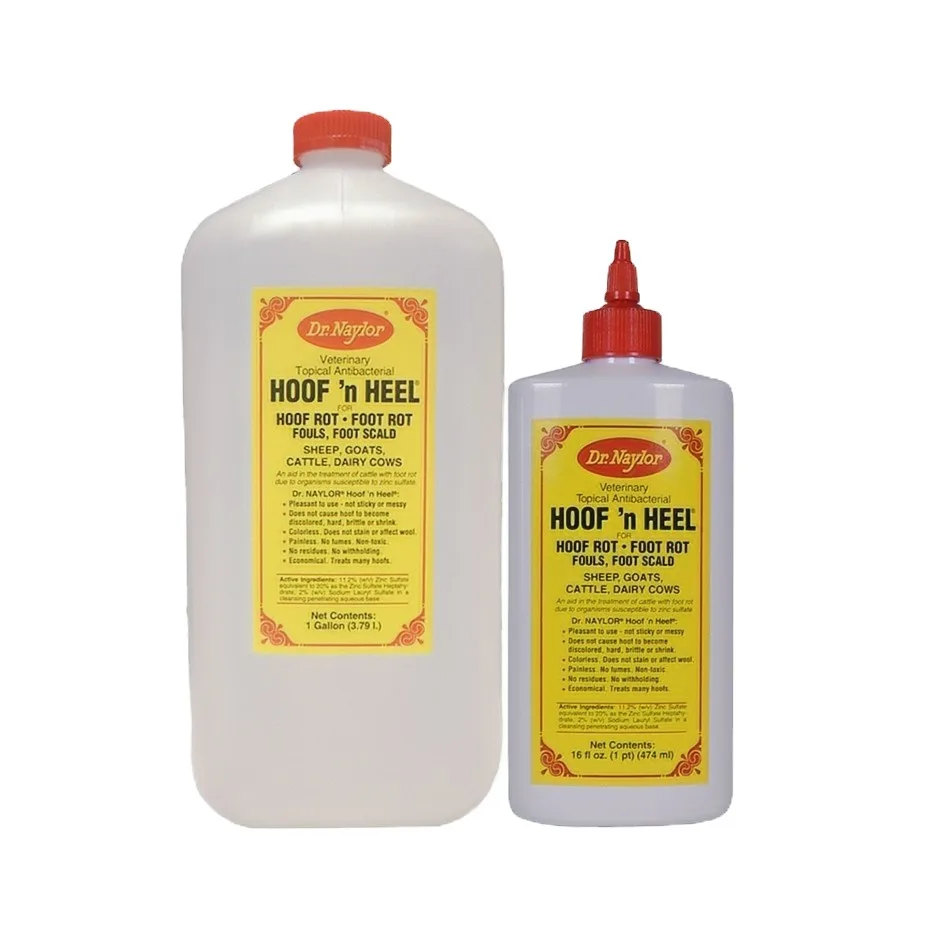
Foot rot does not come from mud. It comes from bacteria that live in the hoof and spread through direct contact, and it waits for warm, wet weather to flare up. Dr. Naylor Hoof 'n Heel drives zinc into the hoof to go after those bacteria, and the zinc stays put instead of washing out with the next rain.
One hour in Hoof 'n Heel puts in the same zinc as six hours in a zinc sulfate solution alone, because the sodium lauryl sulfate in the mix makes the water wetter, so it soaks in faster. It is painless and gives off no fumes, and it leaves no residues and needs no withholding, which makes it a practical product for a flock or herd that needs a steady routine.
Highlights
- For foot rot, hoof rot, thrush and foot scald
- Works six times faster than a zinc sulfate soak alone
- Zinc stays in the hoof instead of rinsing out
- Works as a liquid for individual treatment or as a foot bath
- No residues and no withholding
Why a foot bath routine works
Foot rot is a flock problem as much as a hoof problem. Treating the lame ewe is only half the job, because a carrier can look perfectly sound and still carry the bacteria into the whole flock. A walk-through foot bath gets every animal's feet treated, including the ones that have not shown a sign yet.
Foot rot tends to show up in the spring and fall, when the weather is wet and warm and the pastures turn muddy. Keep a bottle for individual treatment, and set a foot bath where the animals must walk through it every day.
| Species | Horses, sheep, goats, cattle and dairy cows |
|---|
| Use | Foot rot, hoof rot, thrush and foot scald |
|---|
| Active ingredient | Zinc sulfate 11.2% (w/v) |
|---|
| Also contains | Sodium lauryl sulfate 2% (w/v) |
|---|
How to use it
Sort the flock first, then treat each group on its own schedule. Keep the groups apart until treatment is complete.
- Clean and trim affected hoofs to expose and remove all dead, loose, undermined tissue, and control any bleeding first. Slowly squirt Hoof 'n Heel on the lesion while holding the hoof inverted, saturating it and the surrounding area, and let it soak in before you release the animal. Treat twice daily until healing results, and keep the animal in a clean, dry area while it is under treatment.
- Chronically infected animals: treat twice daily with the liquid until healing shows, or soak the feet in a foot bath for one hour, repeated at five-day intervals. Keep treating for at least two five-day intervals after the symptoms are gone.
- Difficult cases: saturate cotton or gauze with the liquid, pack it between the claws and around the hoof, and bandage it. Cover with a sturdy plastic bag or a cut-down plastic bottle. Leave it 24 hours, then repeat for a second 24 hours at five-day intervals.
- Mildly infected animals: treat twice daily with the liquid, or stand them in a foot bath for one hour at five-day intervals. Keep them on ground that has not been used for 14 days, and check their feet often.
- Healthy animals: walk them through a dilute foot bath every day, and move them to a dry, clean area that has not been used for at least 14 days.
Good to know
- Sanitize hoof shears between every hoof, and sanitize boots when you move between pens.
- Treat new animals like mildly infected ones, and keep them apart before they join the flock.
- Rest a pasture at least 14 days before turning treated animals back onto it, since the bacteria can live in warm, moist soil that long.
- At a show or fair, pour the liquid on every hoof daily, and keep the show animals apart from the flock for a week after getting home.
About Dr. Naylor
Dr. Naylor has been making animal health products since 1926. The products are made in New York State, and the company is still family owned.
Cautions
CAUTION: If redness, irritation or swelling persists or increases consult veterinarian. Livestock remedy. Not for human use. For external veterinary use only. Keep out of the reach of children.
Keep a bottle on the shelf before the fall wet season turns the ground soft.

 Ask Daisy