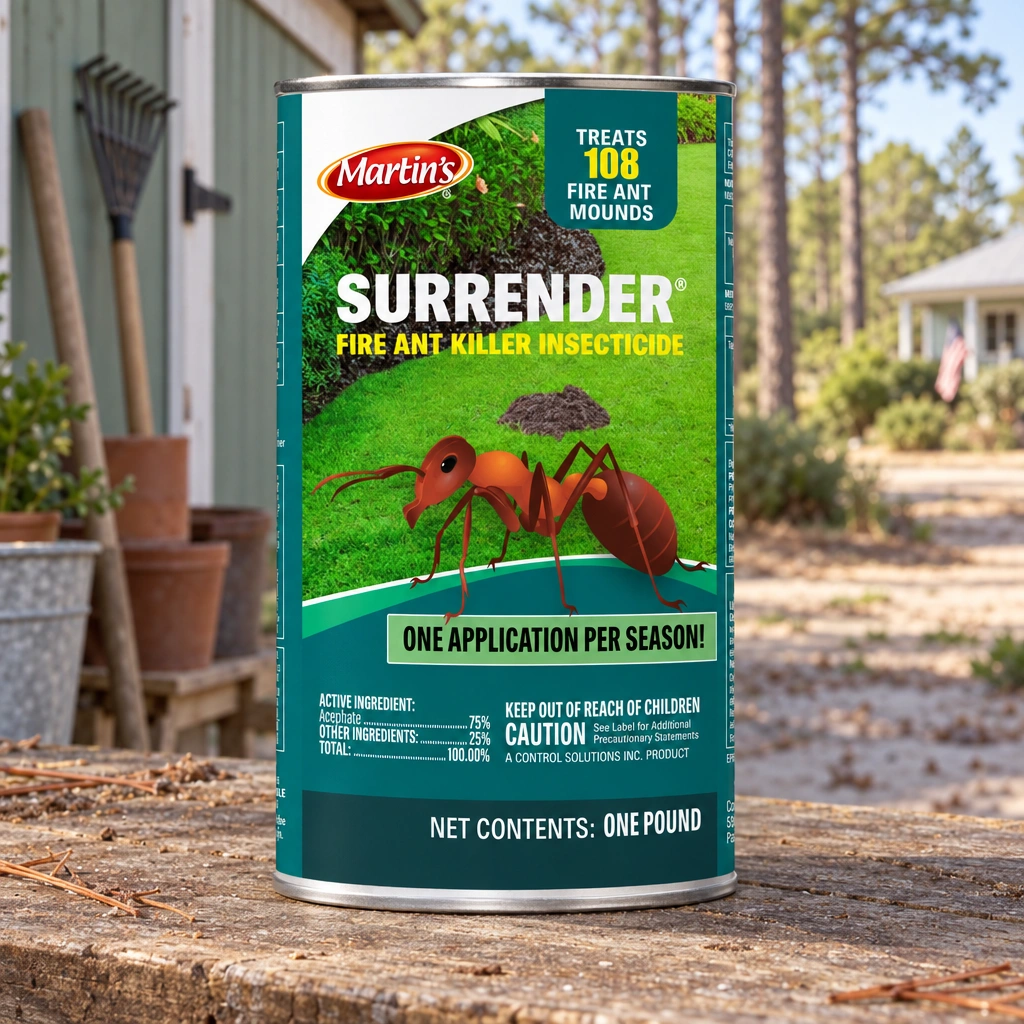
A one-pound, 75% acephate product for fire ant mound treatment in labeled outdoor areas.
A treatment for individual fire ant mounds
Surrender Fire Ant Killer contains 75% acephate in a dry formulation. Its job is mound treatment: the applicator finds a fire ant mound and treats that location. This differs from distributing bait across an entire lawn and waiting for foraging workers to collect it. The visible mound provides the treatment point, making this a useful format when separate colonies can be located across an otherwise usable outdoor area.
Why ant activity changes the result
The retail directions favor early morning or late afternoon, when ants are active near their mounds. During prolonged hot, dry weather, ants may be deeper in the nest and harder to reach. That is a practical reason to choose the treatment window rather than simply apply whenever a mound is noticed. A quiet surface at the hottest part of the day does not necessarily mean the colony has disappeared.
Dry application has its own method
The one-pound container holds dry product, not a finished liquid spray. The retail directions specify evenly distributing one to two teaspoons over the mound. Both the turfgrass and non-crop site tables describe this dry application. This is not a water-drench mixture. The container weight does not describe square-foot coverage, and the treatment can injure grass at the application point. That local effect matters when deciding how to address a mound in an otherwise established lawn.
Understand the mound-count claim
The manufacturer describes one can as treating up to 108 fire ant mounds. That is a maximum count associated with mound treatment, not a promise that every property or every application method will use exactly that amount. It helps compare a container with a known number of visible treatment points. It does not mean the product should be spread across 108 square feet, or that all outdoor ants call for the same treatment.
Where this format fits
The listed outdoor uses include lawns and turfgrass, with other specified locations such as fencerows and ditch banks. A series of visible mounds along a permitted fencerow is a different job from insects feeding on ornamental leaves. Surrender addresses the mound problem directly. Its focused use makes identifying the mound and reaching the treated location more useful purchase considerations than choosing a product by lawn size alone.
Directions for use
DIRECTIONS FOR USE It is a violation of Federal law to use this product in a manner inconsistent with its labeling. READ ENTIRE LABEL. USE STRICTLY IN ACCORDANCE WITH PRECAUTIONARY STATEMENTS AND DIRECTIONS AND WITH APPLICABLE STATE AND FEDERAL REGULATIONS. Do not apply this product in a way that will contact workers or other persons, either directly or through drift. Only protected handlers may be in the area during application. For any requirements specific to your State or T ribe, consult the agency responsible for pesticide regulation. NON-AGRICULTURAL USE REQUIREMENTS The requirements in this box apply to uses of this product that are NOT WITHIN the scope of the Worker Protection Standard for agricultural pesticides (40 CFR Part 170). The WPS applies when this product is used to produce agricultural plants on farms, forests, nurseries or greenhouses. For other non-agricultural areas, do not enter or allow others to enter until dust has settled.
Non crop areas (field borders, fencerows, roadsides, ditchbanks, borrow pits)
USE RESTRICTION Do not treat mound more than once per season.
| CROPS | INSECTS | AMOUNT SURRENDER PER ACRE | FURTHER USE INSTRUCTIONS |
|---|
| Non-Crop Areas | Ants (excluding carpenter and pharoah) | Mound Treatment - Evenly distribute 1 to 2 teaspoons over the mound. | For best results apply the material in the early morning or late afternoon when the ants are most active. Applications made under prolonged hot and dry conditions may be ineffective due to the location of the ants deep within the nest. Grass in treated area may be injured. |
Mound treatment of fire ants and harvester ants in turfgrass
USE RESTRICTIONS Do not treat mound more than once per season.
| PLANT | INSECTS | AMOUNT SURRENDER | TIME OF APPLICATION | APPLICATION RATE |
|---|
| Turfgrass Residential, Recreational and Commercial Turf | Fire Ants and Harvester Ants* Only. | Mound Treatment - Evenly distribute 1 to 2 teaspoons over the mound. | For best results apply the material in the early morning or late afternoon when the ants are most active. Applications made under prolonged hot and dry conditions may be ineffective due to the location of the ants deep within the nest. | Apply the specified amount of SURRENDER as directed. Grass in treated area may be injured. |
*Not registered in California for control of Harvester Ants.
Cautions
FIRST AID Contains an organophosphate that inhibits cholinesterase. If swallowed • Call a poison control center or doctor immediately for treatment advice. • Do not induce vomiting unless told to do so by the poison control center or doctor. • Do not give anything by mouth to an unconscious person. If in eyes • Hold eye open and rinse slowly and gently with water for 15-20 minutes. • Remove contact lenses, if present, after the first 5 minutes, then continue rinsing eye. • Call a poison control center or doctor for treatment advice. If on skin or clothing • Take off contaminated clothing. • Rinse skin immediately with plenty of water for 15-20 minutes. • Call a poison control center or doctor for treatment advice. If inhaled • Move person to fresh air. • If person is not breathing, call 911 or an ambulance, then give artificial respiration, preferably by mouth-to- mouth, if possible. • Call a poison control center or doctor for further treatment advice. Have the product container or label with you when calling a poison control center or doctor, or going for treatment. You may also contact SafetyCall® (866) 897-8050 for emergency medical treatment information NOTE TO PHYSICIAN Acephate is a cholinesterase inhibitor. If signs of cholinesterase inhibition appear, atropine is antidotal. 2-PAM may also be used in conjunction with atropine but should not be used alone. FOR CHEMICAL EMERGENCY: Spill, leak, fire, exposure, or accident, call CHEMTREC 1-800-424-9300 PRECAUTIONARY STATEMENTS Hazards to Humans and Domestic Animals CAUTION Harmful if swallowed. Causes eye irritation. Avoid contact with eyes, skin and clothing. Avoid breathing dust. Wash hands thoroughly after handling. PERSONAL PROTECTIVE EQUIPMENT (PPE): Some materials that are chemical-resistant to this product are listed below. If you want more options, follow the instructions for category A on an EPA chemical-resistance category selection chart. Applicators and other handlers must wear: long-sleeved shirt and long pants; socks and shoes; chemical-resistant gloves made of any water-proof material such as polyethylene or polyvinyl chloride. Discard clothing and other absorbent materials that have been drenched or heavily contaminated with this product’s concentrate. Do not reuse them. Follow manufacturer’s instructions for cleaning/ maintaining PPE. If no such instructions for washables, use detergent and hot water. Keep and wash PPE separately from other laundry. USER SAFETY RECOMMENDATIONS Users should: • Wash hands before eating, drinking, chewing gum, using tobacco or using the toilet. • Remove clothing immediately if pesticide gets inside. Then wash thoroughly and put on clean clothing. • Remove PPE immediately after handling this product. Wash the outside of gloves before removing. As soon as possible, wash thoroughly and change into clean clothing.. ENVIRONMENTAL HAZARDS Do not apply directly to water or to areas where surface water is present or to intertidal areas below the mean high water mark. Do not contaminate water when cleaning equipment or disposing of equipment washwaters. Exposed treated seed may be hazardous to birds and other wildlife. Dispose of all excess treated seed and seed packaging by burial away from bodies of water. This product and its degradate are highly toxic to bees exposed to direct treatment on blooming crops or weeds. Do not apply this product or allow it to drift to blooming crops or weeds while bees are actively visiting the treatment area. This pesticide is toxic to birds.
PESTICIDE STORAGE AND DISPOSAL Do not contaminate water, food or feed by storage, disposal or cleaning of equipment. Open dumping is prohibited. PESTICIDE STORAGE: Keep pesticide in original container. Do not put concentrated or dilute product into food or drink containers. Store in cool, dry place. Protect from excessive heat. Do not contaminate food or feedstuffs. Do not store or transport near feed or food. PESTICIDE DISPOSAL: Wastes resulting from the use of this product must be disposed of on site or at an approved waste disposal facility. CONTAINER HANDLING: Non-refillable container. Do not reuse or refill this container. Empty container through use according to label instructions. Do not rinse unless required for recycling. Offer for recycling, if available. If recycling is not available; then dispose of container in a sanitary landfill or, if allowed by State and local authorities, by burning. If burned, stay out of smoke.

 Ask Daisy