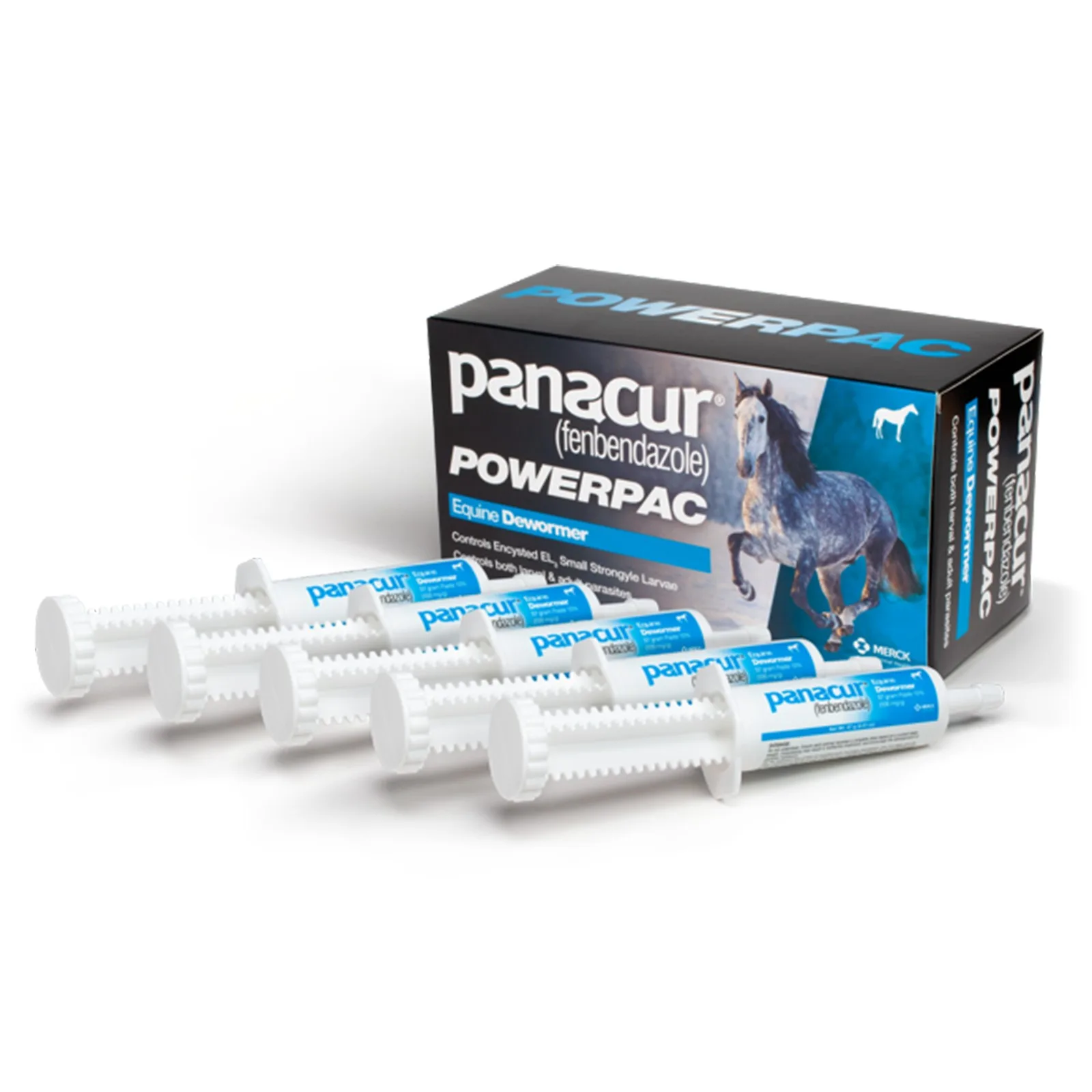
Deworming day should cover the tough stuff, not just the easy worms. PANACUR (fenbendazole) Paste 10% in the POWERPAC pack is indicated for the control of large strongyles, small strongyles, pinworms and ascarids, and for arteritis caused by fourth stage larvae of Strongylus vulgaris in horses.
It is safe for foals, pregnant mares and older horses at the standard dose. The five-day larvicidal dose has not been evaluated in stallions or pregnant mares, so plan that course with your vet. A larvicidal dose handles the encysted stages that are hard to reach, and the paste works by inhibiting energy metabolism in the parasite.
Highlights
- Safe for foals, pregnant mares and older horses
- Controls large and small strongyles, pinworms and ascarids
- Larvicidal dose for encysted small strongyles
- Covers migrating larvae of Strongylus vulgaris
- Used as part of a strategically designed anthelmintic program
Why choose a paste dewormer
Worms do not all behave the same way. Some live in the gut, some curl up inside the gut wall as encysted larvae and wait, and pinworms cause itching around the tail. A paste that covers several parasite types in one dose means one syringe handles a wide range of worms, so you are not guessing which one is in the horse on a given day.
It fits the way a working barn runs. The five syringes in the pack cover a five-day larvicidal course for a horse up to 1,250 lb, so the whole course is on the shelf when you start. It fits best inside a program your vet sets up, with a fecal egg count to show which worms are present and how many.
At a glance
| Active ingredient | Fenbendazole 10% |
|---|
| Form | Oral paste in a syringe |
|---|
| Species | Horses |
|---|
| Controls | Large and small strongyles, pinworms and ascarids |
|---|
| Encysted stages | Larvicidal dose for early third, late third and fourth stage cyathostome larvae |
|---|
| Safety | Foals, pregnant mares and older horses |
|---|
| Approval | NADA 120-648 |
|---|
How to use it
- Weigh or tape-measure the horse before you dose, so the amount matches the animal and not a guess.
- Check the expiration date on the syringe before you open it.
- For encysted small strongyles and fourth stage Strongylus vulgaris larvae, give 4.6 mg/lb (10 mg/kg) daily for 5 consecutive days: one syringe for each 1,250 lb of body weight per day. For large strongyles, small strongyles and pinworms, the dose is 2.3 mg/lb (5 mg/kg), and one syringe deworms two 1,250 lb horses.
- Make sure the horse's mouth is free of food, insert the nozzle through the space between the teeth and deposit the paste on the back of the tongue.
- Keep the syringe capped and out of the sun between uses.
- Write the date and the horse in the barn log, so the next dose falls on schedule.
Good to know
- Use it as part of a strategic deworming program, especially where fenbendazole resistance has shown up before. Plan that with your vet.
- Ask your vet to run a fecal egg count. The count shows which worms are present and how heavy the load is, so you deworm on what the horses carry, not only on the calendar.
- Rotating dewormer classes is a decision for your vet, not a habit to start on your own.
- Each horse gets its dose by its own weight, and the five-day course means one dose every day for five days in a row.
Cautions
Consult your veterinarian for the diagnosis, treatment and control of parasitism.
Do not use in horses intended for human consumption.
NOT FOR USE IN HUMANS. KEEP OUT OF REACH OF CHILDREN.
The recommended dose for control of 4th stage Strongylus vulgaris larvae, 4.6 mg/lb (10 mg/kg) daily for 5 consecutive days, has not been evaluated for safety in stallions or pregnant mares.
Have it on hand when your vet's deworming plan calls for a larvicidal dose.


 Ask Daisy