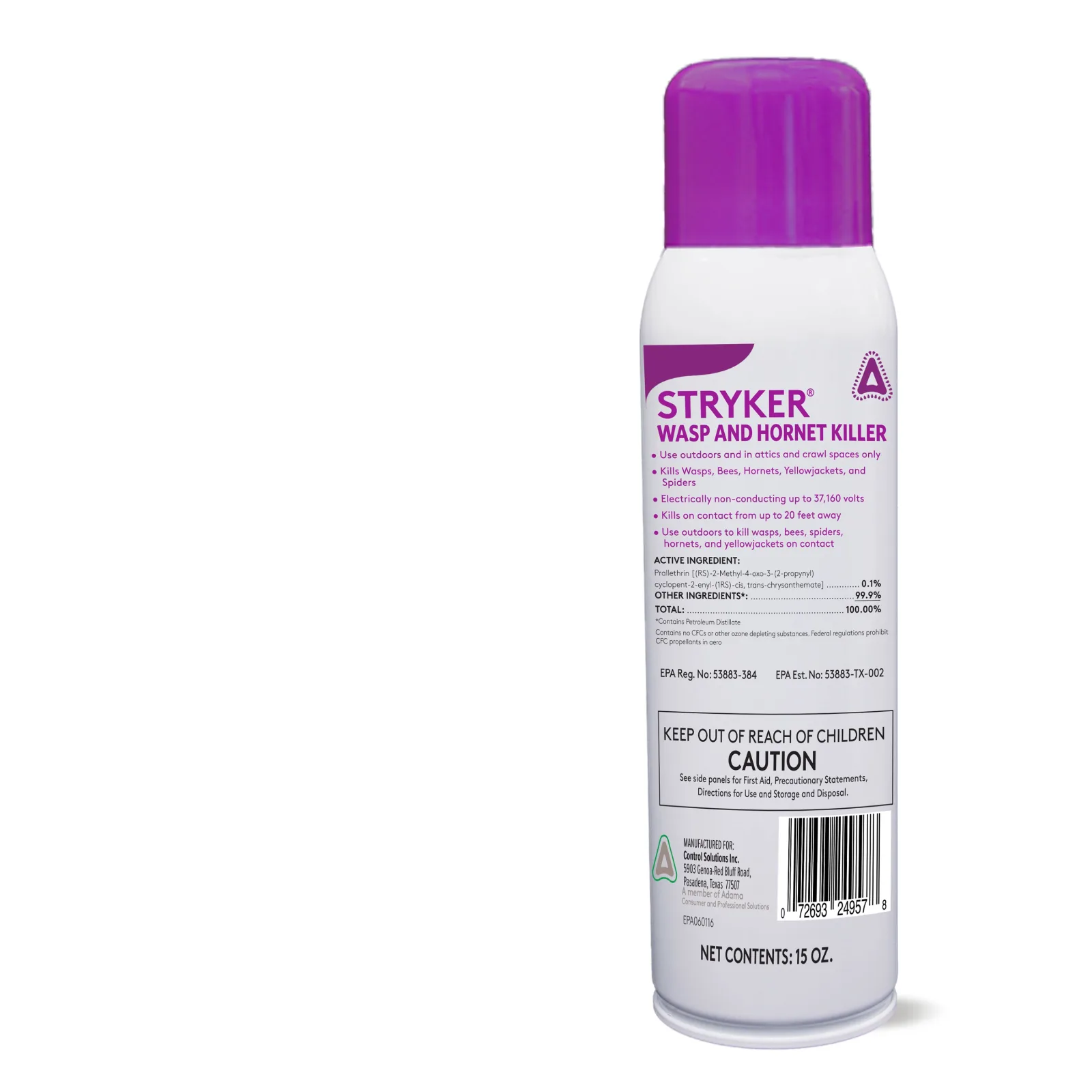
A wasp nest in the eave or the attic is a job you want done quickly and from a distance. This aerosol kills on contact from up to 20 feet away, and it knocks hornets and wasps down before they can release their stinging pheromones.
It is ready to use with no mixing, and it also kills spiders, including brown recluse and black widow. The formula is electrically non-conductive up to 37,160 volts, which matters when a nest sits near wiring or a light fixture.
Highlights
- Kills on contact from up to 20 feet
- Fast knockdown before wasps can release stinging pheromones
- Kills spiders, including brown recluse and black widow
- Electrically non-conductive up to 37,160 volts
- Ready to use with no mixing
What it's for
Nests turn up in the worst places: under the eave above the back step, in a gap in the soffit, or in the attic where you only find out when wasps come through a vent. A spray that reaches 20 feet lets you treat the nest from the ground.
It suits the homeowner with a porch, a shed or a carport, the farm family with barn eaves and fence lines to keep clear, and anyone who works in crawl spaces or attics, where a nest or a spider can go unnoticed. Treat wiring and fixtures as live until you have checked them.
At a glance
| Active ingredient | 0.1% Prallethrin |
|---|
| EPA Reg. No. | 53883-384 |
|---|
| Form | Ready-to-use aerosol |
|---|
| Use sites | Outdoors, attics and crawlspaces |
|---|
| Effective against | Wasps, bees, hornets, yellowjackets and spiders |
|---|
| Spray reach | Up to 20 feet |
|---|
| Non-conductive | Up to 37,160 volts |
|---|
| Spiders | Brown recluse and black widow |
|---|
How to use it
Treat nests in the evening or early morning, when the wasps are gathered at the nest and less active. Stand 6 to 15 feet from the nest, not directly underneath it, with the wind at your back, and keep the path behind you clear. Use it only where the directions allow: outdoors, in attics and in crawl spaces.
- Find the nest and its entrance, and check how far you can stand back.
- Hold the can upright, aim at the nest and spray until the nest is thoroughly wet, hitting any wasps or hornets on it.
- For spiders, including black widow and brown recluse, spray the spider and its web directly, and check what surfaces the spray will land on, since it can stain.
Good to know
- Keep a spare can on a cool, dry shelf so a nest meets a ready can. Heat above 130°F can burst an aerosol, so never leave one in a hot attic or a closed truck.
- Pair it with a flashlight for checking the eaves, the soffit and the attic vents at dusk.
- Store the can away from heat and out of reach of children and pets.
- Test a small hidden spot first when you spray near shingles or asphalt, since the spray can stain or darken them.
Replace the can when the spray starts to sputter, because a weak jet won't reach a nest up high.
About Stryker
Stryker is a line from Control Solutions Inc., a hybrid company based in Pasadena, Texas. Its divisions, including Quali-Pro and CSI Pest, cover pest management, turf and ornamental, animal health and consumer products.
Cautions
Use outdoors and in attics and crawl spaces only. When using in an attic, do not contaminate stored items, HVAC systems, water heaters or other non-structural items.
KEEP OUT OF REACH OF CHILDREN. CAUTION: Causes moderate eye irritation. Avoid contact with eyes, skin or clothing. Wash thoroughly with soap and water after handling and before eating, drinking, chewing gum, using tobacco or using the toilet. Remove contaminated clothing and launder before reuse.
Flammable. Contents under pressure. Keep away from heat, sparks and open flame. Do not puncture or incinerate containers. Exposure to temperatures above 130°F may cause bursting.
Do not apply directly to water or to areas where surface water is present or to intertidal areas below the mean high water mark. This pesticide is toxic to bees exposed to direct treatment on blooming crops or weeds. Do not apply this product or allow it to drift to blooming crops or weeds while bees are foraging the treatment area.
Grab a can now, before the next nest turns up at dusk.




 Ask Daisy