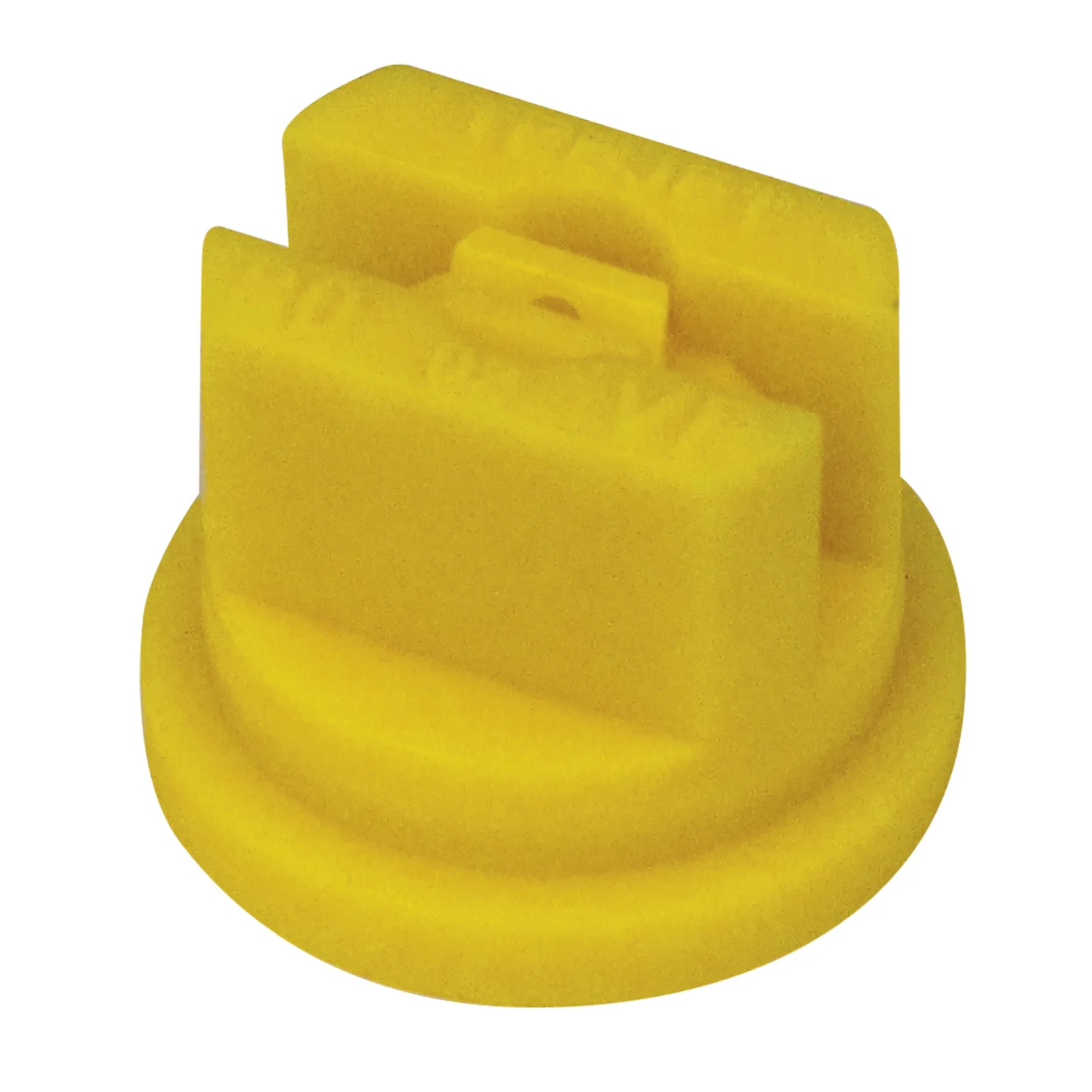
Get an even broadcast spray pattern from a tip built for uniform coverage. The tapered-edge flat fan lays down a pattern whose edges taper off, so neighboring fans overlap evenly along the boom and you don't end up with stripes of heavy and light spray across the field.
The 80 degree spray angle gives a wide, even fan, and the polymer body keeps the cost down for everyday spraying. It is the tip to reach for when you are covering ground and want the pattern to behave the same from one end of the boom to the other.
Highlights
- Tapered-edge flat fan for uniform broadcast coverage
- 80 degree spray angle
- Polymer construction for everyday spraying
- Model TP8002VP
- Lower-cost tip for general broadcast work
- Helps neighboring fans overlap evenly
What it's for
Broadcast spraying covers a field, a pasture or a lawn with a boom of nozzles running at the same time. Each tip has to put out the same pattern as its neighbors, or the ground gets stripes. Flat fan tips are the standard for that job, because the fan spreads spray across the boom width in a predictable pattern.
An 80 degree fan needs a little more boom height than a wider 110 degree fan to reach full overlap at the same nozzle spacing. Set the boom height to match the angle and the nozzle spacing, and the fans overlap into one even coat.
It suits a farm rig running a broadcast boom, a lawn care operator who sprays large open turf, a hobby farmer with a field sprayer, and anyone who wants an even pattern without guessing at the setup.
At a glance
| Material | Polymer |
|---|
| Pattern | Tapered-edge flat spray |
|---|
| Spray angle | 80 degrees |
|---|
| Tip number | TP8002VP |
|---|
How to use it
- Match the tip to the nozzle body and cap you have. A tip only fits the body and cap made to hold it.
- Set boom height from a spacing and angle chart, so the fans overlap across the full width.
- Check the output and pattern with clean water before you spray a field.
- Keep the tip clean and dry in storage, and use the same tip on every nozzle in a bank so the pattern matches.
Good to know
- Choose the body for the job. Polymer tips are the lower-cost option. For abrasive products, such as wettable powders, ceramic and stainless tips last longer.
- Clean with care. Use a soft brush and water. Don't push wire or pins into the opening, because that can damage the orifice and change the pattern.
- Replace on wear. A tip that puts out a stripy pattern, changes output or has a chipped orifice is ready for a new one.
- Keep a strainer in the line. A screen keeps grit out of the tip, and grit is a common way a tip clogs.
About TeeJet
TeeJet traces its roots to 1937, when Spraying Systems Co. was founded in a Chicago garage. The TeeJet name comes from the tee shape of its spray tip, and its products have been part of farm spraying since crop protection products first came to market in the 1940s.
Keep a spare on hand for the next pass across the field.

 Ask Daisy