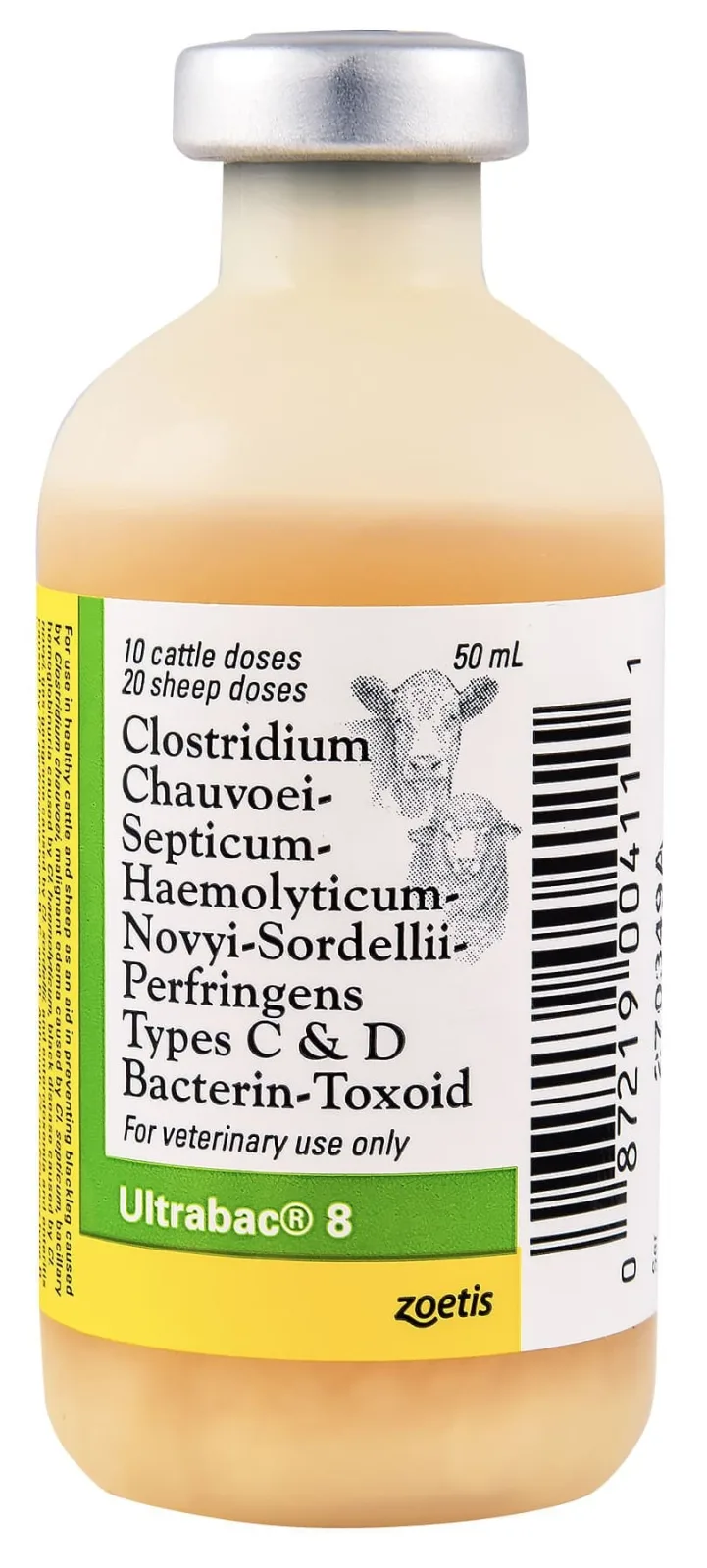
Clostridial diseases can strike fast, which is why many cattle and sheep operations keep a clostridial vaccine in the herd health plan. ULTRABAC 8 is for healthy cattle and sheep, and it aids in preventing disease caused by several Clostridium organisms, including Cl. perfringens types B, C and D.
It is made from killed, standardized cultures of the Clostridium organisms, with an adjuvant. Killed vaccines contain no live organisms, and the adjuvant is there to help the immune response.
It fits a cow-calf herd, a stocker operation or a sheep flock where you would rather plan a vaccine than treat a loss. Clostridium organisms live in soil and manure, so pastures and lots can hold them.
Highlights
- For healthy cattle and sheep
- Aids in preventing clostridial disease
- Killed, standardized cultures
- Adjuvant included
- Covers several Clostridium species, including Cl. perfringens types B, C and D
- Fits a planned herd health schedule
Why a killed clostridial vaccine
Killed vaccines work differently from modified live ones. Nothing in the bottle is alive, and killed vaccines are generally kept cold until they are used.
Clostridial organisms are soil bacteria, so a pasture or a lot can keep them around. Vaccination is the planned step, taken while the animals are healthy and the herd is on a set schedule.
It suits the cattle producer who wants one vaccine that covers several clostridial organisms, and the sheep flock where a lost animal is hard to make up.
At a glance
| Use | Healthy cattle and sheep |
|---|
| Formulation | Killed, standardized cultures with an adjuvant |
|---|
| Disease coverage | Clostridium chauvoei, Cl. septicum, Cl. haemolyticum, Cl. novyi, Cl. sordellii, and Cl. perfringens Types B, C and D |
|---|
| Dose | Cattle 5 mL SC, sheep 2 1/2 mL SC, second dose 4-6 weeks later |
|---|
| Slaughter withdrawal | Do not vaccinate within 21 days before slaughter |
|---|
| License | U.S. Veterinary License No. 190 |
|---|
How to use it
Ask your vet to set the vaccination schedule for your herd or flock, then:
- Use a clean, sterilized needle and syringe for each animal.
- Keep the vaccine cold, out of sunlight and never frozen, from pickup to the chute.
- Cattle: Aseptically administer 5 mL subcutaneously, followed by a second dose 4-6 weeks later. In accordance with Beef Quality Assurance guidelines, this product should be administered SC under the skin. Sheep: Aseptically administer 2 1/2 mL subcutaneously, followed by a second dose 4-6 weeks later. Mix well before use. For information on revaccination and in the face of Cl. haemolyticum exposure, contact your veterinarian.
- Record the date and the lot number for each animal or group.
Good to know
Vaccines must stay cold, so we don't ship them. Pick yours up at the store in Baker.
- Pair it with fresh needles and syringes from the same aisle, and keep a sharps container for used needles.
- Plan boosters on the calendar with your vet, since the timing depends on the herd.
- Keep the lot number in your records for each group, so a question about a vaccinated group has an answer.
About Zoetis
Zoetis makes animal health medicines, vaccines and diagnostics for veterinarians and livestock producers.
Cautions
Store at 2°-8°C. Do not freeze. Use entire contents when first opened. Do not vaccinate within 21 days before slaughter. Contains formalin as a preservative. This product has not been tested in pregnant animals. As with many vaccines, anaphylaxis may occur after use. Initial antidote of epinephrine is recommended and should be followed with appropriate supportive therapy. Do not mix with other products. In case of human exposure, contact a physician.
Set the calendar now, so the next crop of calves and lambs has a plan before pasture season.

 Ask Daisy