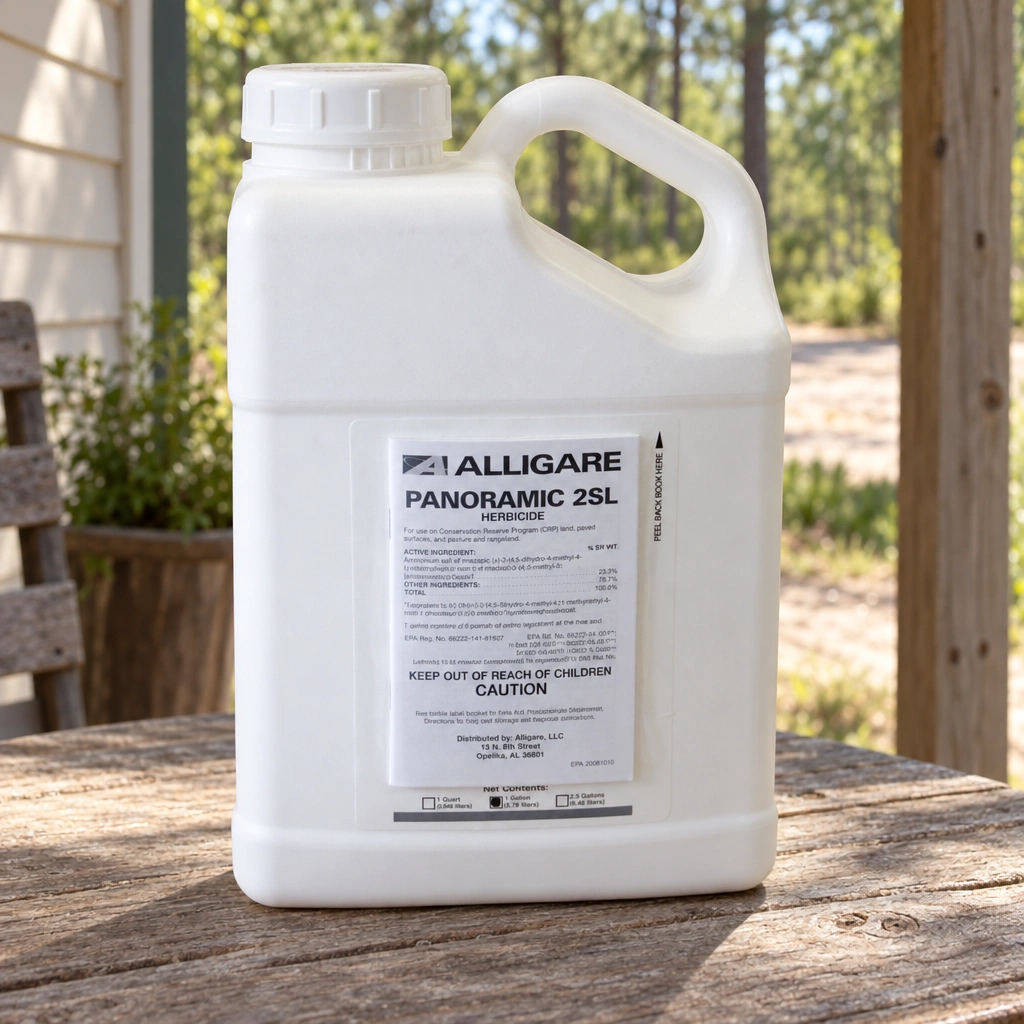
Alligare Panoramic 2SL is an imazapic herbicide for labeled pasture, rangeland and non-cropland sites. Match the target weed and treatment area to the current label.
For pasture and non-cropland weed control
Alligare Panoramic 2SL is a liquid imazapic herbicide for labeled weed-control and turf-height-suppression uses. The label includes sites such as pasture, rangeland, roadsides, rights-of-way and Conservation Reserve Program land. It names targets including leafy spurge, cheatgrass, sandbur and johnsongrass. A match on the weed alone is not enough. Confirm that both the target and the treatment site appear in the current directions before choosing the product. This jug is a concentrate, so application rates come from the label for the specific site and method.
Make site selection part of the decision
Panoramic is used across managed areas where the goal can range from suppressing unwanted growth to protecting an established grass planting. A roadside, a pasture and a CRP field call for different treatment decisions. Start by identifying the vegetation you want to control and the grass or habitat you want to retain. Then check the label for that exact use, including application timing and any site restrictions. The product’s broad target list is a starting point for selection, not a substitute for the directions tied to the location.
Plan for resistance management
Panoramic belongs to Group 2. Repeated use of herbicides with the same mode of action can favor resistant weed populations, and the label describes that risk. A management plan can include scouting before treatment, checking results afterward, and rotating to an effective herbicide with a different site of action when that product is labeled for the same use. The point is to keep a single tool from carrying the entire weed-control program year after year. Choose any rotation partner from its own label, not from a generic assumption that two products can be mixed or substituted.
Use the full directions for each application
The current label supplies the use rates, methods, protective equipment, restrictions and application conditions. Review it for the specific site and target before preparing a spray plan. It also covers drift reduction, resistance management and environmental restrictions. The Alligare product page lists Florida among the states where the product is registered; check current state requirements alongside the federal label for the intended use. The one-gallon size is the retail package. It does not determine how much product to apply or how many acres a treatment will cover.
Composition and use-site rates
Alligare Panoramic 2SL Herbicide, imazapic, Group 2. Ammonium salt of imazapic 23.3% by weight; other ingredients 76.7%; total 100%. One gallon contains 2.0 lb active ingredient as free acid. EPA Reg. No. 66222-141-81927.
Directions for use
Follow the complete current manufacturer label for the intended site and target: https://alligare.com/wp-content/uploads/2024/06/Panoramic-2SL-2.5Gal-Book_customer-copy.pdf. The rates below are only the label's bermudagrass pasture and hay meadow tables. Do not apply them to another site. The label requires complete bermudagrass green-up and complete spray coverage. It says growth may be suppressed for 30-45 days depending on conditions and Jiggs bermudagrass is more sensitive.
Postemergent summer annual grasses in bermudagrass pasture and hay meadow
| Common name | Species | Weed height | Rate per acre |
|---|
| Large crabgrass | Digitaria sanguinalis | 4 in or less | 4 fl oz (0.06 lb ae) |
| Large crabgrass | Digitaria sanguinalis | Over 4 in | 6 fl oz (0.09 lb ae) |
| Southern crabgrass | Digitaria ciliaris | 4 in or less | 4 fl oz (0.06 lb ae) |
| Southern crabgrass | Digitaria ciliaris | Over 4 in | 6 fl oz (0.09 lb ae) |
| Smooth crabgrass | Digitaria ischaemum | 4 in or less | 4 fl oz (0.06 lb ae) |
| Smooth crabgrass | Digitaria ischaemum | Over 4 in | 6 fl oz (0.09 lb ae) |
| Giant foxtail | Setaria faberi | All listed heights | 6 fl oz (0.09 lb ae) |
| Green foxtail | Setaria viridis | 4 in or less | 4 fl oz (0.06 lb ae) |
| Green foxtail | Setaria viridis | Over 4 in | 6 fl oz (0.09 lb ae) |
| Yellow foxtail | Setaria glauca | 4 in or less | 4 fl oz (0.06 lb ae) |
| Yellow foxtail | Setaria glauca | Over 4 in | 6 fl oz (0.09 lb ae) |
| Texas panicum | Panicum taxanum | All listed heights | 6 fl oz (0.09 lb ae) |
| Fall panicum | Panicum dichotomiflorum | All listed heights | 6 fl oz (0.09 lb ae) |
| Broadleaf signalgrass | Bracharia platyphylla | 4 in or less | 4 fl oz (0.06 lb ae) |
| Broadleaf signalgrass | Bracharia platyphylla | Over 4 in | 6 fl oz (0.09 lb ae) |
| Annual jewgrass | Microstegium vimineum | 4 in or less | 4 fl oz (0.06 lb ae) |
| Annual jewgrass | Microstegium vimineum | Over 4 in | 6 fl oz (0.09 lb ae) |
| Barnyardgrass | Echinchloa crus-galli | 4 in or less | 4 fl oz (0.06 lb ae) |
| Barnyardgrass | Echinchloa crus-galli | Over 4 in | 6 fl oz (0.09 lb ae) |
| Sandbur | Cenchrus spp. | 4 in or less | 4 fl oz (0.06 lb ae) |
| Sandbur | Cenchrus spp. | Over 4 in | 6 fl oz (0.09 lb ae) |
Label footnotes: (1) Be sure bermudagrass has completely greened up; application too early could delay green-up and subsequent growth. If delayed green-up will be an issue, do not apply. (2) Use the higher rate when summer annual grasses are older, larger or have been subjected to multiple cuttings.
Postemergent summer perennial grasses in bermudagrass pasture and hay meadow
| Common name | Species | Weed height | Rate per acre |
|---|
| Johnsongrass | Sorghum halepense | 18-24 in | 8 fl oz (0.13 lb ae) |
| Johnsongrass | Sorghum halepense | Over 24 in | 12 fl oz (0.19 lb ae) |
| Vaseygrass | Paspalum urvillei | 4-8 in | 6-8 fl oz (0.09-0.13 lb ae) |
| Nutsedge | Cyperus spp. | 4 in or less | 4 fl oz (0.06 lb ae) |
| Nutsedge | Cyperus spp. | Over 4 in | 6 fl oz (0.09 lb ae) |
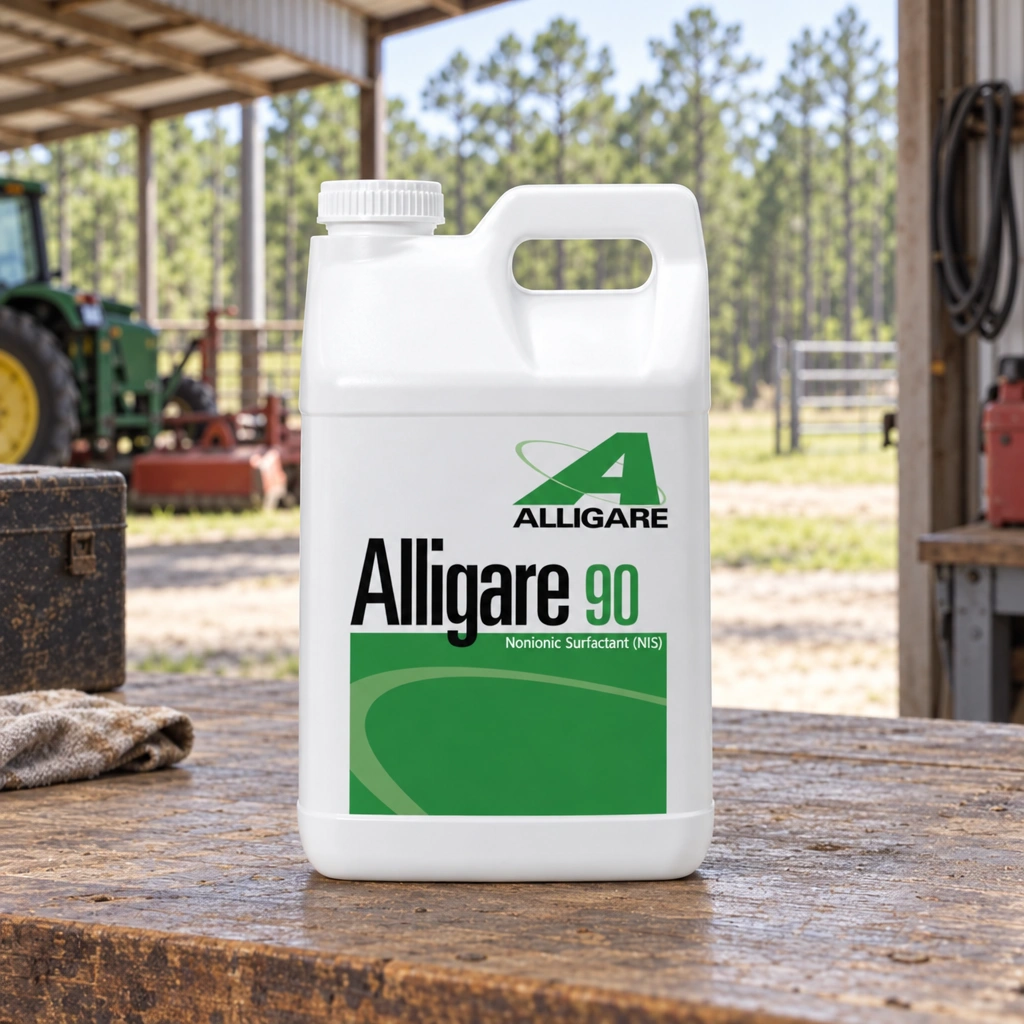
Mixing with water: Fill the spray tank at least one-half full of clean water. With the pump and agitator running, add the specified amount using a calibrated measuring device. Fill the tank with remaining water and add surfactant near the end. Add antifoam if needed. Maintain agitation while spraying. For a permitted tank mix, follow the most restrictive label, do not exceed label rates, and add dry formulations first, emulsifiable concentrates next, Panoramic 2SL next, and spray adjuvants last. Do not tank mix if another product label prohibits it. For postemergence use, add an adjuvant except when liquid fertilizer is the spray carrier. The label's preferred MSO is 1.5-2 pints per acre; at spray volumes over 30 gallons per acre, use 1% of total spray volume. The alternative NIS rate is 0.25% v/v or higher. Do not use MSO on newly emerged seedling prairiegrass or wildflowers.
Cautions
CAUTION. Keep out of reach of children. Causes moderate eye irritation. Avoid breathing spray mist and contact with skin, eyes or clothing. Wash thoroughly with soap and water after handling and before eating, drinking, chewing gum or using tobacco. Applicators and handlers must wear: long-sleeved shirt and long pants; chemical-resistant gloves made of any waterproof material; shoes plus socks. Wash PPE separately using detergent and hot water when the manufacturer's instructions are not available. Users should wash after handling; remove clothing immediately if pesticide gets inside, wash, and put on clean clothing; wash the outside of gloves before removing PPE, then wash and change as soon as possible. First aid: Eyes: hold eye open and rinse slowly and gently with water for 15-20 minutes; remove contact lenses after the first 5 minutes, then continue rinsing; call a poison control center or doctor. Inhaled: move to fresh air; if not breathing, call 911 or an ambulance and give artificial respiration, preferably mouth-to-mouth; call a poison control center or doctor. Skin or clothing: remove contaminated clothing, rinse skin immediately with plenty of water for 15-20 minutes, and call a poison control center or doctor. Swallowed: call a poison control center or doctor immediately; have the person sip water if able; do not induce vomiting unless directed; give nothing by mouth to an unconscious person. Have the container or label available. Prosar emergency medical treatment information: 1-877-250-9291. Environmental hazards: Do not apply directly to water, areas with surface water or intertidal areas below mean high water. Do not contaminate water when cleaning equipment or disposing of rinsate. The product is toxic to plants and may affect forage and habitat of non-target organisms, including pollinators, adjacent to treated sites; follow drift directions. Avoid application where rainfall or irrigation is expected within 48 hours to reduce runoff. Restricted-entry interval: 12 hours for agricultural uses covered by the Worker Protection Standard. For early entry permitted under WPS, wear coveralls, waterproof chemical-resistant gloves, shoes and socks. For non-agricultural noncrop uses, do not enter treated areas without protective clothing until sprays have dried. Storage and disposal: Do not contaminate water, food or feed. Keep from freezing; do not store below 20°F. Dispose of pesticide waste on site or at an approved facility. The container is nonrefillable and must not be reused or refilled. Offer for recycling if available. Clean promptly after emptying; triple rinse: drain into equipment or mix tank for 10 seconds after flow begins to drip; fill one-quarter with water, recap, shake 10 seconds, pour rinsate into equipment or store it for use or disposal, drain for 10 seconds, and repeat twice. Then recycle/recondition, puncture and landfill, incinerate, or burn if state and local authorities allow. Stay out of smoke if burned. The full label includes detailed drift restrictions and all other use-site tables.

 Ask Daisy