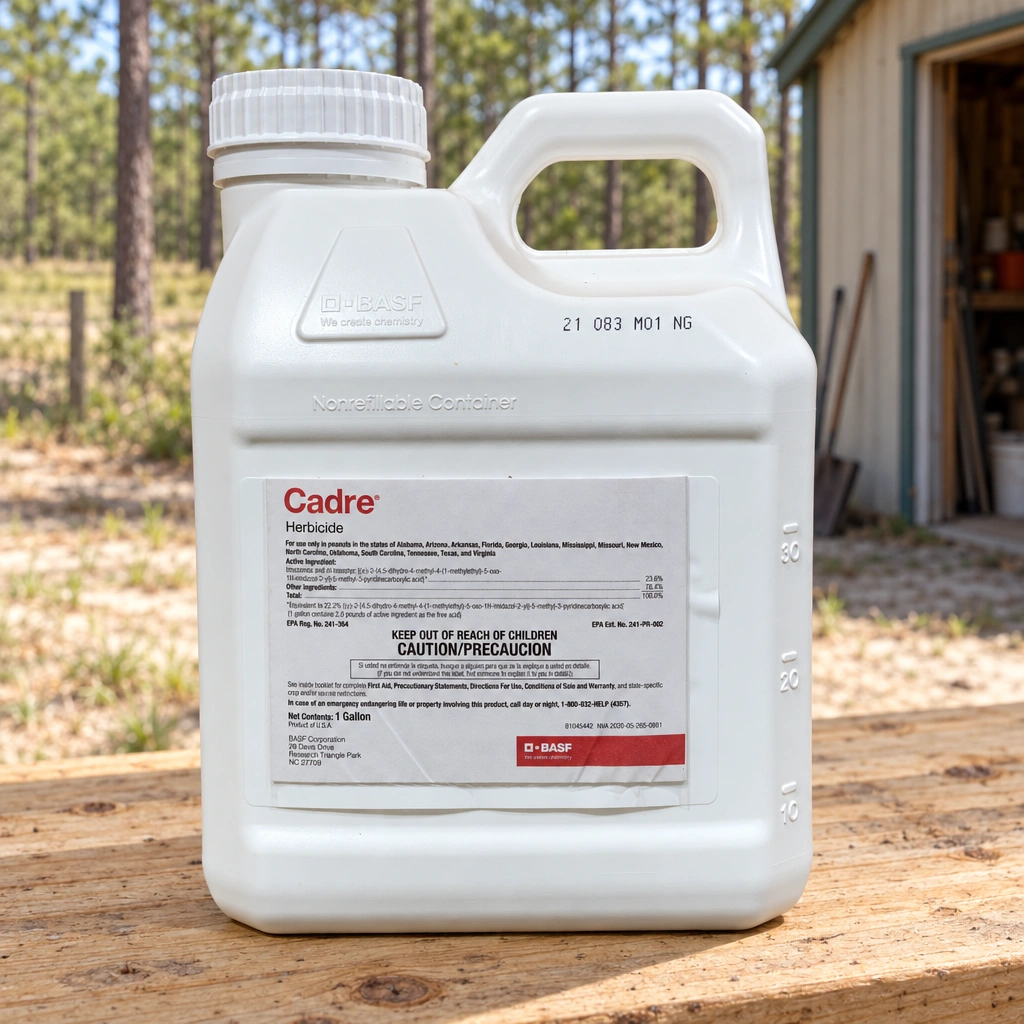
An imazapic herbicide for early postemergence weed control in peanuts. This is the one-gallon jug.
A peanut herbicide with a specific job
Cadre is made for weed control in peanuts. It can control or suppress listed broadleaf weeds and grasses, including certain sedges, when applied at the growth stages on its label. This is not a general pasture or lawn herbicide. Start with the crop and state named on the label, then identify the weed. The distinction between control and suppression matters: a weed listed for suppression should not be treated as a promise of complete control. The maker label sets a maximum application height for each listed target.
Treat the weed while it is small
The label calls for early postemergence application. That means scouting before weeds become too large, rather than waiting for a field to look badly infested. Cadre enters susceptible weeds through roots or foliage and moves to their growing points. Growth can stop before the plant is completely dead, so immediate appearance does not tell the whole story. Soil moisture also affects performance and residual activity. Use the label chart to check the actual species and height, then follow its application instructions for the field conditions.
Keep the adjuvant and sprayer settings together
Cadre requires the appropriate spray adjuvant. The label has different adjuvant directions for different regions, so do not carry a rate from another state into the mix plan. Its ground-application section also specifies spray volume and equipment requirements. Measure the product for the treated acreage using a calibrated device and maintain agitation as directed. This one-gallon jug is the retail package, not a ready-to-spray mixture. Buying the jug does not remove the need to calculate the amount for the actual treated area.
Plan the crop that comes next
A peanut treatment can affect the next planting decision. Cadre has rotational-crop intervals, with additional conditions for some crops and states. Check those before spraying if the field is scheduled to return to another crop. Keep the treatment date and location in the field record so the interval can be followed later. Group 2 resistance is another reason to review the whole program. Scout after treatment and investigate surviving patches instead of assuming another application of the same mode of action will solve the problem.
Formulation
Ammonium salt of imazapic 23.6%; other ingredients 76.4%; total 100.0%. Equivalent to 22.2% imazapic acid, with 2.0 lb of active ingredient as free acid per gallon. Group 2. EPA Reg. No. 241-364.
Directions for use
Cadre is labeled for early postemergence use on peanuts in Alabama, Arizona, Arkansas, Florida, Georgia, Louisiana, Mississippi, Missouri, New Mexico, North Carolina, Oklahoma, South Carolina, Tennessee, Texas and Virginia. The rate is 4.0 fluid ounces per acre, plus an approved spray adjuvant. The label caps use at 4.0 fluid ounces per acre per application and per season, and sets a 90-day interval before peanut harvest. These weed heights are target limits, not product rates.
Ground mixing and application
Fill the spray tank one-half to three-quarters full with clean water. Measure Cadre with a calibrated device, add it while agitating, then fill the tank with water. Add the label-approved adjuvant and maintain agitation. Do not apply if wind, temperature inversions, or other conditions could move spray onto adjacent sensitive crops. Rainfall within three hours may reduce control. Apply with calibrated ground equipment in at least 10 gallons of water per acre at the label-recommended pressure of 20 to 40 psi. Do not apply by aircraft.
Grass weeds controlled and maximum height at application
| Grass weed | Maximum height |
|---|
| Crabgrass, large | 4 inches |
| Crabgrass, smooth | 4 inches |
| Crowfootgrass | 2 inches |
| Johnsongrass, rhizome | 8 to 10 inches |
| Johnsongrass, seedling | 4 inches |
| Panicum, fall | 4 inches |
| Panicum, Texas | 2 inches |
| Sandbur spp. | 4 inches |
| Signalgrass, broadleaf | 4 inches |
Cadre may control grass weeds that escape soil-applied grass herbicides. Use it as part of a grass-weed program after a soil-applied grass herbicide, with grass weeds present at application. Rhizome johnsongrass must be at least 8 to 10 inches tall; smaller plants may not have enough leaf surface for complete control.
Complete current manufacturer label, including the full peanut-use, drift, adjuvant and state-specific directions: https://www.cdms.net/ldat/ld337001.pdf
Cautions
CAUTION. Keep out of reach of children.
Human and environmental precautions, PPE and first aid
2
Precautionary Statements
Hazards to Humans and Domestic Animals
CAUTION. Avoid breathing spray mist. Avoid contact with
skin, eyes or clothing. Wash thoroughly with soap and
water after handling.
Personal Protective Equipment (PPE)
Applicators and other handlers must wear:
• Long-sleeved shirt and long pants
• Chemical-resistant gloves made of any waterproof
material
• Shoes plus socks
Follow manufacturer’s instructions for cleaning and main-
taining PPE. If no such instructions for washables exist,
use detergent and hot water. Keep and wash PPE sepa-
rately from other laundry.
USER SAFETY RECOMMENDATIONS
Users should:
• Wash hands before eating, chewing gum, using tobac-
co or using the toilet.
• Remove clothing/PPE immediately if pesticide gets
inside. Then wash thoroughly and put on clean
clothing.
• Remove PPE immediately after handling this product.
Wash the outside of gloves before removing. As soon
as possible, wash thoroughly and change into clean
clothing.
Environmental Hazards
DO NOT apply directly to water, or to areas where surface
water is present, or to intertidal areas below the mean high
water mark.
DO NOT contaminate water when cleaning equipment or
disposing of equipment washwaters or rinsate.
Nontarget Organism Advisory Statement: This prod-
uct is toxic to plants and may adversely impact the forage
and habitat of nontarget organisms, including pollinators,
in areas adjacent to the treated site. Protect the forage and
habitat of nontarget organisms by following label directions
intended to minimize spray drift.
Groundwater Advisory Statement: This chemical has
properties and characteristics associated with chemicals
detected in groundwater. This chemical may leach into
groundwater if used in areas where soils are permeable,
particularly where the water table is shallow.
Surface Water Advisory Statement: This product may
impact surface water quality due to runoff of rain water.
This is especially true for poorly draining soils and soils
with shallow ground water. This product is classified as
having high potential for reaching surface water via runoff
for several months or more after application.
A level, well-maintained vegetative buffer strip between
areas to which this product is applied and surface water
features such as ponds, streams, and springs will reduce
the potential loading of Cadre® herbicide from runoff
water and sediment. Runoff of this product will be reduced
by avoiding applications when rainfall or irrigation is
expected to occur within 48 hours.
Directions For Use
It is a violation of federal law to use this product in a man-
ner inconsistent with its labeling.
DO NOT apply this product in a way that will contact
workers or other persons, either directly or through drift.
Only protected handlers may be in the area during applica-
tion. For any requirements specific to your state or tribe,
consult the agency responsible for pesticide regulation.
This labeling must be in the possession of the user at the
time of pesticide application.
Observe all cautions and limitations on this label and on
the labels of products used in combination with Cadre.
DO NOT use Cadre other than in accordance with the
instructions set forth on this label; this may help prevent
crop response. Keep containers closed to avoid spills and
contamination.
FIRST AID
If Inhaled
• Move person to fresh air. If person is not breathing, call 911 or an ambulance; then give
artificial respiration, preferably mouth to mouth if possible.
• Call a poison control center or doctor for further treatment advice.
If on skin or clothing
• Take off contaminated clothing.
• Rinse skin immediately with plenty of water for 15 to 20 minutes.
• Call a poison control center or doctor for treatment advice.
If in eyes
• Hold eye open and rinse slowly and gently with water for 15 to 20 minutes.
• Remove contact lenses, if present, after the first 5 minutes; then continue rinsing.
• Call a poison control center for treatment advice.
HOTLINE NUMBER
Have the product container or label with you when calling a poison control center or doctor or going for treatment.
You may also contact BASF Agricultural Solutions US LLC (hereafter “BASF”) for emergency medical treatment infor-
mation: 1-800-832-HELP (4357).
First aid
| FIRST AID | |
| If Inhaled | • Move person to fresh air. If person is not breathing, call 911 or an ambulance; then give
artificial respiration, preferably mouth to mouth if possible.
• Call a poison control center or doctor for further treatment advice. |
| If on skin or clothing | • Take off contaminated clothing.
• Rinse skin immediately with plenty of water for 15 to 20 minutes.
• Call a poison control center or doctor for treatment advice. |
| If in eyes | • Hold eye open and rinse slowly and gently with water for 15 to 20 minutes.
• Remove contact lenses, if present, after the first 5 minutes; then continue rinsing.
• Call a poison control center for treatment advice. |
| HOTLINE NUMBER | |
Have the product container or label with you when calling a poison control center or doctor or going for treatment.
You may also contact BASF Agricultural Solutions US LLC (hereafter “BASF”) for emergency medical treatment infor-
mation: 1-800-832-HELP (4357). | |
Worker protection, entry interval, storage and disposal
3
DO NOT apply this product through any type of irrigation
system.
DO NOT graze or feed treated peanut hay to livestock.
DO NOT apply more than 0.063 lb ai/A imazapic (4.0 fluid
ozs/A of Cadre® herbicide) per application or per use
season.
Preharvest Interval: There must be an interval of at least
90 days between an application of Cadre and peanut
harvest.
AGRICULTURAL USE REQUIREMENTS
Use this product only in accordance with its labeling and
with the Worker Protection Standard, 40 CFR Part 170.
This standard contains requirements for the protection
of agricultural workers on farms, forests, nurseries, and
greenhouses, and handlers of agricultural pesticides. It
contains requirements for training, decontamination,
notification, and emergency assistance. It also contains
specific instructions and exceptions pertaining to the
statements on this label about personal protective
equipment (PPE) and restricted-entry interval. The
requirements in this box only apply to uses of this prod-
uct that are covered by the Worker Protection Standard.
DO NOT enter or allow worker entry into treated areas
during the restricted-entry interval (REI) of 12 hours.
PPE required for early entry to treated areas that is per-
mitted under the Worker Protection Standard and that
involves contact with anything that has been treated,
such as plants, soil, or water, is:
• Coveralls
• Chemical-resistant gloves made of any waterproof
material
• Shoes plus socks
STORAGE AND DISPOSAL
DO NOT contaminate water, food or feed by storage or
disposal.
Pesticide Storage
KEEP FROM FREEZING. DO NOT store below 20º F.
Pesticide Disposal
Wastes resulting from the use of this product may be
disposed of on-site or at an approved waste disposal
facility.
Container Handling
Nonrefillable Container. DO NOT reuse or refill this
container. Triple rinse or pressure rinse container (or
equivalent) promptly after emptying; then offer for recy-
cling, if available, or reconditioning, if appropriate, or
puncture and dispose of in a sanitary landfill, or by incin-
eration, or by other procedures approved by state and
local authorities.
(continued)
STORAGE AND DISPOSAL (continued)
Container Handling (continued)
Triple rinse containers small enough to shake
(capacity ≤ 5 gallons) as follows: Empty the remain-
ing contents into application equipment or a mix tank
and drain for 10 seconds after the flow begins to drip. Fill
the container 1/4 full with water and recap. Shake for
10 seconds. Pour rinsate into application equipment or a
mix tank, or store rinsate for later use or disposal. Drain
for 10 seconds after the flow begins to drip. Repeat this
procedure two more times.
Triple rinse containers too large to shake
(capacity > 5 gallons) as follows: Empty the remain-
ing contents into application equipment or a mix tank.
Fill the container 1/4 full with water. Replace and tighten
closures. Tip container on its side and roll it back and
forth, ensuring at least one complete revolution, for
30 seconds. Stand the container on its end and tip it
back and forth several times. Turn the container over
onto its other end and tip it back and forth several times.
Empty the rinsate into application equipment or a mix
tank, or store rinsate for later use or disposal. Repeat
this procedure two more times.
Pressure rinse as follows: Empty the remaining con-
tents into application equipment or mix tank and
continue to drain for 10 seconds after the flow begins to
drip. Hold container upside down over application
equipment or mix tank, or collect rinsate for later use or
disposal. Insert pressure rinsing nozzle in the side of the
container and rinse at about 40 PSI for at least 30 sec-
onds. Drain for 10 seconds after the flow begins to drip.
In Case of Emergency
In case of large-scale spill of this product, call:
• CHEMTREC
1-800-424-9300
• BASF
1-800-832-HELP (4357)
In case of medical emergency regarding this product, call:
• Your local doctor for immediate treatment
• Your local poison control center (hospital)
• BASF
1-800-832-HELP (4357)
Steps to be taken in case material is released or
spilled:
• Dike and contain the spill with inert material (sand, earth,
etc. ) and transfer liquid and solid diking material to sepa-
rate containers for disposal.
• Remove contaminated clothing and wash affected skin
areas with soap and water.
• Wash clothing before reuse.
• Keep the spill out of all sewers and open bodies of water.

 Ask Daisy