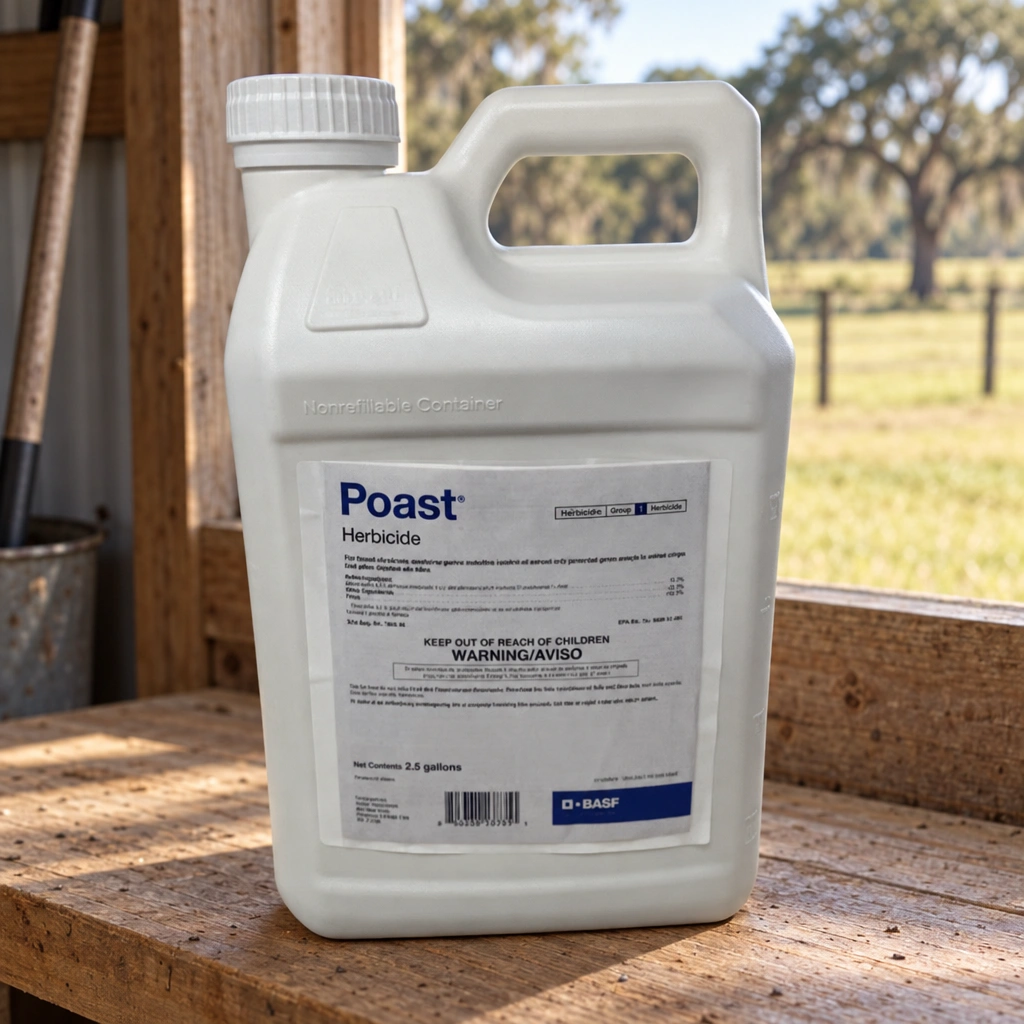
A sethoxydim herbicide for postemergence control of listed grass weeds in selected crops and other labeled sites. Sold as one 2.5-gallon jug.
For grass weeds that have emerged
Poast is a selective postemergence grass herbicide. Its target is an emerged grass weed in a crop or other use site that appears on the label. It does not provide broadleaf weed or sedge control. That makes identification the first useful step: a grass-like plant is not always a grass, and the right herbicide depends on that difference. The current directions give separate rates and maximum weed heights for the listed targets. Use those details together rather than choosing a rate from the product name alone.
Check the crop as carefully as the weed
Crop selectivity is specific. A product that can be used on one planting may injure a different crop, particularly another grass. Find the crop in the label and read its restrictions before planning the application. Poast is an 18 percent sethoxydim formulation, so directions from Poast Plus or another sethoxydim concentration do not automatically apply. This 2.5-gallon jug is concentrate. The amount needed depends on treated acreage and the labeled use, not simply on how much water the sprayer will hold.
Match coverage to the growth stage
Poast works through foliage, which makes spray coverage and weed growth stage important. A grass that has passed the label height can be a different treatment problem from a young seedling. The label also distinguishes initial applications from any permitted follow-up treatment for perennial weeds. Use its tables to check both the grass species and the treatment sequence. Record what was treated and return to inspect the result. New emergence or regrowth needs its own assessment rather than an automatic repeat of the first spray.
Read the mixing directions before filling
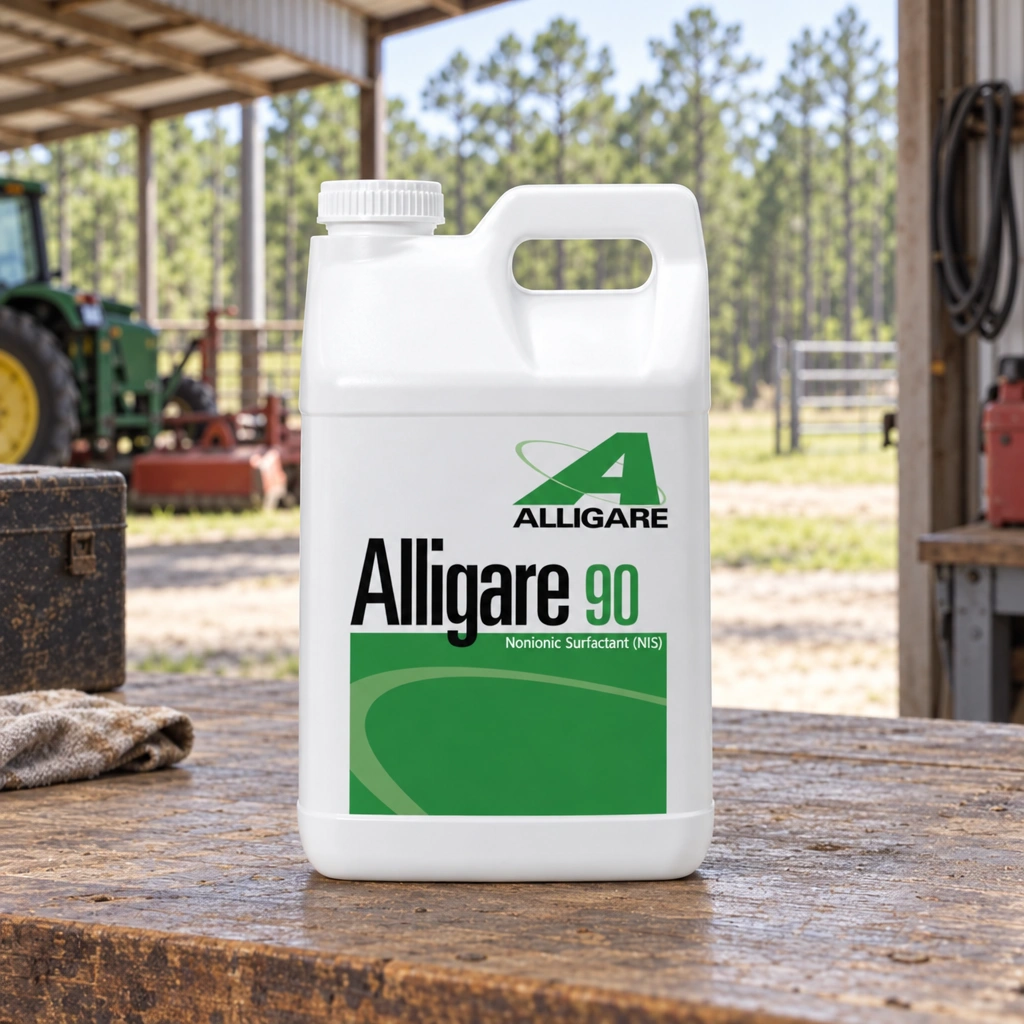
The spray additive is part of the labeled program. Review the adjuvant section and the crop-specific instructions before filling the tank, especially if another pesticide is planned for the same application. A tank mix can have restrictions that are stricter than either product used alone. Follow the mixing sequence and keep the required agitation. The complete label also sets harvest and grazing intervals where they apply. Keep that information with the field record so a later harvest decision is based on the treatment actually made.
Formulation
Sethoxydim 18.0%; other ingredients 82.0%; total 100.0%. Equivalent to 1.5 lb of sethoxydim per gallon. Emulsifiable concentrate containing petroleum distillate. Group 1. EPA Reg. No. 7969-58.
Directions for use
Poast is a postemergence herbicide for labeled crops and sites. Table 5 below applies to annual grass weeds only. Rates and maximum heights depend on the label-defined region. Use the crop-specific label section for restrictions and maximum seasonal rates; do not apply this table to perennial weeds or to another crop without checking those directions.
Table 5. Annual grass weed application rate and timing
| Annual grass weed | Region 1 (West and High and Rolling Plains): Maximum Height (inches) | Region 1 (West and High and Rolling Plains): Product Rate (pints/A) | Region 2 (Midwest, South, and Northeast): Maximum Height (inches) | Region 2 (Midwest, South, and Northeast): Product Rate (pints/A) |
|---|
| Barley, interseeded cover crops and volunteer1,2,4 | 4 | 2.0 | 4 | 1.5 |
| Barnyardgrass | 8 | 1.5 | 8 | 1.0 |
| Corn, volunteer1,2,4 | 12 | 1.5 | 20 | 1.0 |
| Crabgrass, large1 | 4 | 1.5 | 6 | 1.0 |
| Crabgrass, smooth1 | 4 | 1.5 | 6 | 1.0 |
| Cupgrass, southwestern | 8 | 1.5 | N/A | N/A |
| Cupgrass, woolly | N/A | N/A | 8 | 1.0 |
| Fescue, tall (seedling) | N/A | N/A | 6 | 1.5 |
| Foxtail, giant | 8 | 1.5 | 8 | 1.0 |
| Foxtail, green | 8 | 1.5 | 8 | 1.0 |
| Foxtail, yellow | 8 | 1.5 | 8 | 1.0 |
| Goosegrass | 4 | 1.5 | 6 | 1.0 |
| Itchgrass | N/A | N/A | 4 | 2.0 |
| Johnsongrass (seedling) | 8 | 1.5 | 8 | 1.0 |
| Junglerice | 8 | 1.5 | 8 | 1.0 |
| Lovegrass | N/A | N/A | 6 | 1.5 |
| Millet, wild proso | 10 | 1.0 | 10 | 0.5 |
| Oats, interseeded cover crops and volunteer1,2,4 | 4 | 2.0 | 4 | 1.5 |
| Oats, tame | N/A | N/A | 6 | 1.5 |
| Oats, wild1 | 4 | 1.5 | 4 | 1.0 |
| Orchardgrass (seedling) | N/A | N/A | 6 | 1.5 |
| Panicum, browntop | 8 | 1.5 | 8 | 1.0 |
| Panicum, fall | 8 | 1.5 | 8 | 1.0 |
| Panicum, Texas | 8 | 1.5 | 8 | 1.0 |
| Red rice1 | N/A | N/A | 4 | 2.0 |
| Rye, interseeded cover crops and volunteer1,2,4 | 4 | 2.0 | 4 | 1.5 |
| Ryegrass, annual | 8 | 1.5 | 8 | 1.0 |
| Sandbur, field | N/A | N/A | 3 | 1.25 |
| Shattercane/Wildcane1 | 18 | 1.5 | 18 | 1.0 |
| Signalgrass, broadleaf | 8 | 1.5 | 8 | 1.0 |
| Sprangletop, red3 | 8 | 1.5 | 8 | 1.0 |
| Stinkgrass | N/A | N/A | 6 | 1.5 |
| Wheat, interseeded cover crops and volunteer1,2,4 | 4 | 2.0 | 4 | 1.5 |
| Witchgrass1 | 8 | 1.5 | 8 | 1.0 |
1 Add nitrogen to COC or MSO to improve control. 2 A pply Poast® herbicide before tillering. 3 DO NOT apply Poast on red sprangletop in Arizona, California, or western New Mexico. 4 In Region 1, volunteer cereals emerging from late spring through early summer (May through July) may be partially or incompletely controlled because of unfavorable conditions at application time. N/A = Not Applicable
Complete current label with crop-specific rates, use sites, perennial grass tables, mixing directions and all restrictions: https://www.cdms.net/ldat/ld00F017.pdf
Cautions
WARNING. Keep out of reach of children.
Human and environmental precautions, PPE and first aid
2
Precautionary Statements
Hazards to Humans and Domestic Animals
WARNING. Causes substantial but temporary eye injury.
Causes skin irritation. Harmful if absorbed through skin or
swallowed. DO NOT get in eyes, on skin, or on clothing.
Personal Protective Equipment (PPE)
Applicators and other handlers must wear:
• Coveralls over short-sleeved shirt and short pants
• Chemical-resistant gloves, made of barrier laminate,
nitrile rubber ≥ 14 mils, butyl rubber ≥ 14 mils, or
viton ≥ 14 mils
• Chemical-resistant footwear plus socks
• Protective eyewear
• Chemical-resistant headgear for overhead exposure
• Chemical-resistant apron when cleaning equipment,
mixing, and loading
Discard clothing and other absorbent materials that have
been drenched or heavily contaminated with this product’s
concentrate. DO NOT reuse them. Follow manufacturer’s
instructions for cleaning and maintaining PPE. If no such
instructions for washables exist, use detergent and hot
water. Keep and wash PPE separately from other laundry.
Engineering Controls Statement
When handlers use closed systems, enclosed cabs, or
aircraft in a manner that meets the requirements listed in
the Worker Protection Standard (WPS) for agricultural
pesticides [40 CFR 170.240(d)(4-6)], the handler PPE
requirements may be reduced or modified as specified in
the WPS.
USER SAFETY RECOMMENDATIONS
Users should:
• Wash hands thoroughly after handling and before eat-
ing, drinking, chewing gum, using tobacco, or using
the toilet.
• Remove clothing/PPE immediately if pesticide gets
inside. Then wash thoroughly and put on clean
clothing.
• Remove PPE immediately after handling this product.
Wash the outside of gloves before removing. As soon
as possible, wash thoroughly and change into clean
clothing.
Environmental Hazards
This product is toxic to aquatic organisms. For terrestrial
uses, DO NOT apply directly to water, or to areas where
surface water is present, or to intertidal areas below the
mean high water mark. DO NOT contaminate water when
disposing of equipment washwater or rinsate.
Nontarget Organism Advisory: This product is toxic to
plants and may adversely impact the forage and habitat of
non-target organisms, including pollinators, in areas adja-
cent to the treated site. Protect the forage and habitat of
nontarget organisms by following label directions intended
to minimize spray drift.
Endangered Species Concerns
NOTE: The use of any pesticide in a manner that may kill
or otherwise harm an endangered species or adversely
modify their habitat is a violation of federal law. This pesti-
cide is toxic to vascular plants and should be used strictly
FIRST AID
If in eyes
• Hold eyes open and rinse slowly and gently with water for 15 to 20 minutes.
• Remove contact lenses, if present, after first 5 minutes; then continue rinsing eyes.
• Call a poison control center or doctor for treatment advice.
If on skin or clothing
• Take off contaminated clothing.
• Rinse skin immediately with plenty of water for 15 to 20 minutes.
• Call a poison control center or doctor for treatment advice.
If swallowed
• Call a poison control center or doctor immediately for treatment advice.
• DO NOT give any liquid to the person.
• DO NOT induce vomiting unless told to do so by a poison control center or doctor.
• DO NOT give anything by mouth to an unconscious person.
If inhaled
• Move person to fresh air.
• If person is not breathing, call 911 or an ambulance; then give artificial respiration, prefer-
ably by mouth to mouth, if possible.
• Call a poison control center or doctor for further treatment advice.
HOTLINE NUMBER
Have the product container or label with you when calling a poison control center or doctor or going for treatment.
In case of medical emergency involving this product, call BASF Corporation at 1-800-832-HELP (4357) or dial 911.
NOTE TO PHYSICIAN
Probable mucosal damage may contraindicate the use of gastric lavage. Contains petroleum distillate. Vomiting may
cause aspiration pneumonia.
First aid
| FIRST AID | |
| If in eyes | • Hold eyes open and rinse slowly and gently with water for 15 to 20 minutes.
• Remove contact lenses, if present, after first 5 minutes; then continue rinsing eyes.
• Call a poison control center or doctor for treatment advice. |
| If on skin or clothing | • Take off contaminated clothing.
• Rinse skin immediately with plenty of water for 15 to 20 minutes.
• Call a poison control center or doctor for treatment advice. |
| If swallowed | • Call a poison control center or doctor immediately for treatment advice.
• DO NOT give any liquid to the person.
• DO NOT induce vomiting unless told to do so by a poison control center or doctor.
• DO NOT give anything by mouth to an unconscious person. |
| If inhaled | • Move person to fresh air.
• If person is not breathing, call 911 or an ambulance; then give artificial respiration, prefer-
ably by mouth to mouth, if possible.
• Call a poison control center or doctor for further treatment advice. |
| HOTLINE NUMBER | |
Have the product container or label with you when calling a poison control center or doctor or going for treatment.
In case of medical emergency involving this product, call BASF Corporation at 1-800-832-HELP (4357) or dial 911. | |
| NOTE TO PHYSICIAN | |
Probable mucosal damage may contraindicate the use of gastric lavage. Contains petroleum distillate. Vomiting may
cause aspiration pneumonia. | |
Worker protection, entry interval and storage/disposal
3
in accordance with drift precautions on this label to mini-
mize off-site exposures.
Physical and Chemical Hazards
COMBUSTIBLE. DO NOT use or store near heat or open
flame.
Directions For Use
It is a violation of federal law to use this product in a man-
ner inconsistent with its labeling. This label must be in
possession of the user at the time of herbicide application.
DO NOT apply this product in a way that will contact
workers or other persons, either directly or through drift.
Only protected handlers may be in the area during applica-
tion. For requirements specific to your state or tribe,
consult the agency responsible for pesticide regulation.
Observe all precautions and limitations in this label and the
labels of products used in combination with Poast®
herbicide. Use of Poast not consistent with this label can
result in injury to crops, animals, or persons.
AGRICULTURAL USE REQUIREMENTS
Use this product only in accordance with its labeling and
with the Worker Protection Standard, 40 CFR Part 170.
This standard contains requirements for the protection
of agricultural workers on farms, forests, nurseries, and
greenhouses, and handlers of agricultural pesticides. It
contains requirements for training, decontamination,
notification, and emergency assistance. It also contains
specific instructions and exceptions pertaining to the
statements on this label about personal protective
equipment (PPE) and restricted-entry interval. The
requirements in this box only apply to uses of this prod-
uct that are covered by the Worker Protection Standard.
DO NOT enter or allow worker entry into treated areas
during the restricted-entry interval (REI) of 12 hours.
PPE required for early entry to treated areas that is per-
mitted under the Worker Protection Standard and that
involves contact with anything that has been treated,
such as plants, soil, or water is:
• Coveralls over short-sleeved shirt and short pants
• Chemical-resistant gloves, made of barrier laminate,
nitrile rubber ≥ 14 mils, butyl rubber ≥ 14 mils, or
viton ≥ 14 mils
• Chemical-resistant footwear plus socks
• Protective eyewear
• Chemical-resistant headgear for overhead exposure
NONAGRICULTURAL USE REQUIREMENTS
The requirements in this box apply to uses of this prod-
uct that are NOT within the scope of the Worker
Protection Standard (WPS) for agricultural pesticides
(40 CFR Part 170). The WPS applies when this product
is used to produce agricultural plants on farms, forests,
nurseries, or greenhouses.
DO NOT enter or allow others to enter treated areas
until sprays have dried.
STORAGE AND DISPOSAL
DO NOT contaminate water, food, or feed by storage or
disposal.
Pesticide Storage
DO NOT allow this product to freeze. DO NOT store
below 32° F or above 100° F. Store in original container
only, in a dry place away from heat or open flame, and
separate from feed or foodstuffs.
Pesticide Disposal
To avoid pesticide waste, use all material in this
container by application according to label directions. If
pesticide waste cannot be avoided, offer remaining
product to a waste disposal facility or pesticide disposal
program (often such programs are run by state or local
governments or by industry).
Container Handling
Nonrefillable Container. DO NOT reuse or refill this
container. Triple rinse or pressure rinse container (or
equivalent) promptly after emptying; then offer for recy-
cling, if available, or reconditioning, if appropriate, or
puncture and dispose of in a sanitary landfill, or by incin-
eration, or by other procedures approved by state and
local authorities.
Triple rinse containers small enough to shake
(capacity ≤ 5 gallons) as follows: Empty the remain-
ing contents into application equipment or a mix tank
and drain for 10 seconds after the flow begins to drip.
Fill the container 1/4 full with water and recap. Shake for
10 seconds. Pour rinsate into application equipment or a
mix tank, or store rinsate for later use or disposal. Drain
for 10 seconds after the flow begins to drip. Repeat this
procedure two more times.
(continued)
Container handling and disposal, continued
4
STORAGE AND DISPOSAL (continued)
Container Handling (continued)
Triple rinse containers too large to shake
(capacity > 5 gallons) as follows: Empty the remain-
ing contents into application equipment or a mix tank.
Fill the container 1/4 full with water. Replace and tighten
closures. Tip container on its side and roll it back and
forth, ensuring at least one complete revolution, for
30 seconds. Stand the container on its end and tip it
back and forth several times. Turn the container over
onto its other end and tip it back and forth several times.
Empty the rinsate into application equipment or a mix
tank, or store rinsate for later use or disposal. Repeat
this procedure two more times.
Pressure rinse as follows: Empty the remaining con-
tents into application equipment or mix tank and
continue to drain for 10 seconds after the flow begins to
drip. Hold container upside down over application
equipment or mix tank, or collect rinsate for later use or
disposal. Insert pressure rinsing nozzle in the side of the
container and rinse at about 40 PSI for at least 30 sec-
onds. Drain for 10 seconds after the flow begins to drip.
Refillable Container. Refill this container with pesticide
only. DO NOT reuse this container for any other pur-
pose. Triple rinsing the container before final disposal is
the responsibility of the person disposing of the contain-
er. Cleaning before refilling is the responsibility of the
refiller.
Triple rinse as follows: To clean the container before
final disposal, empty the remaining contents from this
container into application equipment or mix tank. Fill the
container about 10% full with water. Agitate vigorously or
recirculate water with the pump for 2 minutes. Pour or
pump rinsate into application equipment or rinsate col-
lection system. Repeat this rinsing procedure two more
times.
When this container is empty, replace the cap and seal
all openings that have been opened during use; return
the container to the point of purchase or to a designated
location. This container must only be refilled with a
pesticide product. Prior to refilling, inspect carefully for
damage such as cracks, punctures, abrasions, worn-out
threads and closure devices. Check for leaks after refill-
ing and before transport. DO NOT transport if this
container is damaged or leaking. If the container is dam-
aged, or leaking, or obsolete and not returned to the
point of purchase or to a designated location, triple rinse
emptied container and offer for recycling, if available, or
dispose of container in compliance with state and local
regulations.
In Case of Emergency
In case of a spill of this product, call:
• CHEMTREC
1-800-424-9300
• BASF Corporation
1-800-832-HELP (4357)
Steps to take if this material is released into the
environment or spilled:
• Wear Personal Protective Equipment (PPE) and
avoid exposure when managing a spill. (See
Precautionary Statements section of this label for
required PPE. )
• Dike and contain the spill with inert, absorbent material
(e. g. , sand, earth) and transfer liquid and solid diking
material to separate containers for disposal. Small-scale
spills of Poast® herbicide (that can be cleaned up with
a typical spill kit) may be applied to labeled sites.
• Remove contaminated clothing, and wash affected skin
areas with soap and water. Wash clothing before reuse.
• Keep spill out of all sewers and open bodies of water.
Use Restrictions
• Maximum annual application rate - Refer to the
Use-specific Information section of the label for each
crop use.
• Preharvest interval (PHI) - Refer to the Use-specific
Information section of the label.
• DO NOT apply preplant or preemergence before plant-
ing grass crops except field corn. Refer to Use-specific
Information.
• DO NOT plant harvestable crops for 30 days after appli-
cation unless sethoxydim is labeled for use on that crop.
• Avoid all direct or indirect contact with any desired grass
crop (e. g. , corn, rice, small grains, sorghum, and orna-
mental grasses and turfgrass).
• Stress - DO NOT apply to grass weeds or crops under
stress because of lack of moisture, hail damage, flood-
ing, herbicide injury, mechanical injury, or widely
fluctuating temperatures. Unsatisfactory control may
result. In irrigated areas, it may be necessary to irrigate
before application to ensure active grass weed growth.
• DO NOT apply to crops that show injury (leaf phytotoxic-
ity or plant stunting) produced by any other prior
herbicide applications because this injury may be
enhanced or prolonged with new or additional herbicide
application.
• Re-treatment Interval - A minimum of 14 days is
required between sequential applications of Poast.
• DO NOT use selective application equipment such as
recirculating sprayers, wiper applicators, or shielded
applicators.
• DO NOT apply through any type of irrigation equipment.
• Rainfast period - Poast is rainfast 1 hour after
application.

 Ask Daisy