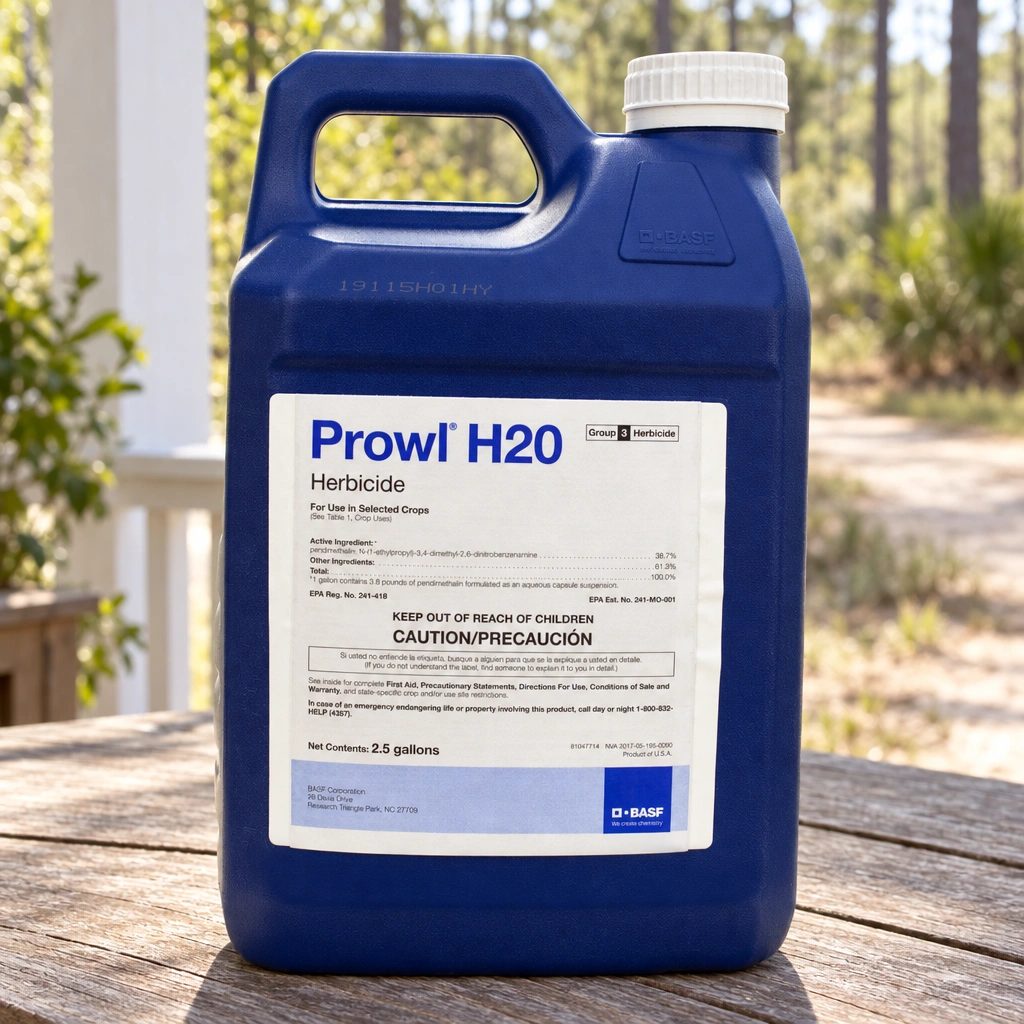
A water-based pendimethalin herbicide for residual control of listed annual grasses and broadleaf weeds in selected crops. One 2.5-gallon jug.
Prevent the next flush of weeds
Prowl H2O is a residual herbicide used in labeled crop programs to control listed annual grasses and certain broadleaf weeds as they germinate. It is not a rescue treatment for a field already covered with established weeds. Look at the existing weed pressure before choosing the application plan. The label explains where a separate treatment is needed for emerged vegetation. Starting with that distinction helps avoid expecting a soil-residual product to do a foliar herbicide’s job. The crop and application timing still have to fit its registered directions.
Use the right rate for the soil and crop
The label rate is not one number for every field. Crop-specific tables distinguish soil texture and, in some uses, organic matter or application timing. Those differences affect the amount permitted for the treatment. Identify the field conditions first and use the corresponding row in the actual label. Do not turn a rate from one crop into a general recommendation for every planting. This package contains 2.5 gallons of concentrate. Its size is useful for purchasing, but it does not determine the acreage covered by a particular application.
Plan for activation and placement
Residual weed control depends on placing the herbicide where germinating weeds will encounter it. Read the crop section for application timing and the moisture or incorporation directions that apply to that use. Field residue and soil conditions can affect the plan, and the instructions distinguish different planting systems. Check the weather forecast as part of scheduling without assuming that any rain event will satisfy the label. If the crop program calls for a partner herbicide, read both labels and use the most restrictive applicable directions.
Keep the rest of the season in view
Scout after application so escapes and later weed pressure are identified while there is time to make another labeled management decision. Prowl H2O belongs to Group 3; relying on one mode of action repeatedly is not a complete resistance-management program. The label includes restrictions for crop use and subsequent planting, so keep the treatment date with the field record. Prowl H2O is also distinct from Prowl 3.3 EC. Check the full product name and formulation before measuring or borrowing directions from an older spray plan.
Formulation
Pendimethalin 38.7%; other ingredients 61.3%; total 100.0%. One gallon contains 3.8 lb of pendimethalin as an aqueous capsule suspension. Group 3. EPA Reg. No. 241-418.
Directions for use
Prowl H2O rates and restrictions depend on the crop, soil, application method and timing. This excerpt is for labeled fruiting vegetables only: bell pepper, nonbell pepper, eggplant and tomato. It is not a general vegetable or pasture rate.
Fruiting vegetables: placement and timing
The label allows broadcast preplant-incorporated or surface-preplant use before transplanting, and post-directed treatment of transplanted or established direct-seeded plants. Do not apply before direct-seeded fruiting vegetables or over the top of plants after emergence. For post-directed spraying, place the spray on soil at the plant base and between rows, avoiding foliage and stems. Transplant roots must be established. Apply before weeds germinate; emerged weeds will not be controlled. Mechanically incorporate when the crop section requires activation and sufficient rainfall or irrigation does not occur.
Broadcast rate by soil texture for fruiting vegetables
| Soil texture | Broadcast rate (pints per acre) |
|---|
| Coarse | 1.0 to 1.5 |
| Medium | 1.5 to 2.0 |
| Fine | 1.5 to 3.0 |
The label also lists 2.0 to 3.0 pints per acre to aid control or suppression of black nightshade and hairy nightshade as part of a comprehensive weed-management program. Do not exceed 3.0 pints per acre per year. Preharvest interval: 21 days for tomatoes, 70 days for all other listed fruiting vegetables. Do not plant lettuce within six months after application where the rows were covered with plastic.
Complete current manufacturer label, including the other crop/site rates, table footnotes, application methods and restrictions: https://www.cdms.net/ldat/ld6CT055.pdf
Cautions
CAUTION. Keep out of reach of children.
Human and environmental precautions, PPE and first aid
2
Precautionary Statements
Hazards to Humans and Domestic Animals
CAUTION. Causes moderate eye irritation. Harmful if
swallowed or absorbed through the skin. Avoid contact
with skin, eyes, or clothing.
Personal Protective Equipment (PPE)
Applicators and other handlers must wear:
• Long-sleeved shirt and long pants
• Chemical-resistant gloves including barrier laminate,
butyl rubber ≥ 14 mils, nitrile rubber ≥ 14 mils, neoprene
rubber ≥ 14 mils, natural rubber ≥ 14 mils, polyethylene,
polyvinyl chloride ≥ 14 mils, or viton ≥ 14 mils
• Shoes plus socks
Follow manufacturer’s instructions for cleaning/maintaining
PPE. If no such instructions for washables exist, use deter-
gent and hot water. Keep and wash PPE separately from
other laundry. Discard clothing and other absorbent mate-
rials that have been drenched or heavily contaminated with
this product’s concentrate. DO NOT reuse them.
Engineering Controls
When handlers use closed systems, enclosed cabs, or air-
craft in a manner that meets the requirements listed in the
Worker Protection Standard (WPS) for agricultural pesti-
cides [(40 CFR 170.240)(d)(4-6)], the handler PPE
requirements may be reduced or modified as specified in
the WPS.
USER SAFETY RECOMMENDATIONS
Users should:
• Wash hands thoroughly after handling and before eat-
ing, drinking, chewing gum, using tobacco, or using
the toilet.
• Remove clothing/PPE immediately if pesticide gets
inside. Wash thoroughly and put on clean clothing.
• Remove PPE immediately after handling this product.
Wash the outside of gloves before removing. As soon
as possible, wash thoroughly and change into clean
clothing.
Environmental Hazards
This product is toxic to fish. DO NOT apply directly to
water, to areas where surface water is present, or to inter-
tidal areas below the mean high water mark. Drift and
runoff from treated areas may be hazardous to aquatic
organisms in adjacent aquatic sites. DO NOT contaminate
water when disposing of equipment washwater or rinsate.
Nontarget Organism Advisory Statement: This prod-
uct is toxic to plants and may adversely impact the forage
and habitat of nontarget organisms, including pollinators,
in areas adjacent to the treated site. Protect the forage and
habitat of nontarget organisms by following label directions
intended to minimize spray drift.
Endangered Species Protection
This product may have effects on federally listed
threatened or endangered plant species or their critical
habitat. When using this product, you must follow the
measures contained in the Endangered Species Protection
Bulletin for the county or parish in which you are applying
the pesticide. To determine whether your county or parish
has a Bulletin, and to obtain that Bulletin, consult
http://www.epa.gov/espp/, or call 1-844-447-3813 no more
than 6 months before using this product. Applicators must
use Bulletins that are in effect in the month in which the
pesticide will be applied. New Bulletins will be available
from the above sources 6 months before their effective
dates.
FIRST AID
If swallowed
• Call a poison control center or doctor immediately for treatment advice.
• Have person sip a glass of water if able to swallow.
• DO NOT induce vomiting unless told to do so by a poison control center or doctor.
• DO NOT give anything to an unconscious person.
If in eyes
• Hold eye open and rinse slowly and gently with water for 15 to 20 minutes.
• Remove contact lenses, if present, after first 5 minutes; then continue rinsing.
• Call a poison control center or doctor for treatment advice.
If on skin
• Take off contaminated clothing.
• Rinse skin immediately with plenty of water for 15 to 20 minutes.
• Call a poison control center or doctor for treatment advice.
HOTLINE NUMBER
Have the product container or label with you when calling a poison control center or doctor or going for treatment.
You may also contact BASF Agricultural Solutions US LLC (hereafter “BASF”) for emergency medical treatment infor-
mation: 1-800-832-HELP (4357).
First aid
| FIRST AID | |
| If swallowed | • Call a poison control center or doctor immediately for treatment advice.
• Have person sip a glass of water if able to swallow.
• DO NOT induce vomiting unless told to do so by a poison control center or doctor.
• DO NOT give anything to an unconscious person. |
| If in eyes | • Hold eye open and rinse slowly and gently with water for 15 to 20 minutes.
• Remove contact lenses, if present, after first 5 minutes; then continue rinsing.
• Call a poison control center or doctor for treatment advice. |
| If on skin | • Take off contaminated clothing.
• Rinse skin immediately with plenty of water for 15 to 20 minutes.
• Call a poison control center or doctor for treatment advice. |
| HOTLINE NUMBER | |
Have the product container or label with you when calling a poison control center or doctor or going for treatment.
You may also contact BASF Agricultural Solutions US LLC (hereafter “BASF”) for emergency medical treatment infor-
mation: 1-800-832-HELP (4357). | |
Storage, disposal and directions for use
3
If endangered plant species occur in proximity to the appli-
cation site, the following mitigation measures are required:
• If applied by ground, leave an untreated buffer zone of
200 feet. The product must be applied using a low boom
(20 inches above the ground) and ASAE fine to medium/
coarse nozzles.
• If applied by air, leave an untreated buffer zone of
170 feet. Must use straight-stream nozzles (D-6 or larg-
er); wind can be no more than 8 mph, and release height
must be 15 feet or less.
Directions For Use
It is a violation of federal law to use this product in a man-
ner inconsistent with its labeling. This label must be in the
possession of the user at the time of pesticide application.
Observe all precautions and restrictions in this label and
the labels of products used in combination with
Prowl® H2O herbicide. Use of Prowl H2O not consis-
tent with this label can result in injury to crops, animals, or
persons. Keep containers closed to avoid spills and
contamination.
DO NOT apply this product in a way that will contact
workers or other persons, either directly or through drift.
Only protected handlers may be in the area during applica-
tion. For any requirements specific to your state or tribe,
consult the agency responsible for pesticide protection.
BASF intends that this product may not be used for manu-
facturing products for application to turf and ornamentals.
DO NOT enter or allow other people (or pets) to enter the
treated area until sprays have dried.
STORAGE AND DISPOSAL
DO NOT contaminate water, food, or feed by storage or
disposal.
Pesticide Storage
Prowl H2O freezes around 15° F and is stable under
conditions of freezing and thawing. Product that has
been frozen must be thawed and recirculated prior to
use.
Pesticide Disposal
Pesticide wastes are toxic. Improper disposal of excess
pesticide, spray mixture, or rinsate is a violation of feder-
al law. Open dumping is prohibited.
If these wastes cannot be disposed of by use according
to label directions, contact your State Pesticide or Envi-
ronmental Control Agency, or the Hazardous Waste
representative at the nearest EPA Regional Office for
guidance.
(continued)
STORAGE AND DISPOSAL (continued)
Container Handling
Nonrefillable Container. DO NOT reuse or refill this
container. Triple rinse or pressure rinse container (or
equivalent) promptly after emptying; then offer for recy-
cling, if available, or reconditioning, if appropriate, or
puncture and dispose of in a sanitary landfill, or by incin-
eration, or by other procedures approved by state and
local authorities.
Triple rinse containers small enough to shake
(capacity ≤ 5 gallons) as follows: Empty the remain-
ing contents into application equipment or a mix tank
and drain for 10 seconds after the flow begins to drip. Fill
the container 1/4 full with water and recap. Shake for
10 seconds. Pour rinsate into application equipment or a
mix tank, or store rinsate for later use or disposal. Drain
for 10 seconds after the flow begins to drip. Repeat this
procedure two more times.
Triple rinse containers too large to shake
(capacity > 5 gallons) as follows: Empty the remain-
ing contents into application equipment or a mix tank.
Fill the container 1/4 full with water. Replace and tighten
closures. Tip container on its side and roll it back and
forth, ensuring at least one complete revolution, for
30 seconds. Stand the container on its end and tip it
back and forth several times. Turn the container over
onto its other end and tip it back and forth several times.
Empty the rinsate into application equipment or a mix
tank, or store rinsate for later use or disposal. Repeat
this procedure two more times.
Pressure rinse as follows: Empty the remaining
contents into application equipment or mix tank and
continue to drain for 10 seconds after the flow begins to
drip. Hold container upside down over application
equipment or mix tank, or collect rinsate for later use or
disposal. Insert pressure rinsing nozzle in the side of the
container and rinse at about 40 PSI for at least 30 sec-
onds. Drain for 10 seconds after the flow begins to drip.
Refillable Container. Refill this container with pesticide
only. DO NOT reuse this container for any other pur-
pose. Triple rinsing the container before final disposal is
the responsibility of the person disposing of the con
tainer. Cleaning before refilling is the responsibility of the
refiller.
Triple rinse as follows: To clean the container before
final disposal, empty the remaining contents from this
container into application equipment or mix tank. Fill the
container about 10% full with water. Agitate vigorously or
recirculate water with the pump for 2 minutes. Pour or
pump rinsate into application equipment or rinsate col-
lection system. Repeat this rinsing procedure two more
times.
(continued)
Worker protection, entry interval and container handling
4
STORAGE AND DISPOSAL (continued)
Container Handling (continued)
When this container is empty, replace the cap and seal
all openings that have been opened during use; return
the container to the point of purchase or to a designated
location. This container must only be refilled with a pesti-
cide product. Prior to refilling, inspect carefully for
damage including cracks, punctures, abrasions, worn-
out threads and closure devices. Check for leaks after
refilling and before transport. DO NOT transport if this
container is damaged or leaking. If the container is dam-
aged, or leaking, or obsolete and not returned to the
point of purchase or to a designated location, triple rinse
emptied container and offer for recycling, if available, or
dispose of container in compliance with state and local
regulations.
In Case of Emergency
In case of large-scale spill of this product, call:
• CHEMTREC
1-800-424-9300
• BASF
1-800-832-HELP (4357)
In case of medical emergency regarding this product, call:
• Your local doctor for immediate treatment
• Your local poison control center (hospital)
• BASF
1-800-832-HELP (4357)
Steps to take if material is released or spilled:
• Dike and contain the spill with inert material (sand, earth,
etc.) and transfer liquid and solid diking material to sepa-
rate containers for disposal.
• Remove contaminated clothing and wash affected skin
areas with soap and water.
• Wash clothing before reuse.
• Keep the spill out of all sewers and open bodies of water.
AGRICULTURAL USE REQUIREMENTS
Use this product only in accordance with its labeling and
with the Worker Protection Standard, 40 CFR Part 170.
This standard contains requirements for the protection
of agricultural workers on farms, forests, nurseries, and
greenhouses, and handlers of agricultural pesticides. It
contains requirements for training, decontamination,
notification, and emergency assistance. It also contains
specific instructions and exceptions pertaining to the
statements on this label about personal protective
equipment (PPE) and restricted-entry interval. The
requirements in this box only apply to uses of this prod-
uct that are covered by the Worker Protection Standard.
DO NOT enter or allow worker entry into treated areas
during the restricted-entry interval (REI) of 24 hours.
EXCEPTION: If the product is soil-injected or soil-
incorporated, the Worker Protection Standard, under
certain circumstances, allows workers to enter the treat-
ed area if there will be no contact with anything that has
been treated.
PPE required for early entry to treated areas that is per-
mitted under the Worker Protection Standard and that
involves contact with anything that has been treated,
including plants, soil, or water, is:
• Coveralls
• Waterproof gloves
• Shoes plus socks

 Ask Daisy