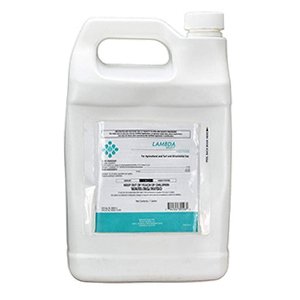
A restricted-use lambda-cyhalothrin concentrate for certified applicators treating labeled crop, turf, and ornamental sites.
For certified applicators
Lambda Select is a restricted-use insecticide and acaricide. It belongs in the hands of a certified applicator, or a person working under that applicator’s direct supervision. The certification must cover the intended use. This is a fit for a farm, nursery, greenhouse, or commercial turf program where the operator already has the credentials, equipment, and site-specific pest plan. It is not a household bug spray.
Match the treatment to the crop and pest
Agricultural crops plus specified turf and ornamental operations are among this product's use settings. That breadth is useful when a professional program serves more than one production area, but the fit still depends on the exact crop, pest, growth stage, and application method. Rates vary by crop and target. Start with scouting and the local action threshold, then confirm that the pest and site appear together in the permitted use section. A rate from one crop table does not carry over to another crop or a landscape treatment.
A measured liquid concentrate
The concentrate contains 13 percent lambda-cyhalothrin, equal to one pound of active ingredient per gallon. It mixes with water for spray application with suitable equipment. Concentration makes accurate measuring part of the job: use the rate and carrier volume for the particular site, and keep the treated area tied to the calculation. Avoid guessing by tankful or using a crop rate on turf. Those shortcuts can miss control targets or create illegal residues and crop injury.
Plan around the treatment
Lambda Select is a Group 3A insecticide. A sound program tracks which mode of action has been used on the target population and follows the crop-specific rotation and seasonal limits. Scouting helps time an application while the pest is at a vulnerable stage and before damage becomes harder to contain. It also helps avoid treating by calendar when populations do not warrant it. Record the site, target, rate, date, and treated area so the next applicator can make an informed decision.
Commercial site limits matter
Use on ornamentals in commercial greenhouses, shade houses, nurseries, and commercial landscapes around institutional, public, commercial, and industrial buildings. Turf use covers sod farms, commercial seed production, golf courses, and specified nonresidential sites. Residential lawns and areas frequented by the public are outside the turf-use sites. Avoid runoff, drains, and aquatic areas; the active ingredient is highly hazardous to aquatic organisms and pollinators. Keep the application away from blooming plants when bees are visiting. Before mixing, match the crop or site, pest, protective equipment, entry interval, spray method, and environmental limits to the planned treatment.
Active ingredients
ACTIVE INGREDIENT: Lambda-cyhalothrin [1α(S*),3α(Z)]-(±)-cyano-(3-phenoxyphenyl)methyl-3-(2-chloro-3,3,3-trifluoro-1-propenyl)-2,2-dimethylcyclopropanecarboxylate 13.0%. OTHER INGREDIENTS 87.0%. TOTAL 100.0%. Contains 1 lb. of active ingredient per gallon. Contains petroleum distillates.
Directions for use
It is a violation of Federal law to use this product in a manner inconsistent with its labeling.
LAMBDA SELECT may be used on ornamentals in commercial greenhouses, shade houses, and nurseries; on turf grown on sod farms or for commercial seed production; and in non-residential landscapes around institutional, public, commercial, and industrial buildings, golf courses, and their fairways, greens, greens aprons, and tee areas. Treat surfaces for thorough coverage without runoff. Crack-and-crevice applications must limit dripping and prevent runoff onto untreated structural surfaces or plants. All outdoor spray applications must be spot or crack-and-crevice treatments, except applications to pervious surfaces such as soil and vegetation. Spot treatments may cover no more than 2 square feet (for example, 2 ft by 1 ft or 4 ft by 0.5 ft). Time applications to flowering plants for periods when pollinators are absent, such as early morning or late evening.
Use restrictions
- Do not apply to residential lawns or areas frequented by the public, including homes, parks, schools, or athletic fields.
- Do not use irrigation systems for turf or ornamental applications. Do not treat edible crops or crops grown for food or feed in these uses. Do not apply aerially.
- In New York, do not apply to turf within 100 feet of a coastal marsh or streams that drain into a coastal marsh.
- Keep the product out of drains during and after application. Do not apply into fish pools, ponds, streams, lakes, sewers, storm drains, drains, or gutters that can drain to sewers, storm drains, water bodies, or aquatic habitat.
- Do not apply during rain or when rain is expected before the spray has at least 4 hours to dry. Rain within 24 hours may cause unintended runoff.
- Do not apply directly to impervious horizontal surfaces such as sidewalks, driveways, or patios except as a spot or crack-and-crevice treatment. Do not apply or irrigate to runoff.
- DO NOT make applications when wind speed is 15 miles per hour or greater. Low humidity and high temperatures increase the likelihood of spray drift to sensitive areas. Avoid spraying during conditions of low humidity and/or high temperature. Risk of exposure to sensitive aquatic areas can be reduced by avoiding applications when the wind direction is toward the aquatic area. DO NOT make outdoor applications during temperature inversions.
- For outdoor commercial-nursery applications, do not apply above 15 mph. Select a nozzle and pressure producing medium or coarser droplets under ASABE S572. For ground soil or foliar applications, stay at least 25 feet from lakes, reservoirs, rivers, permanent streams, marshes, natural ponds, estuaries, and commercial fish-farm ponds.
Mixing and application
Dilute with water. Fill the tank one-half to three-quarters full. Water pH between 5 and 7 is suggested; use a buffer if needed. Slowly add Lambda Select with maximum agitation, fill the tank, and continue agitation during spraying. If work stops, agitate or resuspend before restarting. Add Lambda Select last when other tank-mix products are used. Use mixtures with EC formulations or oils within 24 hours. Prepare only the volume needed. Use coarse-droplet spray nozzles, avoid excess pressure, and minimize very small droplets. For holly, pine, ivy, or other hard-to-wet foliage, a spreader-sticker can improve knockdown and residual activity. Concentrate or mist applications use the same amount of product as a dilute application. Apply dilute spray to the point of runoff. DO NOT apply or irrigate to the point of runoff.
| Ornamental rate per 100 gal | 25 gal tank | 50 gal tank | 100 gal tank | 200 gal tank | 300 gal tank |
|---|
| 1.3 fl oz | 0.33 fl oz | 0.65 fl oz | 1.3 fl oz | 2.6 fl oz | 4.0 fl oz |
| 2.6 fl oz | 0.65 fl oz | 1.3 fl oz | 2.6 fl oz | 5.2 fl oz | 7.9 fl oz |
| 4.4 fl oz | 1.1 fl oz | 2.2 fl oz | 4.4 fl oz | 8.8 fl oz | 13.3 fl oz |
Lambda Select Mixing Chart for Turf Insect Pest Control. Amounts of Lambda Select to add per 100 gallon spray tank.
| Rate of Lambda Select | 2 gals | 4 gals | 6 gals | 8 gals | 10 gals |
|---|
| 4.4 fl oz/A | 5.0 fl oz | 2.5 fl oz | 1.7 fl oz | 1.2 fl oz | 1.0 fl oz |
| 8.8 fl oz/A | 10.0 fl oz | 5.0 fl oz | 3.3 fl oz | 2.5 fl oz | 2.0 fl oz |
| 17.6 fl oz/A | 20.0 fl oz | 10.0 fl oz | 6.7 fl oz | 5.0 fl oz | 4.0 fl oz |
One fluid ounce equals 29 mL.
Ornamental applications
| Target pests | Rate per 100 gal |
|---|
| Ants (including Imported fire ants), Aphids, Armyworms, Azalea caterpillars, Bagworms, Black Vine Weevils (Adult), Boxelder bugs, Budworms, California Oakworms, Cankerworms, Cockroaches, Crickets, Cutworms, Eastern Tent Caterpillars, Elm Leaf Beetles, European Sawflies, Fall Webworms, Flea Beetles, Forest Tent Caterpillars, Gypsy Moth Larvae, Japanese Beetles (Adult), June Beetles (Adult), Lace Bugs, Leaf-feeding Caterpillars, Leafhoppers, Leafminers (Adult), Leaf Rollers, Leaf Skeletonizers, Midges, Mosquitoes, Oleander Moth Larvae, Pillbugs, Pine Sawflies, Pine Shoot Beetles, Pine Tip Moths, Plant Bugs, Root Weevils, Sawflies, Scale Insects (Crawlers), Spiders, Spittlebugs, Striped Beetles, Striped Oakworms, Thrips, Tip Moths, Tussock Moth Larvae, Wasps | 1.3–4.4 fl oz (38–128 mL) |
| Broad Mites, Brown Soft Scales, California Red Scales (Crawler), Clover Mites, Mealybugs, Pine Needle Scales (Crawler), Spider Mites, Whiteflies | 2.6–4.4 fl oz (75–128 mL) |
Begin before high pest populations become established. Reapply as necessary, using higher rates as pest pressure increases. Thorough coverage is required. For waxy, hard-to-wet foliage, add a spreader-sticker at its recommended rate. Spot treatments use 0.44 fl oz per 1–2.5 gallons of water and may not exceed 2 square feet. If retreatment is needed, wait 7 days. Do not exceed 0.36 lb active ingredient (46 fl oz product) per acre per year. For bagworms, apply as larvae begin hatching and spray young larvae directly. For scale crawlers, cover trunks, stems, twigs, and foliage. Do not broadcast spray with a mechanically pressurized handgun in industrial or commercial areas such as tire, rail, or junk yards.
Turfgrass applications
Permitted sites include sod farms, commercial seed production, lawns around institutional, public, commercial, and industrial buildings, and golf-course turf. Do not use on residential lawns or public-frequented areas. Do not broadcast spray with a mechanically pressurized handgun in industrial or commercial areas such as tire, rail, or junk yards.
| Target pests | Rate per 1,000 sq ft | Equivalent rate per acre |
|---|
| Ants (including Imported fire ants), Armyworms, Centipedes, Crickets, Cutworms, Earwig, Fleas (Adult), Grasshoppers, Japanese Beetles (Adult), Millipedes, Mites, Pillbugs, Sod Webworms, Sow Bugs, Ticks (including species which transmit Lyme disease) | 2.9–6 mL | 4.4–8.8 fl oz |
| Bluegrass Billbugs (Adult), Black Turfgrass Ataenius (Adult), Chiggers, Fleas (Adult), Grub (Suppression), Hyperodes Weevils (Adult), Mole Crickets (Nymphs and Young Adults) | 6 mL | 8.8 fl oz |
| Chinch bugs, Mole crickets (Mature Adults) | 12 mL | 17.6 fl oz; not for mature adult mole crickets or chinch bugs in New York State |
Apply before high insect populations and significant turf damage. Reapply if needed at 7-day intervals. Do not exceed 0.36 lb active ingredient (46 fl oz product) per acre per year. Spot treatments use 0.44 fl oz in 1–2.5 gallons and are limited to 2 square feet. Do not treat waterlogged turf or saturated soils. Keep children and pets off treated areas until spray dries.
Surface insects: apply in 2–5 gallons water per 1,000 sq ft. If high rainfall is forecast, a spreader-sticker may help; otherwise adjuvants are not needed under normal surface-insect conditions. Delay watering or mowing 12–24 hours. Thatch insects: apply in 2–10 gallons water per 1,000 sq ft. Use a nonionic wetting agent, penetrant, or similar adjuvant at its label rate. Irrigate lightly with up to 1/2 inch to move product into the thatch; use a high water volume if irrigation is unavailable. Subsurface insects: apply in 4–10 gallons water per 1,000 sq ft with a nonionic wetting agent, penetrant, or similar adjuvant at its label rate. Use the highest practical water volume. Apply to turf wet with dew, rain, or irrigation, then water in immediately with 1/4–1/2 inch.
Fire ants: mix 0.32 fl oz in 2.5 gallons of water. Gently drench each mound and a 3-foot diameter circle around it without disturbing the mound. Apply early morning or late evening; repeat if needed, no more often than every 7 days. Mosquitoes: spray landscape plantings, turf, and building foundations using 2–5 gallons water per 1,000 sq ft.
Worker entry: the restricted-entry interval is 24 hours. The REI is 48 hours for hand or mechanically assisted detasseling of field corn grown for seed, popcorn grown for seed, or sweet corn grown for seed, and for hard harvesting sweet corn grown for grain.
Cautions
KEEP OUT OF REACH OF CHILDREN
WARNING/AVISO
May be fatal if swallowed. Harmful if inhaled or absorbed through skin. Causes moderate eye irritation. Avoid contact with skin, eyes, or clothing. Avoid breathing spray mist. Wash hands thoroughly with soap and water after handling and before eating, drinking, or using tobacco. Remove contaminated clothing and wash before reuse.
Applicators and Other Handlers Must Wear:
- Long-sleeved shirt and long pants and long pants
- Chemical-resistant gloves made of barrier laminate or Viton ≥ 14 mils
- Shoes plus socks
- Protective eyewear
In addition to the above PPE, handlers for specific applications must also wear:
- Coveralls for mixers, loaders, and applicators for foliar spray treatment using a mechanically pressurized handgun on landscaping trees and shrubs
- A respirator for mixers, loaders, and applicators for foliar broadcast spray treatment or drench/soil/ground-directed liquid treatment using a mechanically pressurized handgun on nurseries; and for mixers and loaders supporting aerial applications to wild rice at a rate of 0.04 lb. a.i./A and treating 1,200 acres or more per day. Minimum respirator is a NIOSH-approved particulate filtering facepiece with any R or P filter, a NIOSH-approved elastomeric particulate respirator with any R or P filter, or a NIOSH-approved powered air purifying respirator with HE filters.
Discard clothing and other absorbent materials that have been drenched or heavily contaminated with this product’s concentrate. DO NOT reuse them. Follow manufacturer’s instructions for cleaning/maintaining PPE. If no such instructions for washables exist, use detergent and hot water. Keep and wash PPE separately from other laundry.
USER SAFETY RECOMMENDATIONS
- Wash hands before eating, drinking, chewing gum, using tobacco, or using the toilet.
- Remove clothing immediately if pesticide gets inside. Then wash thoroughly and put on clean clothing.
- Remove PPE/clothing immediately after handling this product. Wash the outside of gloves before removing. As soon as possible, wash thoroughly and change into clean clothing.
ENVIRONMENTAL HAZARDS: This pesticide is extremely toxic to fish and aquatic organisms and toxic to wildlife. DO NOT apply directly to water or to areas where surface water is present or to intertidal areas below the mean highwater mark. DO NOT apply when weather conditions favor drift from treated areas. Drift and runoff from treated areas may be hazardous to aquatic organisms in neighboring areas. DO NOT contaminate water when disposing of equipment wash waters.
NON-TARGET ORGANISM ADVISORY STATEMENT: This product is highly toxic to bees and other pollinating insects exposed to direct treatment or to residues in/on blooming crops or weeds. DO NOT apply this product or allow it to drift to blooming crops or weeds if bees are visiting the treatment area. Protect pollinating insects by following label directions intended to minimize drift and reduce pesticide risk to these organisms.
PHYSICAL AND CHEMICAL HAZARDS: Combustible. DO NOT use or store near heat or open flame. DO NOT use this product in or on electrical equipment due to the possibility of shock hazard.
FIRST AID IF SWALLOWED: Call a Poison control center or doctor immediately for treatment advice. DO NOT give any liquid to the person. DO NOT induce vomiting unless told to do so by the poison control center or doctor. DO NOT give anything by mouth to an unconscious person.
FIRST AID IF IN EYES: Hold eye open and rinse slowly and gently with water for 15-20 minutes. Remove contact lenses, if present, after the first 5 minutes then continue rinsing eye. Call a poison control center or doctor for treatment advice.
FIRST AID IF ON SKIN OR CLOTHING: Take off contaminated clothing. Rinse skin immediately with plenty of water for 15-20 minutes. Call a poison control center or doctor for treatment advice.
FIRST AID IF INHALED: Move person to fresh air. If person is not breathing, call 911 or an ambulance, give artificial respiration immediately, preferably by mouth-to-mouth. Call a poison control center or doctor for treatment advice.
Note to Physician: Contains petroleum distillates. Vomiting may cause aspiration pneumonia.
HOTLINE NUMBER: Have the product container or label with you when calling a poison control center, doctor, or going for treatment. For emergency information concerning this product, call your poison control center at 1-800-222-1222.

 Ask Daisy