A selective broadleaf weed treatment for established lawns, turf, parks and athletic fields.
Keep desirable turf in place
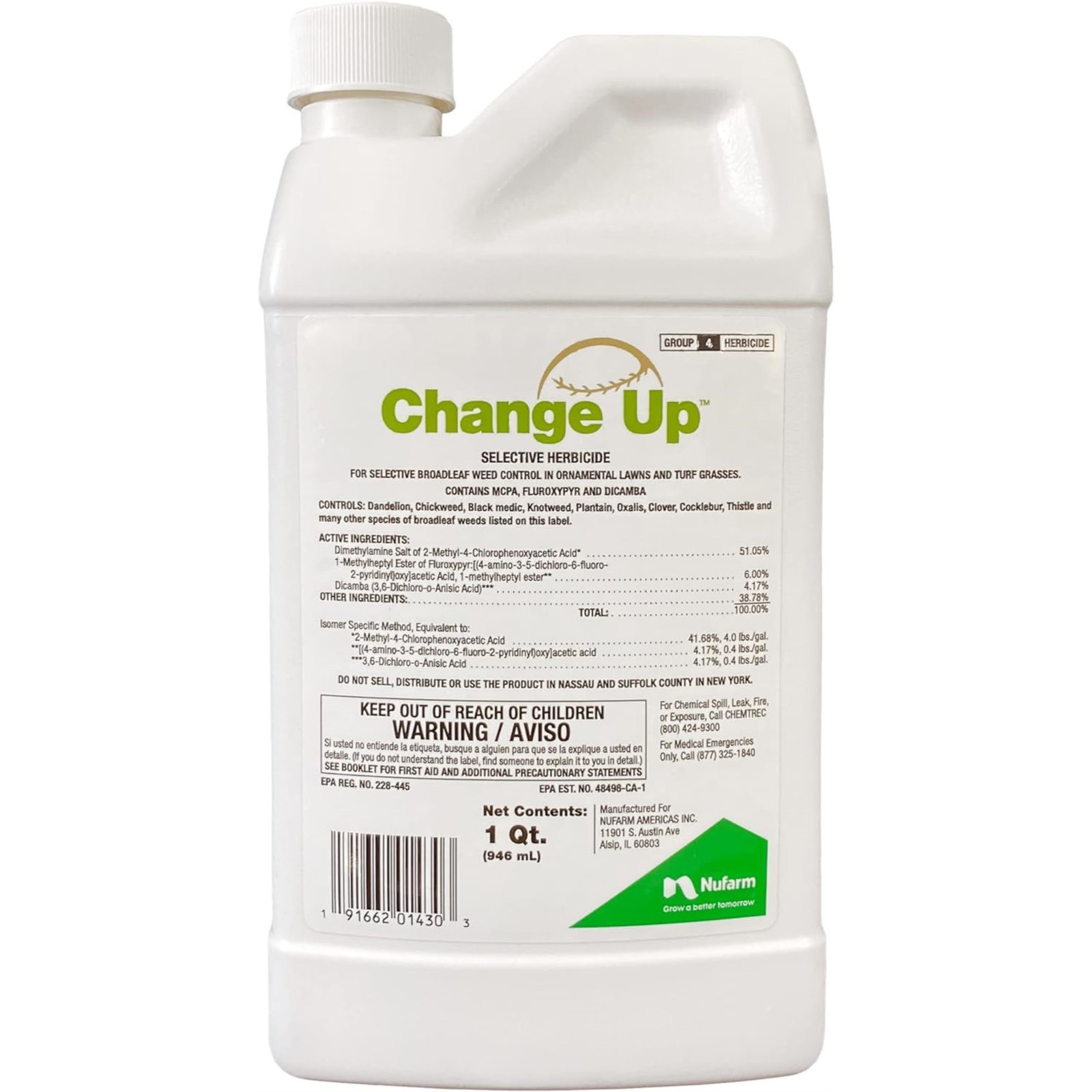
Change Up targets broadleaf weeds while preserving labeled turf species when used correctly. It is suited to lawns, parks, athletic fields, cemeteries, golf course turf and sod farms. Common targets include dandelion, chickweed, clover, plantain, oxalis and thistle. This is a turf treatment, not a general weed killer for flower beds or vegetable gardens.
Three actives, one selective treatment
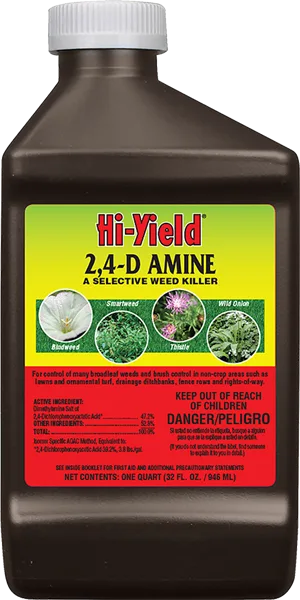
The liquid combines MCPA, fluroxypyr and dicamba. These active ingredients work as growth regulators on broadleaf weeds. The product contains no 2,4-D. Treat actively growing weeds for best control. Spring and early fall are useful windows when weeds and turf are growing steadily, rather than stalled by drought, heat or cold.
Match the application to your grass
Turf species tolerate different rates. Cool-season grasses such as bluegrass, ryegrass and fescue have a different rate range from warm-season bahiagrass, bermudagrass, carpetgrass, centipedegrass, zoysiagrass and St. Augustinegrass. Use the rate for the exact grass and site, and calibrate the sprayer before treating. Newly seeded turf must be well established before treatment. Avoid overlapping a broadcast pass because double coverage can injure grass.
Protect turf and nearby plants
Avoid treatment during spring green-up and when grass is under severe heat or drought stress. Avoid broadcast applications above 90°F; spot treatments may still injure turf at those temperatures. Use added caution on carpetgrass and St. Augustinegrass when air temperature exceeds 80°F. Do not allow spray to drift onto vegetables, flowers, trees or shrubs; even small amounts may injure sensitive plants. Keep people and pets away during application and until sprays have dried. Wait at least 21 days before repeating an application, and count spot and broadcast treatments toward the yearly limit. Plan a ground application; treatment by air or through irrigation equipment is prohibited. If your lawn contains desirable clover, this product is not a good fit. Record the date and treated area so later applications remain within the annual maximum.
Active ingredients
Active ingredients: dimethylamine salt of MCPA 51.05% (equivalent to 41.68% MCPA acid, 4.0 lb/gal); 1-methylheptyl ester of fluroxypyr 6.00% (equivalent to 4.17% fluroxypyr acid, 0.4 lb/gal); dicamba 4.17% (equivalent to 4.17% dicamba acid, 0.4 lb/gal). Other ingredients 38.78%.
Directions for use
| Turf grass | Rate |
|---|
| Bluegrass, ryegrass and fescue | 2 to 3 pints per acre |
| Creeping bentgrass | 1.25 pints per acre |
| Common and hybrid bermudagrass, bahiagrass, carpetgrass, centipedegrass and zoysiagrass | 1.5 to 2 pints per acre |
| St. Augustinegrass | 1 pint per acre |
Broadcast volume: 20 to 240 gallons per acre. Spot treatment: 0.46 to 1.10 fl oz in 0.5 to 5.5 gallons of water per 1,000 square feet. Do not apply more than 3 pints per acre per application or more than 6 pints per acre per year, including broadcast and spot treatments together. Do not apply more than 2 broadcast applications per treatment site per year, excluding spot treatments. Minimum retreatment interval: 21 days. Do not apply during spring transition (green-up), by air, through irrigation, or to newly seeded grasses until well established. Turf should not be mowed for 1 to 2 days before or after treatment. Reseed no sooner than 3 to 4 weeks after application. Maintain continuous agitation after mixing and during application; reagitate if mixture stands. Do not use on Dichondra, or on turf where desirable clovers are present. Do not exceed specified rates. For Carpetgrass and St. Augustinegrass, the label advises a small-scale trial and evaluation for turf injury before full treatment. Use only a medium or coarser spray, or a volume mean diameter of 300 microns or greater for spinning atomizer nozzles. Apply only when wind speed is 2 to 10 mph. Groundboom nozzle height must not exceed 4 feet above the canopy.
Ornamental lawns and turf
The grass-specific rate table above is for ornamental lawns and turf. Broadcast spray volume is 20 to 240 gallons per acre. Spot treatment is 0.46 to 1.10 fl oz in 0.5 to 5.5 gallons of water per 1,000 square feet. Lower-volume equipment may use as little as 5 gallons per acre when it can spread a uniform droplet and wet each weed surface. Avoid double coverage unless temporary turf injury can be tolerated; reduce rates when turf is stressed by heat or drought.
Sod farms
| Grass on sod farms | Rate per acre |
|---|
| Bluegrass, ryegrass and fescue | 2 to 3 pints |
| Creeping bentgrass | 1.25 pints |
| Common and hybrid bermudagrass, bahiagrass, carpetgrass, centipedegrass and zoysiagrass | 1.5 to 2 pints |
| St. Augustinegrass | 1 pint |
For sod farms, use 5 to 175 gallons of spray per acre. Treat actively growing broadleaf weeds. Delay application to newly sodded, sprigged or plugged grasses until 3 to 4 weeks after the operation. Treat grass seedlings after the second mowing. Follow the site-specific rate and observe the full label restrictions.
Current manufacturer rates: https://nufarm.com/usturf/product/change-up/. Complete EPA-accepted label: https://www3.epa.gov/pesticides/chem_search/ppls/000228-00445-20160422.pdf
Cautions
DO NOT SELL, DISTRIBUTE OR USE THE PRODUCT IN NASSAU AND SUFFOLK COUNTY IN NEW YORK. KEEP OUT OF REACH OF CHILDREN.
WARNING / AVISO: Causes substantial but temporary eye injury. Harmful if swallowed or absorbed through skin. Do not get in eyes, on skin or on clothing.
PERSONAL PROTECTIVE EQUIPMENT (PPE): Mixers, loaders, applicators, and other handlers must wear long-sleeved shirt and long pants; shoes plus socks; chemical-resistant gloves when mixing, loading, or using any hand-held equipment; and protective eyewear (goggles, face shield, or safety glasses). Some materials that are chemical-resistant to this product are made of waterproof material.
USER SAFETY REQUIREMENTS: Follow manufacturer’s instructions for cleaning/maintaining PPE. If no such instructions for washables exist, use detergent and hot water. Keep and wash PPE separately from other laundry. USER SAFETY RECOMMENDATIONS: Wash hands, face and arms with soap and water before eating, drinking, chewing gum, using tobacco or using the toilet. Remove clothing/PPE immediately if pesticide gets inside. Then wash thoroughly and put on clean clothing. Remove PPE immediately after handling this product. Wash the outside of gloves before removing. As soon as possible, wash thoroughly and change into clean clothing.
FIRST AID: If in eyes, hold eye open and rinse slowly and gently with water for 15 to 20 minutes. Remove contact lenses, if present, after the first 5 minutes, then continue rinsing eye. Call a poison control center or doctor for treatment advice. If swallowed, call a poison control center or doctor immediately for treatment advice. Have person sip a glass of water if able to swallow. Do not induce vomiting unless told to do so by the poison control center or doctor. Do not give anything by mouth to an unconscious person. If on skin or clothing, take off contaminated clothing. Rinse skin immediately with plenty of water for 15 to 20 minutes. Call a poison control center or doctor for treatment advice. Have the product container or label with you when calling a poison control center or doctor, or going for treatment. You may also contact 1-877-325-1840 for emergency medical treatment information.
ENVIRONMENTAL HAZARDS: This pesticide is toxic to fish, aquatic invertebrates and aquatic plants. Do not apply directly to water, to areas where surface water is present, or to intertidal areas below the mean high water mark. Do not contaminate water when disposing of equipment washwater or rinsate. Drift and runoff may be hazardous to aquatic organisms in water adjacent to treated areas. Runoff of this product will be reduced by avoiding applications when rainfall is forecasted to occur within 48 hours. This chemical has properties and characteristics associated with chemicals detected in groundwater. The use of this chemical in areas where soils are permeable, particularly where the water table is shallow, may result in groundwater contamination.
Do not apply this product in a way that will contact any person or pet, either directly or through drift. Keep people and pets out of the area during application. Do not apply by air. Do not apply through any type of irrigation system. Do not apply this product to lawn or turf during spring transition (green-up). Avoid broadcast applications when air temperature exceeds 90°F. For spot treatments above 90°F, turf injury may occur. Use added caution when treating carpetgrass and St. Augustinegrass above 80°F. Keep people and pets off treated areas during application and until sprays have dried; agricultural uses have a 48-hour restricted-entry interval.


 Ask Daisy