Establish a persistent warm-season forage grass in open, sunny pasture or ground cover areas.
For open, sunny ground
Pensacola bahiagrass is a warm-season perennial for pasture and durable ground cover in the Southeast. It tolerates heat and can persist through dry spells once established. Its growth is open rather than carpet-dense, so expect a functional forage stand, not a tight ornamental lawn. Choose another grass for shaded areas; bahiagrass needs good sunlight to maintain useful growth.
Plant with the season
Sow after the last frost when soil is warming and spring moisture can support establishment. Prepare a firm, weed-free seedbed and distribute seed evenly. Cover lightly, with seed about one-quarter to one-half inch deep. Planting too deep can slow emergence. Keep the surface moist until seedlings are established, then avoid grazing or mowing the stand too short while roots and crowns develop.
Set the rate to the job
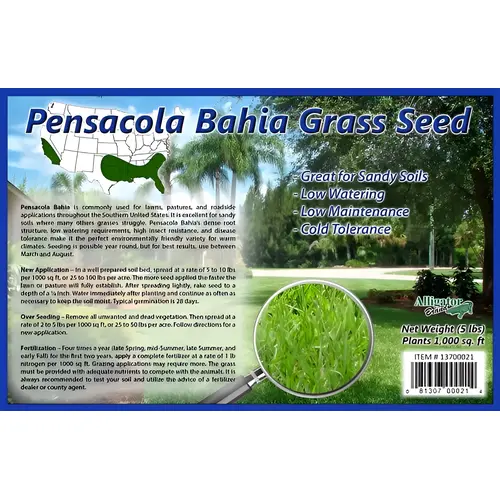
For a new lawn area, use two to five pounds per 1,000 square feet. Pasture establishment calls for 25 to 100 pounds per acre, while overseeding an existing stand uses 25 to 50 pounds per acre. The right rate depends on seedbed condition, intended use, and how much competing vegetation is present. Use the lower end only where preparation and moisture are favorable; increase coverage for rougher ground or overseeding.
Manage it as forage
Bahiagrass has dense rhizomes and low growing points, which help an established stand tolerate grazing. Still, repeated overgrazing eventually weakens pasture and causes stand loss. During midsummer, retain about 3 inches of stubble under rotational grazing or 5 inches under continuous stocking. The correct height depends on how the field is used, so manage for leaf regrowth rather than a close-cut lawn finish. Before applying lime or fertilizer, use a soil test and account for the needs of the pasture. In Florida, most bahiagrass forage production falls between April and September, so plan stored hay or a cool-season companion for the leaner months. A bahiagrass field also benefits from a rest period after grazing; leave enough leaf area for new shoots to replace what livestock removed. Match stocking pressure to seasonal growth, since summer production slows as temperatures cool.



 Ask Daisy