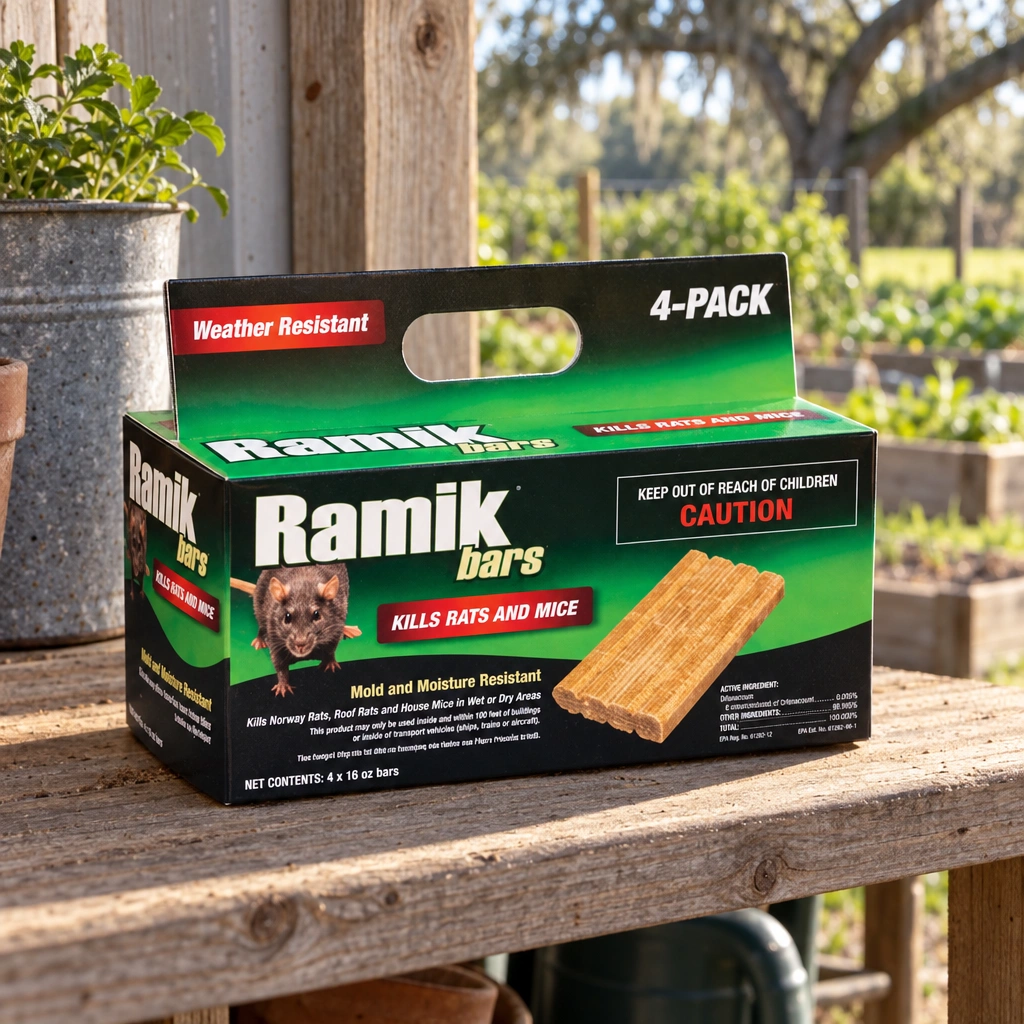
Four scored 16-ounce bait bars for label-directed rat, mouse, and meadow vole control around qualifying structures.
A bar format for planned placements
Ramik Bars are a solid bait format for planned placements around a building or transport vehicle. This box contains four one-pound bars, each scored into one-ounce pieces. A scored bar can be divided into separate portions without pouring loose pellets from a bag. That gives the user a way to organize multiple placement points from one retail box. The bars resist mold and moisture, but they still need protection from rain and snow. Treat that feature as useful in damp areas, not permission to leave bait exposed to weather.
Start where the signs are
Use this product only for its listed rodent pests and allowed sites. The use area is tied to man-made structures vulnerable to rodent invasion, including homes, agricultural buildings, commercial sites, trash receptacles, docks, and transport vehicles. A fence line or field edge beyond 100 feet from a qualifying structure is outside the allowed area. Before setting placements, look for gnawed openings, corners, concealed spaces, or other visible rodent signs. Those clues help distinguish a travel route from a random corner. Place bait where rodents are likely to find and eat it, not simply wherever a box is convenient.
Choose a layout for the target
Rat placements use more bait per point and sit farther apart than placements for mice or meadow voles. For mice and voles, a single one-ounce piece at a closer interval is the starting pattern; a second piece is reserved for points showing very high activity. This difference keeps the amount at each point tied to the target and its activity. The bar form is useful when an infestation calls for separate points over an area rather than one bait location. Do not use the bars for burrows or apply them directly to food or feed crops.
Keep the work site under control
A bait point is one part of rodent control. Store food, pet feed, and refuse in covered, rodent-resistant containers; remove spills and rubbish; dry water sources and clear sheltered clutter that can serve as harborage. Reducing food and shelter makes the site easier to manage alongside bait. Check placements on schedule. Replace spoiled pieces, collect exposed dead rodents, and watch for new feeding rather than assuming the first visit settled the problem. A simple record of each location and whether bait was touched can reveal continuing activity or a route that has shifted.
Active ingredients
Ramik Bars rodenticide, item 116334. Four scored bars, 16 oz each; net contents 4 lb. Diphacinone 0.005%; other ingredients 99.995%; total 100%. EPA Reg. No. 61282-12. Signal word: CAUTION. The latest EPA-accepted label is dated January 18, 2023 and lists Ramik Bars as an alternate brand name.
Directions for use
It is a violation of Federal law to use this product in a manner inconsistent with its labeling. Read the entire label and follow its use directions and precautions. Use only for listed pests, sites, and application methods. Store unused product out of reach of children and pets. Apply bait out of reach of children, pets, domestic animals, and non-target wildlife, or in tamper-resistant bait stations. Stations must resist destruction by dogs and children under six and prevent children from reaching bait compartments. Secure or immobilize stations if bait can shake out when lifted. Use stronger stations where hoofed livestock, raccoons, bears, vandalism, or other destructive animals are a concern. Outdoor above-ground baiting requires stations. Use tamper-resistant stations if children, pets, non-target mammals, or birds could access bait. Dispose of product and unused, spoiled, or unconsumed bait as directed below.
USE RESTRICTIONS: Only for house mice, Norway rats, roof rats, cotton rats, eastern harvest mice, golden mice, Polynesian rats, meadow voles, white-throated woodrats, southern plains woodrats, Mexican woodrats, and bushy-tailed woodrats in and around man-made structures vulnerable to commensal rodent invasion or infestation. Use only inside and within 100 feet of qualifying structures, or inside transport vehicles (ships, trains, or aircraft). Examples include residences, food-processing facilities, industrial and commercial buildings, trash receptacles, agricultural and public buildings, transport vehicles, docks, ports, terminal buildings, and associated structures. Fence or perimeter baiting beyond 100 feet is prohibited. Do not apply directly to food or feed crops. Burrow baiting is prohibited. Do not sell in packaging holding less than 4 pounds of bait. California use is prohibited for cotton rats, eastern harvest mice, golden mice, Polynesian rats, meadow voles, white-throated woodrats, southern plains woodrats, Mexican woodrats, and bushy-tailed woodrats.
SELECTION OF TREATMENT AREAS: Choose places where rats, mice, or meadow voles are likely to find and eat bait, such as along walls, by gnawed openings, in corners and concealed places, between floors and walls, or where rodents or their signs have been seen. Protect bait from rain or snow and remove as much alternative food as possible.
APPLICATION DIRECTIONS: Each 16 oz bar is scored into sixteen 1 oz pieces. RATS: Apply 4 to 16 one-ounce pieces per placement, spaced 15 to 30 feet apart in infested areas. Maintain an uninterrupted supply of fresh bait for at least 10 days or until there are no signs of new rat feeding. MICE AND MEADOW VOLES: Break bars into discrete 1 oz pieces; apply one piece per placement, spaced 8 to 12 feet apart. Two pieces may be needed at points of very high activity. Maintain an uninterrupted supply of fresh bait for at least 15 days or until there are no signs of new feeding.
FOLLOW-UP: Replace contaminated or spoiled bait immediately. Using waterproof gloves, collect and dispose of dead exposed animals and leftover bait properly. Limit food, water, and harborage to discourage reinfestation. If it recurs, repeat treatment. For continuous infestation, establish permanent bait stations and replenish as needed.
STORAGE AND DISPOSAL: Do not contaminate water, food, or feed. Store in the original container in a cool, dry place inaccessible to children and pets; keep closed and away from other chemicals. Dispose of use waste in trash or at an approved disposal facility. This is a nonrefillable container; do not reuse or refill. Triple rinse plastic containers, then offer for recycling or reconditioning, puncture for sanitary landfill disposal, or incinerate where allowed; do not burn unless state and local ordinances permit. Place empty paper containers in trash, an approved waste facility, or incinerate where allowed; do not burn unless state and local ordinances permit.
Cautions
KEEP OUT OF REACH OF CHILDREN. CAUTION. Harmful if swallowed or absorbed through the skin. Causes moderate eye irritation. Avoid contact with eyes, skin, or clothing. Keep away from children, domestic animals, and pets. All handlers, including applicators, must wear long pants, shoes, socks, and waterproof gloves. Anyone retrieving carcasses or unused bait must wear waterproof gloves. Follow PPE cleaning instructions; if none are available for washable PPE, use detergent and hot water. Keep PPE separate from other laundry. Remove PPE immediately after handling; wash the outside of waterproof gloves before removing them. Wash hands thoroughly as soon as possible after applying bait and before eating, drinking, chewing gum, using tobacco, or using the toilet, then change into clean clothing.
FIRST AID: If swallowed, call a poison control center or doctor immediately for treatment advice; have the person sip a glass of water if able to swallow; do not induce vomiting unless told to do so by the poison control center or doctor. If on skin or clothing, remove contaminated clothing, rinse skin immediately with plenty of water for 15 to 20 minutes, then call a poison control center or doctor immediately. If in eyes, hold eye open and rinse slowly and gently with water for 15 to 20 minutes; remove contact lenses after the first 5 minutes if present, then continue rinsing; call a poison control center or doctor immediately.
NOTE TO PHYSICIAN: If swallowed, this material may reduce blood clotting and cause bleeding. If ingested, administer Vitamin K1 intramuscularly or orally and repeat as needed based on prothrombin-time monitoring. If an animal eats bait, call a veterinarian or 1-800-498-5743 at once. Veterinarians should have the label when obtaining advice; for animals ingesting bait or showing poisoning signs, the label directs Vitamin K1. For 24-hour emergency information, call 1-800-498-5743 (US/Canada) or 1-651-523-0318 (all other areas).
ENVIRONMENTAL HAZARDS: Extremely toxic to mammals, birds, and other wildlife. Dogs, cats, and scavenging mammals or birds may be poisoned if they eat animals that consumed bait. Do not apply directly to water, where surface water is present, or below the mean high-water mark in intertidal areas. Do not expose bait on soil or apply where runoff is likely. Do not contaminate water when disposing of equipment wash water or rinsate.

 Ask Daisy