
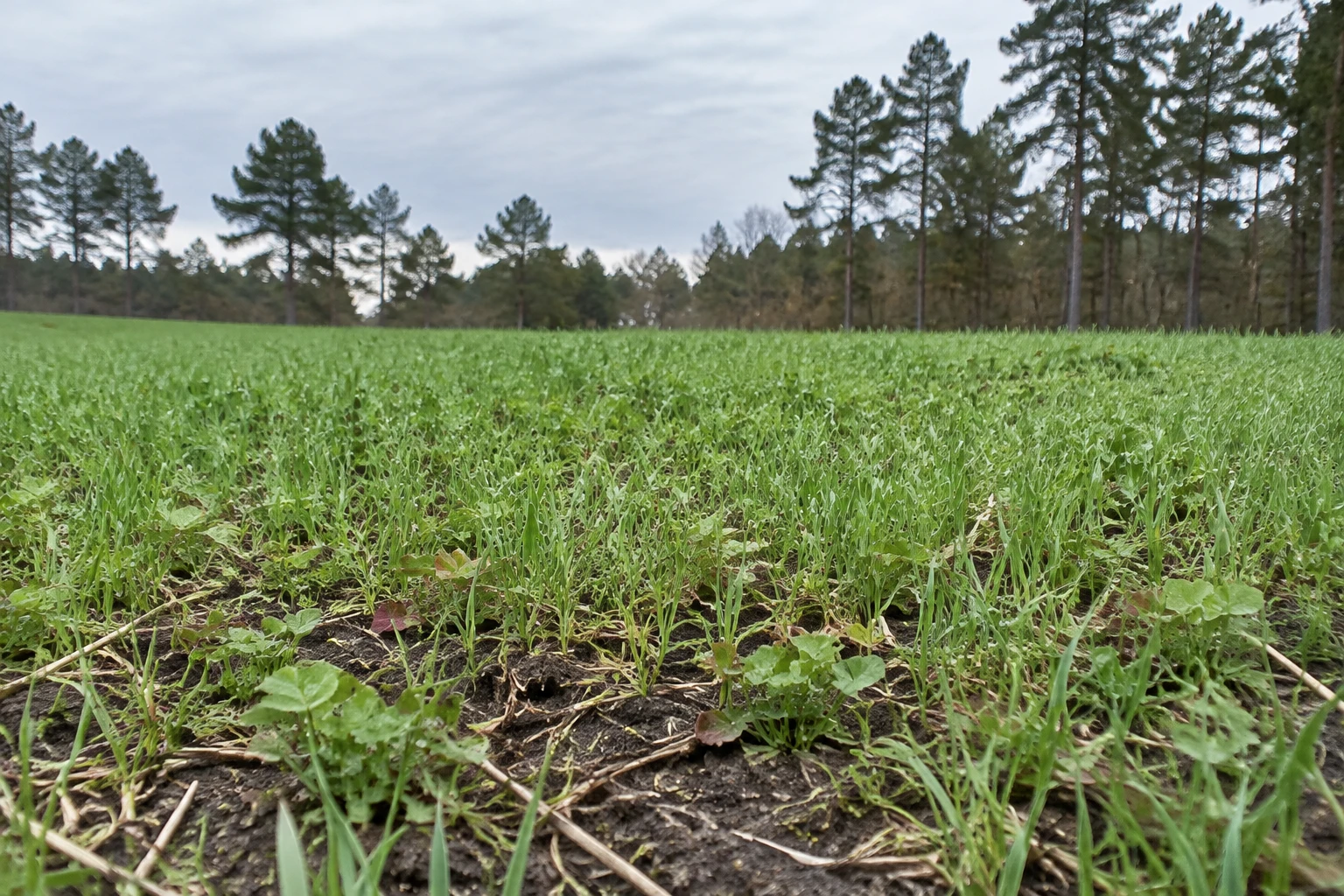
How to Calibrate a Seed Spreader for Food Plots
To calibrate a seed spreader for a food plot, weigh out the seed a known area should receive, spread that measured amount over a known strip at the speed you will actually drive or walk, and adjust the gate or speed until the catch matches the target. The target comes from the seeding rate in pounds per acre, the spreader's effective width and the length of your test pass. Every seed type flows differently, so run the test again each time you switch seed.
Why calibrate when the bag already has a setting
The setting on the bag or the spreader chart is a starting point. It was worked out for a certain seed size, a certain spreader and a certain speed. Walk faster and you put less seed on each acre. Switch from clover to oats and the same gate opening can throw a different weight. UF/IFAS publication AG158 groups calibration methods into counting seed per area and weighing seed per area, and it says broadcast spreaders scatter unevenly, with less seed falling farther from the center. A weighed test strip is the practical check.
What you need before you start
- The seeding rate for your mix in pounds per acre, from the seed tag and the current UF/IFAS table
- A tape measure and a stake or two to mark the test lane
- A tarp, 10 by 10 ft or larger
- A scale that reads in grams or ounces
- A stopwatch and a notebook
Step 1: Set your target rate
For North Florida, start with the cool-season forage recommendations in AA266 and the wildlife food plot guide in AG139. Both are revised from edition to edition, so use the newest one and do not rely on a rate you saw in an old table. UF/IFAS seeding rates are based on pure live seed and assume germination of 80% or higher. If your seed is coated or pre-inoculated, the coating adds weight, so the bulk rate on the bag must be raised to hit the pure live seed rate. The adjustment formula is in UF/IFAS publication AG493, so confirm the exact math there before you rely on it.
If you are planting a mix, divide each species' single-species rate by the number of species in the mix. Pearl millet at 25 lb per acre alone becomes about 5 lb per acre in a five-species mix. Calibrate to each species' share, not to the full rate of any one of them.
Step 2: Measure your effective swath width
Effective width is the strip the spreader covers evenly. It is not the width printed on the box. Lay a tarp across a measured run, spread at your setting, and look at where the seed lands. Mark the point where the seed thins out at each side. Penn State Extension notes that distribution can vary by more than a quarter across the width of a spreader. If one side is much heavier, check the vanes or the gate before you blame the speed.
Step 3: Work out the weight for your test strip
Pick a test length and a width. Then use this formula: weight of seed needed equals (rate divided by 43,560) times (width times length). The 43,560 is the number of square feet in an acre.
Here is a worked example from Perennia. A 6 lb per acre red clover rate on a 23 ft wide, 98 ft long test strip covers 2,254 square feet. Six divided by 43,560, times 2,254, comes to about 0.31 lb, or roughly 142 grams. Weigh out four to six portions of that amount so you can repeat the run without refilling the scale.
A small plot works the same way. A 10 by 10 ft tarp is 100 square feet, so at 6 lb per acre you would want about 0.014 lb, or about 6 grams. That is a light weight, so use a scale that reads in grams for small seed.
Step 4: Run the test at your field speed
Load the weighed seed, set the gate where you plan to start, and drive or walk the test length at the speed you will use in the field. Walking speed on a plot is not the same as ATV speed, so test at whichever one you will really spread at. Catch the seed on the tarp and weigh it. Mississippi State Extension describes this catch-and-weigh method. UF/IFAS also describes a timing method: load a known amount, run it through at a set speed and time how long it takes to empty. Either method works if you keep the speed steady.
To turn the catch into a rate, divide the seed you caught by the test area, then multiply by 43,560. If you caught the full target weight, the setting is right. If you caught more, the spreader is putting out too much. If you caught less, it is putting out too little.
Step 5: Adjust and repeat
- Too heavy: close the gate slightly or walk or drive a little faster.
- Too light: open the gate slightly or slow down.
- Run the test again after every change, and keep going until the catch is close to the target.
Write down the operator, date, spreader, ground speed, gate setting and the weight you caught. Penn State recommends recording these each time you calibrate. Next season, or the next time you switch seed, you will have a number to start from instead of guessing.
Calibrate for each seed, every time
Clover is small and dense. Grass seed is lighter and fluffier. Brassicas and cereal grains often need different gate openings. A setting you worked out for fertilizer does not carry over to seed, and a setting for oats does not carry over to clover. Calibrate again whenever the material changes.
If you mix large and small seed in one spreader, calibrate each seed size separately. Some guides suggest a carrier such as damp sawdust, kitty litter or sand for small seed, with filler to seed ratios from 1:1 up to 5:1. The carrier adds volume and changes the flow, so run your test with the carrier in the hopper.
Spreading pattern and overlap
Small seed like clover does not throw far, and the pattern is uneven. A single pass at full rate leaves light edges. Many food plot guides suggest cutting the rate in half and making two passes at right angles to each other. Do not make two full-rate passes, because that puts down twice the seed you planned.
Getting the seed into the soil
Florida's light, sandy soils and hot, dry spells make food plots hard to establish. UF/IFAS names the common causes of failure: low soil moisture at planting, low soil pH, poor seedbed preparation, no fertilizer, and wildlife grazing the plot while it is getting started. Soil test before you plant, and fertilize and lime by the results.
Depth matters. Clover does best at 0 to 1/2 inch, medic at 0 to 1/4 inch, and turnip at about 1/4 inch. For small seed, soil contact matters more than burial. A heavy rain on loose ground can bury seed too deep, so firm the seedbed before and after you broadcast. A cultipacker works well. Dragging a chain behind the ATV also improves contact without covering the seed too much. A disk buries small seed, so skip it after broadcasting.
When to plant in the Florida Panhandle
UF/IFAS gives fall cool-season plots in North Florida a window from early October through mid-November. October is often the best target if soil moisture allows, but planting into dry ground wastes seed no matter what the calendar says. Warm-season plots such as chufa are planted in spring and summer, roughly April through July. Check AG139 for the species you have in mind.
What you will need from the store
Our Farm Equipment and Sprayers and Sprayer Parts departments are where to look for spreader parts and accessories. Fertilizer and Soil has lime and fertilizer for plots that test low. Pasture, Forage and Grass Seed is the department for plot seed. Our current vegetable seed selection, including Charter Seed and Wild West Seed varieties, is for garden plots and is not a food plot blend, so ask at the counter what is on the shelf before you plan around it.
Call (850) 537-1000 or stop by at 5791 Hwy 4 in Baker. We are open Monday through Friday 8 am to 6 pm, Saturday 8 am to 2 pm, and closed Sunday. Hours are Central Time, so call ahead for holiday hours.
Frequently asked questions
How do I calibrate a broadcast spreader for clover?
Weigh out the seed a measured test strip should receive at your target rate, spread it at your field speed, and weigh what lands on a tarp. Adjust the gate or speed and repeat until the catch matches the target. Clover is small and dense, so expect the gate setting to differ from the one you use for grass seed.
Should I cut the rate in half and spread in two directions?
For small seed like clover, many food plot guides suggest half the rate in two passes at right angles. This evens out the pattern. Do not make two full-rate passes, because that doubles the seed on the ground.
Can I use a 10 by 10 foot tarp to check my spreader?
Yes. A 100 square foot tarp is a practical size for small plots. At 6 lb per acre it catches only about 6 grams, so use a scale that reads in grams. Make a pass at your normal walking speed, weigh the catch, and convert it to a per-acre rate.
Do I need to cover seed after broadcasting?
Small seed needs good soil contact more than burial. Firm the seedbed with a cultipacker or drag a chain behind the ATV. Avoid disking after broadcasting, since that can bury small seed too deep. Clover goes at 0 to 1/2 inch, medic at 0 to 1/4 inch, and turnip at about 1/4 inch.

 Ask Daisy